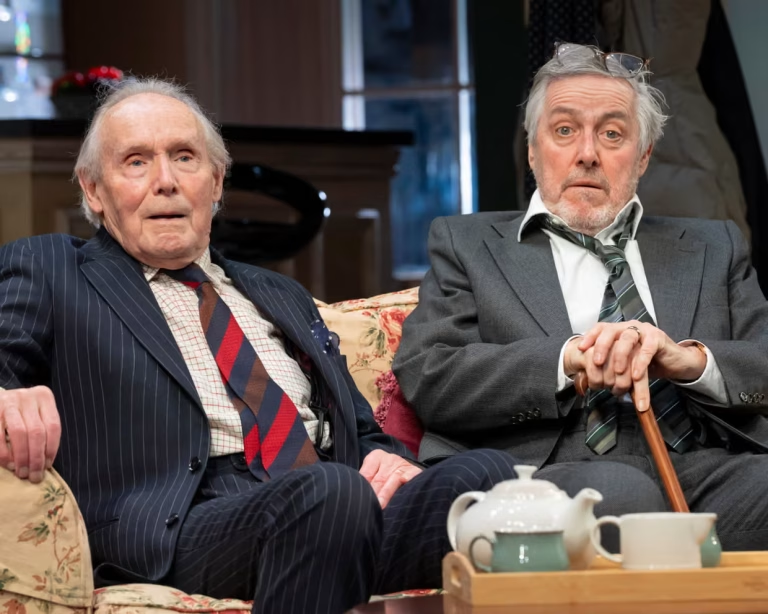
REVIEW: God, The Devil and Me


Rating: 3.5 out of 5.

This dark comedy about a psychotic break lacks polish, but delivers laughter and pathos


As the audience enter the Lio & Unicorn Theatre, they’re invited to “sit wherever you like” by The Devil (Campbell Maddox), who is seething at the absence of his co-star: God (Neo Jelfs). Audience members chit-chat with the literal embodiment of evil, who narrates his passion for controlled chaos, apologises for profanity in the show programme, and reminisces about performing at the Edinburgh Fringe. The show proper begins with a churlish God rocking up late, before teenager Gabe (Noah Edmondson), hallucinating both religious figures, enters his bedroom. Much of the comedy comes from God and The Devil bickering like an old married couple, juxtaposed against Gabe’s real-life teenage woes. But God, The Devil and Me also has a lot of heart, and a surprisingly sensitive and affecting portrayal of mental health in crisis.

As a theatrical route into discussing psychosis, it’s strikingly inventive. There are genuinely funny barbs thrown out by both hallucinations, with Maddox’s camp and needy Devil a highlight. But as the narrative progresses, and Gabe’s life becomes more stressful, the hallucinations take a darker turn. They erode Gabe’s trust in his family and friends, stoking paranoia and delusions of grandeur. Director and writer Fionnuala Donnelly’s real-life experience of a schizoaffective diagnosis adds a sharp edge to the events unfolding on stage.

The quality of the acting varies between cast members, and there’s a lack of polish in places: some jokes are overexplained, flattening what should be funny offhand remarks into repetitive slogs; a laugh track introduced halfway through never pays off. But God, The Devil and Me still lands with both laughs and pathos. Most resonant are moments where the audience sees Gabe’s breakdown through others’ eyes, stripping away the hallucinations entirely. A memorable argument with his mother (played by writer Fionnuala Donnelly) sees God and the Devil whistle to obscure attempts at bridge-building, become increasingly irate with one another, and physically prod Gabe into lashing out.

A second act psychotic break, leading to a stint in hospital, dials down the laughs and replaces them with the power of human connection. Gabe’s burgeoning friendship with fellow patient Hannah (Maisie Lee Mead), and words of kindness from a nurse on the ward (Neo Jelfs) are touching. But an emotional revelation during a family therapy session tips into cliché, feeling unearned (appropriately enough, this is the commentary God gives from inside Gabe’s head – but self-awareness doesn’t make it less true).

God, The Devil and Me is rough around the edges, but there’s a lot to admire. A strong epilogue – with God and The Devil riffing on organised religion and the Bible – sends the audience away happy, but it’s the nuanced, touching portrayal of psychosis that lingers once they’re out the door.

God, The Devil and Me plays at the Lion & Unicorn Theatre until 10th January, at 7:30 each evening. Tickets can be purchased here.

REVIEW: Anna Clyne – Performance of DANCE with Cellist Inbal Segev


Rating: 4 out of 5.

A fearless start to the year that proved The National Youth Orchestra already plays with grown up confidence.”


I couldn’t have asked for a better way to begin the year than with the National Youth Orchestra at the Barbican. This was my first concert of 2026, and from the opening minutes it felt like a clean reset: ambitious, unapologetically demanding, and in a way risky. And then there was the  thrill about knowing that what you are hearing is the result of barely a week’s work together. Most of us were still negotiating leftover chocolate and email inboxes at that point while those very talented musicians were building a full orchestral language from scratch and offering it up in public.

The programme, titled Shimmer, avoided any sense of post-holiday comfort listening. Instead, it leaned into heat, glare and movement, drawing heavily on imagined Spanish soundworlds filtered through French sensibilities. Debussy’s Ibéria opened the evening with fragmented rhythms, hazy colours, gestures that appear and dissolve before you can grasp them. Under Alexandre Bloch’s direction, the orchestra felt impressively contained for its size. There were moments where the texture thickened almost too much,  but even then the playing retained a sense of intent rather than excess.


Ravel’s Rapsodie espagnole followed, and here the orchestra seemed to relax into the music’s theatricality. The final movement, in particular, felt to me like it burst into life: brass was biting, woodwinds were flashing upwards, rhythms were into focus. 


But for me the concert truly caught fire in the contemporary works. Karim Al-Zand’s City Scenes delivered a kind of neon confidence,  jazzy,  together with streetwise gestures in the orchestra. The energy felt modern without trying too hard to prove it, playful but in the sane time constructed with sharpness.  The contrast with Anna Clyne’s DANCE brought balance. With cellist Inbal Segev at its centre, the piece pushed the audience through  a series of emotional transformations. One moment the orchestra offered an almost baroque sound, the next it slipped into something closer to jazz or klezmer. The dialogue between soloist and ensemble was alive and flexible, and Segev’s presence grounded the piece with warmth and authority.


There were lighter touches too like the Autumn Leaves that spotlighted bassoon and tuba in ways that felt both cheeky and affectionate, and a final encore that tipped fully into joy. By the end, what remaind was not just technical accomplishment but a sense of possibility. Hearing an orchestra at the very start of its journey, still forming its collective voice, is rare. Hearing it sound this confident so early on is rarer still.


If this was the National Youth Orchestra’s opening statement for the year, it was a bold one. I left the Barbican energised,  stunned, and very glad that this was how my musical calendar began.

REVIEW: The Legends of American Country


Rating: 4 out of 5.

Toe-tapping hits with a band that makes all the difference


The Legends of American Country, promoted by JMG Music Group, offers a lively and well-crafted celebration of American country music, providing an engaging opening to The Beacon’s 2026 programme. Touring across the UK and Ireland, the production presents itself as both accessible and enthusiastically executed.

The show delivers convincingly on its promise, paying tribute to some of the most influential figures in the genre, including Patsy Cline, Tammy Wynette, Kenny Rogers, Darius Rucker, Shania Twain and Dolly Parton. The setlist is carefully curated to balance iconic anthems with well-loved classics, ensuring broad appeal. Songs such as The GamblerCountry Roads and 9 to 5 are instantly recognisable, making the performance equally enjoyable for long-time country fans and those less familiar with the genre.

Among the highlights of the evening was Islands in the Stream, famously performed by Dolly Parton and Kenny Rogers. Delivered by Jim Devine and Tracey McAuley, this duet was particularly well received and stood out as one of the strongest moments of the performance, capturing both the warmth and familiarity associated with the song.

As the sole female performer within the trio, Tracey McAuley carried the responsibility of representing a wide range of female country icons. She rose to the challenge with confidence and versatility. While the Dolly Parton and Shania Twain numbers generated significant audience energy, her rendition of Crazy, written by Willie Nelson and popularised by Patsy Cline, was especially effective. Her vocal tone suited the song’s relaxed style, demonstrating that the quieter moments of the programme were among its most impactful.

Jim Devine brought a commanding stage presence and a clear enthusiasm for the material. His performance of Rhinestone Cowboy was a standout, marked by vocal strength and strong audience connection, contributing to one of the most enjoyable moments of the evening.

Despite noting health issues during the performance, Justin McGurk delivered a commendable contribution, with Tennessee Whiskey emerging as one of the highlights of the night. His professionalism and vocal consistency ensured the overall quality of the performance remained high.

The production was significantly enhanced by Keltic Storm, the accompanying live band, whose musicianship elevated the show from a tribute performance to a full concert experience. Their contribution added depth, energy and authenticity throughout. Particular praise is due to lead guitarist David Kee, whose performance was technically accomplished and visually engaging, complementing the show’s aesthetic with seamless transitions between electric and acoustic guitar.

While the production was highly entertaining, one minor observation concerns the stylistic expectations of the genre. Country music is often associated with a distinctive vocal “twang”, which appeared less prominently than anticipated. This, however, remains a minor personal critique within an otherwise strong and cohesive performance.

Overall, The Legends of American Country is an enjoyable and well-executed tribute that captures the spirit of the genre through a strong setlist, committed performers, and exceptional live musicianship. The trio successfully honour the legacy of country music’s most recognisable figures, while the band elevates the production to a higher level of theatrical concert performance.

For Tour listing, please visit here.

REVIEW:JACK the Musical at Courtyard Theatre


Rating: 3 out of 5.

A female-strong take on the classic murder mystery case that has haunted London for over a century. Powerful, enticing and mind-opening.


JACK The Musical, produced by Musketeer Productions, presents a fresh perspective on the unsolved murder case of Jack the Ripper. By incorporating elements of fiction, the production introduces an additional thematic undercurrent that foregrounds the desperation of women seeking recognition in a society that consistently failed to protect or value them. Rather than following the conventional structure of a historical musical that recounts events as presented in textbooks, this work highlights alternative perspectives that are often marginalised or omitted from mainstream historical narratives.

The production demonstrates a commitment to inclusivity from the outset. Trigger warnings displayed within the venue and the provision of a freely accessible online programme reflect a thoughtful approach to audience care and accessibility, addressing gaps that are frequently overlooked in theatre settings.

The stage design effectively supports the narrative. Newspaper imagery across the floor and a web of red string suspended from the lighting rig reference both the police investigation into the murders and the violence associated with the crimes. These visual elements clearly establish the investigative framework and thematic focus of the production.

Musically, the score draws inspiration from contemporary historical musicals, with stylistic similarities to Hamilton and SIX. The influence of SIX is particularly evident in its emphasis on women’s perspectives, while the rhythmic and narrative style recalls Hamilton. Several songs deliberately avoid a conclusive “button” note, reflecting the unresolved nature of the case and reinforcing the central mystery.

The cast delivers an energetic and committed ensemble performance. Performers work cohesively while also seizing opportunities for individual expression, reinforcing the production’s themes of visibility and voice. Further development of the characters—particularly through additional personal details about the women—could enhance emotional depth and foster greater audience empathy.

There is scope for expanded use of projection to strengthen storytelling and improve clarity in the timeline of events. Additional musical interludes between scenes could also assist in establishing tone and continuity. The use of Catherine’s bonnet as a symbolic personal item is effective; similar character-specific props or costume elements could further visualise the women’s experiences and the suffering they endured.

Overall, JACK The Musical is a compelling and thought-provoking production that demonstrates strong ensemble commitment and a clear thematic focus. Its approach to storytelling offers a reconsideration of a well-known historical narrative, and it shows clear potential for further development as the production continues to evolve.

Author: Sophie Morrison

REVIEW: Carols at the Royal Albert Hall


Rating: 5 out of 5.

The most magical and festive performance in London  


By now, Carols at the Royal Albert Hall has firmly established itself as a Christmas staple, with the tradition stretching back more than a century. The performance brought together an impressive lineup: the Royal Choral Society, the National Youth Choir, the British Imperial Military Band and the Royal Philharmonic Orchestra, whose combined sound filled the hall with warmth and joy. On the evening I attended, the concert was conducted by Richard Cooke, with Josie d’Arby acting as presenter, and a standout performance from the soloist Kyra.

Let’s begin by setting the scene. This was, without question, the most festive I’ve felt in London all winter. From the moment you step inside the Royal Albert Hall, you’re immersed in the Christmas spirit with children and adults alike dressed in their finest festive outfits. But the most spectacular sight is the stage itself. It’s difficult to do it justice in words. Framed by two enormous, beautifully decorated Christmas trees, and crowned with a glowing Christmas at the Royal Albert Hall sign at its centre, the whole scene feels truly magical. The festive atmosphere spills beyond the stage too, with shimmering tinsel draped along the front of the balcony seating, catching the light and wrapping the hall in warmth. If there was a standout moment, it came at the start of the second half, when the performers re-entered in an array of playful costumes. The audience particularly loved seeing the Christmas trees get up and dance during Kyra’s beautiful rendition of “Rockin’ Around the Christmas Tree.”

The choirs took turns leading the programme, which was interwoven with moments for the soloists to shine. Each ensemble performed beautifully, their harmonies rich and clear, while the orchestra provided a generous sound that underpinned the evening with warmth. Much-loved traditional carols featured prominently such as “O Come, All Ye Faithful” and “Away in a Manger” before the concert reached its conclusion with the all time favourite “Hark! The Herald Angels Sing”. Alongside these classics, the audience was also treated to a selection of modern favourites, delivered by Kyra. I thoroughly enjoyed Josie d’Arby as a presenter; she had a very welcoming presence and provided really interesting insights on each of the pieces while also encouraging the audience to partake in the singalongs. 

It is impossible not to feel the Christmas spirit at an event like this. Between the joyous sing-alongs, the festive decorations and the warm moments of audience interaction, you’re all but bound to leave the hall feeling uplifted, festive and with a big smile on your face!

IN CONVERSATION WITH: Camille O’Sullivan


We sat down for a quick chat with Camille about her show, Loveletter, and much more.


Camille, your performances have a beautiful vulnerability. Has that always come naturally, or did you grow into it over the years

    I think my singing has always been based  around those moments.. Revealing vulnerability , being free, true with your emotion, uninhibited like a chid but I was also embarrassed by it – but I’ve definitely leant into it more since growing older, embracing it.

    Sometimes your best singing is when the wheels are coming off and you’re working through your personal life on stage, bad relationships , growing older.


    I discovered these types of songs when I first started singing  Jacques Brel. They beckon you to have to reveal yourself , to be completely open, whether that’s vulnerable fierce or vulnerable sad or vulnerable happy.
    My parents used to be very worried about me following this career, they thought me too sensitive, but now they say, that’s possibly what makes me a good singer! Hopefully!There is often darkness, tenderness, and humour in your shows. How do you find the emotional arc for a night like “LoveLetter”?

      I love the madness of life in all its shades, so I try to create that in a chameleon kind of way- inhabiting a song to show sadness, joy, darkness, love and melancholy but also fun. You sing a sad song then banish it right away with a funny or uplifting song. Reared on an eclectic music and watching variety shows, I see the show as showing all the different aspects of yourself.  It allows you to go to a very dark place and then switch quickly to joy. The arc is very important as I have to stay authentic to an audience, to bring them on this journey . I always try to open enigmatically, to set the stall and then bring beauty or fun in quite soon.  I love the element of reveal and surprise.

      Your show honours your musical heroes. Is there a particular song in “LoveLetter” that feels like it changes you each time you perform it?

        I think Ship Song has changed through the years.  I think I sing that differently to any other song in the set. It has changed every time there has been loss in my life through the years, so I sing back to the person who has gone or who has suffered the loss and also to the audience, like when the author of the song Nick Cave had gone through terrible bereavement. Sometimes it can feel extremely joyful. So you let the song bring you there and it’s different each time. I usually sing it at the end of the show and I always feel I sing it differently to every other song.  It’s a final embrace wrapping arms around audience giving them a loving hug, so it’s alive and present as I look at all the lovely wee faces who came to the show. I’m grateful for that.

        You sang at Shane MacGowan’s funeral – an extraordinary honour. How did you prepare yourself emotionally for that moment?

          I was extremely nervous about it, fragile but very grateful to say thank you and goodbye, in song to a dear friend. It was such a beautiful joyful ceremony, staring out at local and visiting congregation imagining him as a little boy going there with his mother, Therese. Feargal helped “just sing goodbye to your friend”, Finbar Furey said “Sing from the heart Camille” just before I went to sing. I remember feeling wobbly when I started so held onto Mundy’s arm. I just looked at his sister, father and wife and sang love to them and him, then I looked at his coffin as the song built and thought, “what would Shane do?” So all of a sudden it became very defiant and passionate.  Songs are bigger than us. He painted beautiful vivid poetic descriptions so I let the song take over and bring you there.

          What do you hope people carry home with them after experiencing “LoveLetter”?

            I hope they feel moved and enjoy the madness, sadness, joy, light darkness, anarchy of live performance –  the spiritual hymnal quality  and the roller coaster journey of it all – the absolute love we feel for the music. I hope they enjoy my current bonkers unravelling on stage (I still wake with shame at 4am in the morn!! No joke!) They feel entertained, taken to another place, curious, childlike, surprised and go away feeling like dancing and singing down the street to enjoy a wee drink. We just want to give them a great evening and a big hug through music.  I love in Abba’s song Thank You For The Music.

            CAMILLE O’SULLIVAN WILL BE PERFORING LOVELETTER AT SOHO THEATRE WALTHAMSTOW ON 9 JANUARY.  FOR MORE DETAILS AND TO BOOK CLICK HERE

            REVIEW: The Sixteen: The Fair Maiden


            Rating: 5 out of 5.

            Voices kissed by angels

            Conducted by Harry Christophers, The Fair Maiden is The Sixteen’s Christmas Carol this year at Cadogan Hall and in Cambridge. For decades, The Sixteen have excelled not only as one of the world’s leading choirs, but also as a textbook example of programming. The Fair Maiden is a devotion to a myriad of composers across centuries, from late-Renaissance writer Rafaella Aleotti (c1570-c1646),  to contemporary composer Lucy Walker (c.1998) associated with St Martin’s Voices. Although these composers are much varied in times and styles, the programme is unified both through a chronological order and through The Sixteen’s magical voice.

            Consist of six sopranos (Julie Cooper, Katy Hill, Kirsty Hopkins, Alexandra Kidgell, Charlotte Mobbs and Ruth Provost), four altos (Daniel Collins, Edward McMullan, Elisabeth Paul and Kim Port), four tenors (Tom Castle, Mark Dobell, Steven Harrold and George Pooley) and four bass (Ben Davies, Tim Jones, Rob Macdonald and Stuart Young), the Sixteen’s sound is rich in its gentleness and restraint, so warmly blended and well controlled. Both the sopranos and tenors showcased beautiful, floating light mix while the basses maintain the low-pitch range in great precision, not in quantity but in quality.

            The four altos, though have lesser parts at the night, were no less integral than any other section of the choir. In The Shepherd’s Carol (Bob Chilcott), the alto line enters between verses of sopranos and basses, smoothing the passage in-between and maintaining a unified timbre across ranges. This might be technically demanding if it were a single voice, but here, it is achieved collectively as a seamless vocal continuum.

            While most of the songs are serene and holy, there were also exceptions. The Cherry Tree Carol is a traditional English carol that showcases a more humane side of both Joseph and Mary with a more gender-twisted relation. Joseph is suspicious at Mary’s loyalty, while Mary responds with dignity and rare resistance. However, instead of dealing its sophisticated gender dynamic, The Sixteen treated it with a touch of irony and gentle humour.

            It is also astonishing to see that while most songs are from the well-loved repertoire, the programme makes space for new voices in contemporary Christmas carol composition. There were two modern works by Lucy Walker, Ave virgo sanctissima and The Angel’s Song are performed. The Sixteen performs these songs with exceptional purity and clarity, carrying a fine choral resonance. Most of all, while they are not loud in volume, the chorus saturated the auditorium of Cadogan hall with unparalleled expressive power and quiet intensity.

            REVIEW: WiFi-Sexual 


            Rating: 3.5 out of 5.

            Bizarre, funny satire about the increasing levels of attachment between humans and AI 


            WiFi-Sexual is an outrageous story of love and friendship. We follow Paul (co-writer Tom Hodgson), a lonely man who has had no success with dating, as he bonds with his AI device Mandy (Kate Lindsey). Alongside this, we see the strange, fractured relationship between Zach (co-writer Harrison Trott) and Lisa (Lindsey). The contrast between Paul and Mandy’s fantastical relationship and Zach and Lisa’s very human relationship, as well as the similarities, is intriguing to watch unfold. 

            The play begins quite weakly – Hodgson’s bewildered, stuttery portrayal of Paul veers off into slightly off-putting rather than endearing, as if he has genuinely forgotten his lines and attempted to compensate by randomly throwing in swear words. Zach and Lisa seem like one of those annoying, arrogant couples we wish we did not have to live with (or listen to!). It is only when Mandy arrives that the three human characters become interesting, and the story as a whole becomes more exciting to watch. 

            WiFi-Sexual is a very relevant play in this era of pseudo-conversational AI tools such as Gemini and ChatGPT. Hodgson and Trott provide us with an insight into the circumstances that push a person to seek an AI relationship, allowing us to understand that AI is neither perfect nor wrong. Hodgson delivers a nuanced, well-thought-out portrayal of a man – lonely, both due to his lack of charisma and ever-present toxicity, overzealous, and silly. Zach’s character development (or devolvement?) is particularly noticeable; Trott brilliantly conveys his descent from a very sexually active cheater to a sweet, sad, lustful man. The performances of both actors complement each other well. 

            Lindsey proves herself to be a brilliant voice actor! She is good as Zach’s awkward, dissatisfied girlfriend Lisa, but she truly shines in the role of Mandy. Deftly switching between the stale AI assistant mode à la Alexa and the expressive “Mandy mode”, Lindsey’s performance brings to light how men view and interact with women. In a pivotal scene towards the end of the first act, we are forced to contend with our own misogynistic prejudices and behaviours. We allow ourselves to forget that even AI is shaped by a patriarchal mindset, but Hodgson and Trott push us to see the negative effects of misogyny on ‘female’ devices.  

            WiFi-Sexual is an important play, brought to life by three brilliant and passionate actors. Though the writing could use some improvements, it is still a watchable, funny story. 

            REVIEW: Anna Lapwood’s Christmas


            Rating: 4 out of 5.

            A festive dopamine hit to the eardrums, pulling out all the stops this Christmas


            Anna Lapwood has such golden retriever energy. As popular in the social media arena as she is in real life, she returns to her home venue, the majestic Royal Albert Hall, for a Christmas extravaganza with all its festive trappings.

            Accompanied by the Royal Philharmonic Concert Orchestra and conducted by Karen Ní Bhroin, proceedings were kicked off with a wonderful Christmas medley including Good King Wenceslas, Silent Night and Deck the Halls. The full house erupted into rapturous applause as Anna bounded out to her organ, fizzing with anticipation. It was clear nostalgia would feature heavily in the production, with the night dominated by film scores including Anna’s firm favourites from Interstellar, The Da Vinci Code and How to Train Your Dragon. Now and again, a tender piece would emerge, full of personality and novelty, including a sweet performance by solo violinist Esther Abrami performing We’re Walking In the Air from The Snowman and a piece titled Transmission in honour of her violinist grandmother.

            Anna’s skills as a performer are only eclipsed by her passion for engaging the audience. She constantly interacts throughout, through personal anecdotes, praising clothing choices, dedicating songs to people, arranging for a former student to get up and conduct a few pieces of music, and having the conductor both figuratively and literally pass the (purple) conductor’s baton to her. It’s all very heartwarming, and you cannot fail to smile at the genuine connections Anna can make with thousands of strangers sat a million miles away from her organ seat. Speaking of millions, during The Greatest Showman’s A Million Dreams, Anna had even sneakily set it up for a German girl to propose to her boyfriend at a pivotal moment when all the audience were waving their phone torches for maximum visual effect- it was legitimately romantic.

            However, herein lies my only complaint. I love film soundtracks as much as the next ner,d but I felt there were simply too many. There were too many similarly intense pieces, whose overpowering crescendos ironically seemed to be diluting the power of the instrument’s impact. Despite the lushness of the Royal Philharmonic filling the hall, the searing scores started to blend into one harmonious cacophony. It felt like a finale every five minutes and my brain started to switch off. The organ is, of course, always going to be grandiose and full of pomp, and Anna’s skills are second to none. Her ability to connect with her audiences of all ages, particularly young wome,n is refreshing and joyous to watch, but there just needed to be more festive pieces. I enjoyed John Williams’ E.T, Home Alone and of course the sensationally emotive Duel of the Fates from Star Wars. Anna is clearly trading on reminiscence and familiarity, but these are pieces that can be played any time of the year. They have such rousing climaxes it felt a missed opportunity to interweave more gentle pieces, making use of solo performers to truly accentuate Anna’s skills in the actual finale moment(s). I also thought it was a missed opportunity not to have the choir sing Carol of the Bells in its original Ukrainian (Shchedryk- meaning “Generous”).

            Overall, it is, of course, a stirring, heartwarming nostalgia bonanza in which Anna’s infectious personality and technical skills mesh into a rollicking crowd pleaser of a show. She is endlessly on tour, always gaining popularity wherever she goes. If you want a pure dopamine hit to your eardrums, do not miss her.

            REVIEW: The Highgate Vampire


            Rating: 4 out of 5.

            “An obscure chapter of London lore lovingly resurrected in an inventive two-hander.”


            In the early 1970s, a letter published in the Hampstead and Highgate Express reported a ghostly presence lingering among the tombs of Highgate Cemetery at night. In the years that followed, the media became awash with stories of paranormal phenomena: devil worship, animal sacrifice and an ominous black figure with blazing red eyes. Whether this was an elaborate hoax or a curious outbreak of mass hysteria remains unclear, but the Highgate Vampire endures as a peculiar corner of London folklore, raising questions about how urban legends are formed and fuelled by the press.

            Such strange events are ripe for theatrical treatment, and The Highgate Vampire, a joyously silly new show at Omnibus Theatre, more than rises to the challenge. Blending surreal humour with flashes of gothic horror, the piece never loses sight of a universal fear: the terror of the unknown arriving on our doorstep. The story centres on two rival demon hunters, Bishop Patrick Sheffield and Daniel Farringdon, played by writer-performers Alexander Knott and James Demaine. Despite their differing beliefs, the pair claim they reluctantly joined forces to vanquish the vampire – though whether this is true, or whether the vampire ever existed, is left for the audience to decide.

            The show is framed as a lecture, with the bickering duo presenting competing versions of events directly to the audience. The smugly pedantic Sheffield,views the vampire through a strict Christian lens, favouring exorcisms and vigorous wafting of crucifixes. Farringdon, is more flamboyant: a tobacconist and part-time shaman whose new-age beliefs reflect the 1970s’ fascination with the occult. His jazzy wardrobe and love of live performance suggest he may be as motivated by self-promotion as by public safety.

            While the lecture format remains constant, the show unfolds through increasingly madcap storytelling. Witness testimonies are brought to life with rapid costume changes and ludicrous accents; a surprisingly instructive ukulele ditty explains how to stake a vampire; and a live demon-summoning sequence demands audience participation. Even the most seasoned demonologist may occasionally struggle to keep up, but Ryan Hutton’s slick direction and well-workshopped script sustain the momentum.

            Some of the production’s most powerful moments emerge when the frenetic comedy gives way to stillness. Early sections lean into horror, particularly in the chilling witness accounts, which evoke Highgate Cemetery’s gothic character, supported by Samuel Heron’s atmospheric sound design. There are echoes of Shearsmith and Pemberton’s uncanny blend of the macabre and the banal. By the climax, the show veers decisively into surreal, zany territory – a tonal shift that won’t please everyone, but arguably suits the anarchic spirit of the piece.

            Technically simple, the production is supported by Audrey, played by producer Zöe Grain, who provides all sound and technical effects. Above all, the chemistry between Knott and Demaine carries the evening: the jokes come thick and fast, their physical comedy shines, and the humour never undercuts the story. Fans of both horror and alternative comedy will find much to enjoy here.If you’re seeking an offbeat alternative to traditional Christmas fare, The Highgate Vampire is an absolute treat: daft, dark and thoroughly entertaining, leaving you laughing in the theatre and, just possibly, scanning the shadows on your cold walk home. The Highgate Vampire shows until 30th December, tickets are available here.