

An arresting piece on body and control that could leave a little more space to breathe
Killjoy Theatre’s Russian Roulette is an often unsettling one-hour work-in-progress that leans heavily into abstraction to explore eating disorders and systemic misogyny. It’s a piece rich in imagery and intention, even if not all of its ideas land with equal clarity.
The play opens with a visually arresting image: two women, dressed almost identically, lie on the floor in a yin-yang formation. What follows is a mirrored movement sequence that unfolds slowly from the ground up, immediately establishing a sense of duality. It soon becomes clear that the central figure, played by Venice Billia, is reflected by Christina Leitner, not as a separate character, but as her body. It’s a compelling conceptual choice, this physical externalisation of the self, and one of the production’s strongest ideas.
In contrast stands the “Friend,” played by Erica Gouveia who portrays a vivid figure in a sharp red dress, slicked-back short hair and sharp-winged makeup. She embodies a kind of twisted fairy-tale guide, reminiscent of a stepmother-like presence who oscillates between nurturing and patronising control. Her tone often carries that familiar saccharine condescension delivered with an edge of irritation, also masked by forced warmth. Gouveia handles this balancing act slipping between affection, exasperation and something more sinister. Her performance is one of the most assured in the piece.
Christina Leitner’s role as the Body is largely physical as for much of the play, she remains silent, communicating through movement shaped by Kristin Papathomidou’s choreography. When she finally breaks that silence in a solo moment combining dance with spoken text, it lands as one of the production’s most affecting sequences, giving voice to what has been suppressed throughout.
Venice Billia’s central performance captures the vulnerability and impressionability of a young woman shaped by external forces. She convincingly embodies innocence and a kind of learned submission, particularly in her interactions with the motherly figure. At times, however, the performance could push further as there are moments where a deeper emotional intensity or sharper shifts in resistance might elevate the stakes and make her internal conflict more palpable.
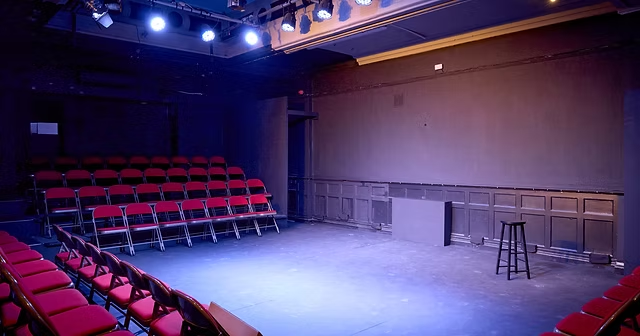
The staging is minimal and keeps the focus on bodies and symbolism. Along the front edges of the stage sit three hooded guards with their cagoules obscuring identity. They emerge towards the end of the play, alongside a figure representing a higher power, reinforcing the idea of unseen systems of control. Positioned near them are plates of fruit including pomegranates split open, limes squeezed and handled, which serve as visceral, recurring evocative imagery tied to the Body, consumption and destruction.
Conceptually, Russian Roulette is ambitious. The separation of the Body as its own entity and the game of Russian roulette is particularly effective, offering a clear lens through which to examine dissociation and control. However, the piece sometimes leans too heavily on this metaphor in a way that feels a little on the nose. There’s a strong foundation here, but it would benefit from pushing further so the themes can resonate with a more global nuance, which is something the play clearly aspires to. At present, many of its ideas feel rooted in a specific, individual experience and while that lends intimacy, it occasionally limits the broader reach of its commentary on systemic misogyny. By complicating its symbols and allowing for more ambiguity, the piece could open itself up to wider cultural and societal interpretations, making its exploration of control, beauty and the Body feel less prescribed and more universally affecting.
Still, as a work-in-progress, it shows clear promise. There is a boldness in its physical language and a willingness to confront difficult subject matter head-on. While it may benefit from further refinement, it’s a production that lingers, asking its audience to sit with discomfort rather than resolve it.
Russian Roulette’s run is now concluded and ran at the Golden Goose Theatre, London.