

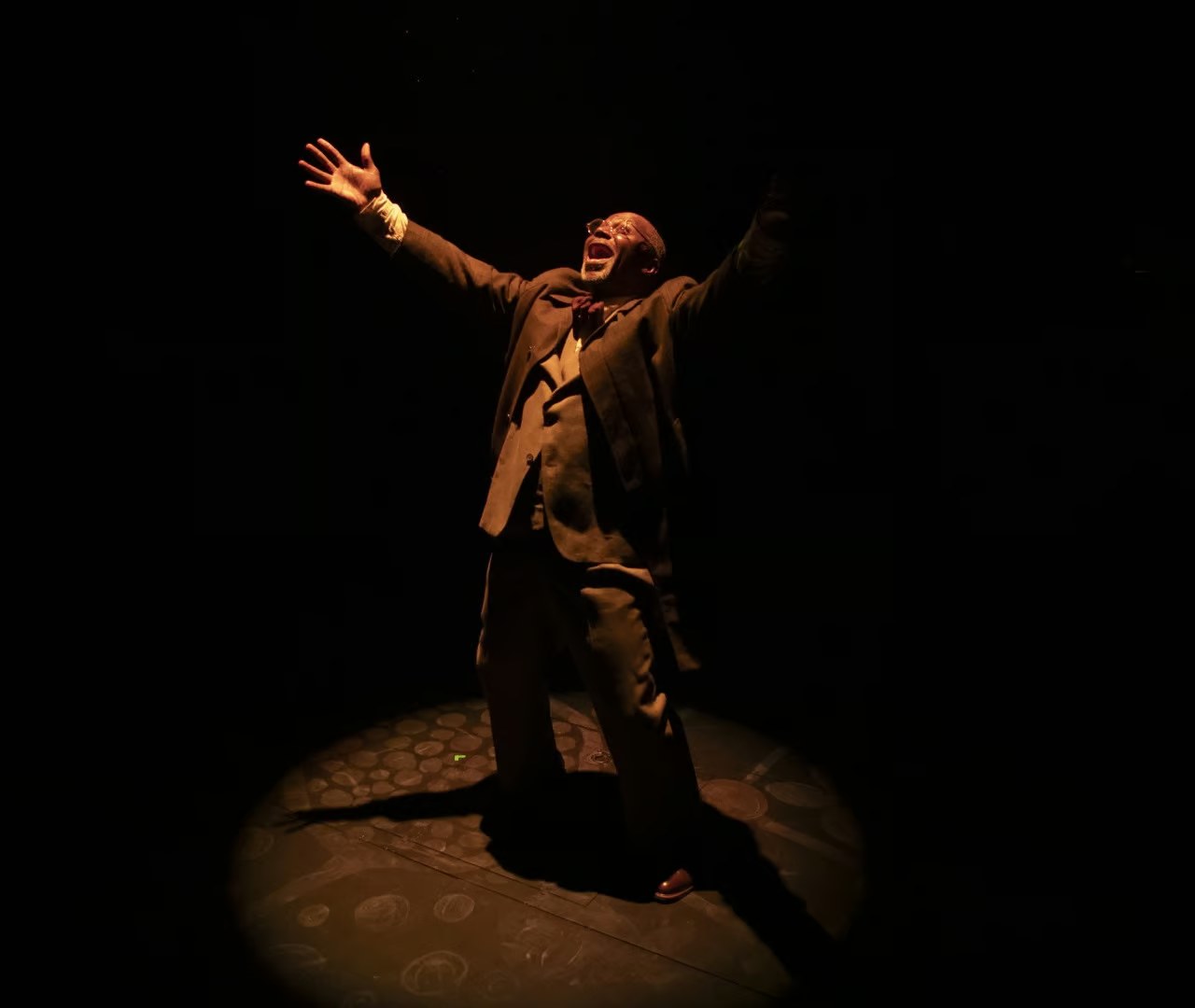
‘An afro-centric Scouse retelling of a timeless classic, Death of a Salesman has arrived to Liverpool Everyman with a strong sense of place, identity and family.’
An Afro-centric Scouse retelling of a timeless classic, Death of a Salesman has arrived to Liverpool Everyman with a strong sense of place, identity and family. Directed by Tristan Fynn-Aiduenu, Arthur Miller’s 1949 play is given a contemporary perspective, while still holding on to the key question at the heart of the story: what happens when the dreams we have built our lives around begin to fall apart?
On arrival there was a buzz around the building, and even before entering the theatre you were drawn into the world of the play. The comforting smell of stew drifted through the foyer from Mama Put & Chop, who are there serving food from 6pm every Thursday to Saturday night before the show. Those home comforting aromas brought the audience into the sense of how it would feel to be Willy returning home from a long stint out on the road. Even the lighting in the foyer, as if a spotlight had been cast on a disco ball, reflected the lighting within the play giving the audience a sample of the powerful lighting design by Stella Okafor-Ross that is demonstrated throughout the show.
It is the lighting and set design that often help to immerse an audience into a play before an actor even sets foot on stage, and Georgia Wilmot’s set design is perfectly married with Okafor-Ross’s lighting. The set design paints a picture of a kitchen in 1940s United States, while further modern touches throughout the set help to update it even further to the 21st century, demonstrating the agelessness of this play.
Death of a Salesman tells the tale of Willy Loman, a travelling salesman who returns home after a failed business trip. It is a story which highlights the death of the American Dream, the stories we tell ourselves about who we are, how dreams can pass you by and how easy it is to be left behind as you age.
The text explores ageing, work, family, and generational changes in a way that still feels poignant today. It examines the struggle between the young and the old and the tensions that can develop in the family dynamic between an adult child trying to find their own way and an ageing parent who thinks they know best and can only view success through their very specific point of view.
This feels particularly relevant when we consider the pressures facing younger generations today. Many young people struggle with high rates of unemployment and an increasingly difficult housing market, with some finding themselves needing to move back in with their parents. The idea of falling behind, or not achieving what you thought you would by a certain age, feels familiar to a modern audience.
With the International Day of Older Persons falling on 1 October this year, the timing of this production also feels especially fitting. Watching Willy grapple with getting older, his changing place within his family and his fear of no longer being the person he once thought he was adds another layer to a play that asks what happens when the world you know starts to change.
Although still set in Brooklyn, this production updates Willy and his wife Linda to be of Nigerian and Irish heritage, reflecting Liverpool’s own migrant and heritage background. It gives the production a distinctly different identity and makes this Death of a Salesman feel rooted in the city where it is being performed. During the performance, moments of dialogue are performed in Igbo, a West African language spoken primarily in the southeastern region of Nigeria. This connects the play to Willy’s sense of identity and heritage and adds another layer to a character who is already struggling with questions around their place in the world.
Cyril Nri’s excitement and emotion as Willy Loman is infectious. The audience can’t help but be drawn into his stories, his belief and his hurt as he suffers the turmoil of a dream that comes crashing down. There is a real feeling of a man trying desperately to hold onto the version of himself that he believes he should be.
There is an undeniable connection between Nri’s Willy and Laurence Ubong Williams’ Biff, particularly in the moments where the love and frustration between father and son clash. Their performances capture the hurt beneath their arguments and the complicated relationship between a father who has built so much of his identity around his expectations for his son, and a son trying to find his own way. Kiren Kebaili-Dwyer’s Happy brings a contrasting energy to this dynamic, with a sense of bravado that demonstrates his vulnerability underneath.
Linda, played by Emma Cater, brings another element to the production through her Irish heritage. Cater’s accent settled naturally as the performance progressed, alongside a performance that brings out Linda’s emotional depth as the woman at the heart of this family who has always tried her best to keep the peace and support their dreams.
The strength of the movement and mask work throughout the production adds another layer to the storytelling. Adelaide Banks, as The Woman, has a particular strong stage presence, using her physicality to command attention whenever she enters the space. The movement supports the production to shift between memories and the present, and allows the play a physical energy that keeps the stage feeling alive.
Joe Speare is strong in the multi-roling of Charley and Stanley. It actually took a while to realise that both characters were being played by the same actor, with Speare changing his posture and physicality so noticeably between the two that they felt like completely separate characters.
The production also includes strong performances from Tayo Aluko as Uncle Ben and Noah Olaoye as Bernard / Howard. At a run time of approximately 3 hours and 15 minutes, including the interval, this is an entire evening to delve into a timeless classic looked at through a reimagined cultural lens. Death of a Salesman is a night not to be missed with a whole host of accompanying events to immerse you into this Afro-centric retelling.
Death of a Salesman runs at Liverpool Everyman until October 10th.