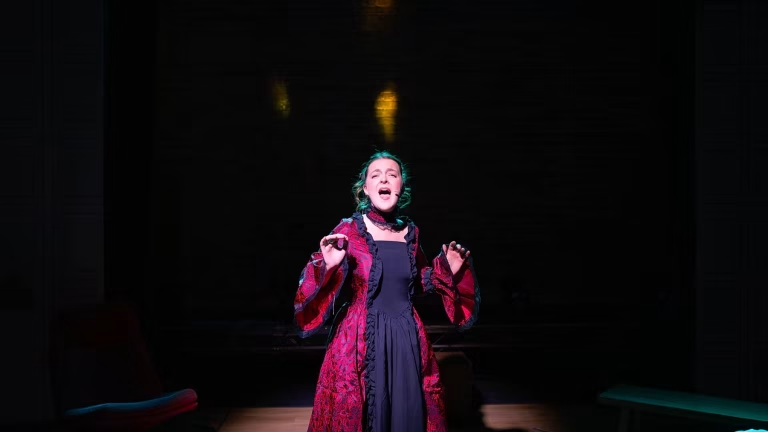
REVIEW: An Evening With Gregor Fisher


Rating: 5 out of 5.

Fisher’s flair for storytelling and absurd humour had the audience in fits of hysteria


Fans filled out the theatre as legend of stage and screen Gregor Fisher sat with Nigel West to discuss his life, career and everything in-between. Having always been known for his sly wit and particular brand of Scottish humour, Fisher hasn’t missed a beat and is just as funny as ever.

Before discussing his famous roles or really anything about his career, he reminisced over his childhood growing up in Scotland. From tales of almost drowning in sewage after taking unnecessary shortcuts to his multiple attempts to skive school, Fisher painted a vivid picture of his early days of mischievousness. However, he also delved into conversation regarding his relationship with his mother and recanted the interesting tale of asking where he was baptised. A conversation about family baptisms, young Fisher did not expect to be met with silence when posing the question, especially after asking as second time. Choosing to “give it up as a bad habit”, Fisher left the topic alone until his Mum knocked on his door one day (a very uncharacteristic action in a house where people came and went as they pleased without much concern). Fisher re-enacts the bashful way in which his Mum sat down with him and told him that the reason they didn’t know where or if he was baptised was that he was adopted. This came as quite the shock to the 14-year-old and it was never spoken of again. When West asked him how he took the news and if it caused him to act out in any way, Fisher admitted that there were times after where it could have caused him to be less than kind to his Mum which he states, “I’ll bitterly regret till the day I die”. It is clear though how much love and affection he had for, stating as the evening went on how she would always come to see him in any stage work he did. He also gave the audience an anecdote about what was said the first time she met his wife, Vicki Burton. Ever the impressionist, Fisher did his best version of her voice as he quoted, “Aren’t you aiming a bit high?” 

It all worked out though as the two were eventually married, even if West did playfully hint that “she gave him the runaround” for a while beforehand. The two met on a production of A Midsommer’s Night Dream, with Fisher going on to do various other stage roles in productions such as The Importance of Being Earnest, Chitty Chitty Bang Bang and The Wizard of Oz, the show that led to Fisher and West’s first encounter as the director hired him to play The Cowardly Lion. We were even treated to renditions of songs from both these musicals, showing that despite his claims he took these jobs as “tax breaks”, he still remembers the work fondly. That was not the only rogue joke made about his past work as Fisher candidly referred to the popular rom-com Love Actually as a “skidmark”. Despite not believing much in the script, he seemed to at least enjoy his time spent with his fellow actors on the project.

Fisher’s most famous role, of course, is playing the titular character in iconic Scottish sitcom Rab C. Nesbitt. When asked why he thought the show worked, he mentioned he’d never quite understood the how or why. He spoke about how if people could work that out, “they’d have the Holy Grail for good television”. This prompted and audience member to loudly exclaim, “YOU ARE THE HOLY GRAIL!” This was a sentimental moment in the evening and while Fisher seemed to slightly play up his emotion for laughs, it was clear to see he was genuinely touched by this comment. That character absolutely still lives in people’s hearts as when West turned to the audience for questions, many revolved around the hit show. When asked if he would ever return and if the character would still work in this day and age, his response was “Never say never”. A more specific question revolved around whether there were plans for a skit involving Rab following the Tartan Army to this year’s World Cup. Though he hadn’t thought of it, Fisher was quick to mention that this was a very good idea, even stating he may pitch this. Another idea he appreciated, in which the entire audience were in sound agreement, came from one of the final audience questions in which a woman asked if he “could save us and finally give us a good Hogmanay this year”. Having only recently returned to living in Scotland after living in France for several years, Fisher was unaware of the dire state of Hogmanay television, a sentiment held by all. Hearing this plea, he simply said,” I’ll write to them”. Perhaps Hogmanay celebrations may be saved after all.

Overall, Fisher’s roguish charm and at times self-deprecating humour made for a night of laughs and stimulating conversation. The way he did small character bits here and there as well as impressions of friends and family really added to the night. It was truly delightful to hear about the life of a true Scottish legend, not only as a reminder of how much he has contributed to the craft over the years but to see how much he still has to offer. 

It’s arguable that even for those who aren’t longtime fans, they could have sat in that room and been turned into one just listening to Gregor Fisher talk. For those who are, this tour won’t disappoint.

REVIEW: Sea Shanties


Rating: 3.5 out of 5.

A surprisingly restrained journey through the history of the sea shanty


Sea shanties erupted into the public consciousness with Nathan Evans’ TikTok rendition of Wellerman deep in the COVID-19 pandemic. It’s not hard to see how a genre focused on bringing people together felt particularly resonant at a time of such separation. But long before TikTok, the sea shanty was a musical mechanism for co-ordinating the manual labour of sailors; ensuring everyone was pulling in the same direction (literally).

Fans drawn in by the compulsive percussion of Wellerman and propulsive vocals in Assassin’s Creed: Black Flag will be surprised by The Manchester Collective and Sean Shibe’s interpretation. Here, the sea shanty becomes a more melancholy, restrained beast. Charting a course across 500 years – from Dowland and Purcell to the contemporary – much of the repertoire is instrumental, with restrained percussion. It’s a beautiful sound, but an unexpectedly reserved one. Interleaving a few more crowd-pleasing numbers would make for a more engaging experience.

The first half of the show evokes the soundtrack played as you enter the tavern in a pirate video game, for both good and bad. It’s a pleasant, often beautiful sound that periodically erupts into something more evocative. But it also feels like accompaniment rather than the centrepiece. The musicians’ performances are accomplished and adept, but it feels like something else should be happening alongside them.

In its second half, the show becomes more playful and takes more risks. Its earlier stuffiness evaporates. Beibei Wang’s percussion is transformative, and Jonathan Morton pulls out wonderfully haunting sounds with every bow stroke. The audience contribute their own chant (“Ho, Row”) to Donald Grant’s arrangement of the traditional Scots Gaelic Ailein Duinn, a nì ’s a nàire (Brown-haired Allan, alas and alack) – this desperately sad piece about a whole family lost at sea is irresistibly rhythmic, and a clear highlight. It echoes around the room and into the very soul.

The performance culminates in the world premiere of Ben Nobuto’s Arksong. It was said that, with the rise of steam-powered ships drowning out the singing, “steam and music are irreconcilable”. Nobuto captures this as a tug-of-war between dissonant (yet strangely compelling) sound and his musician’s skillful fluidity. Wang’s voice beats out a series of orders, jerking the musicians into mechanical motion; later, humanity wrestles back agency and control. This is music as performance art, contrasting with the reserved performances of the show’s first half and ensuring the audience leaves energised and happy.

Shibe and Grant provide background on the upcoming songs between sections, including discussion of original lyrics – a piece based on a Kipling poem about supply ships, written just before the outbreak of the First World War, stands out. Grant acknowledges the unexpectedly dreary tone of the first half. But recognising this dissonance isn’t enough – interleaving some more popular shanties would have elevated the whole performance through its contrast. As it is, the audience would be forgiven for feeling a little tricked by the show – it’s a strong and interesting set of performances, but not what was expected going in. The show never quite reconciles this expectation and reality. It isn’t toe-tapping, but it is undeniably beautiful.

This was a one-off performance at The Southbank Centre. More shows from The Manchester Collective, who perform around the world, can be found on their website.

REVIEW: Chaos


Rating: 3 out of 5.

A slick, frenetic scratch night blending a bizarre array of stories


Chaos at the Pleasance Theatre is an innovative and slick version of a scratch night. From Long Nights Productions (Jack Medlin, Theo Collins, and Sarah Chamberlain), Chaos consists of nine performances, blended together, in a cabaret-esque setting. It’s certainly ambitious, and it’s unusual, even for a scratch night.

Naturally, given its context as a scratch night, the pieces themselves vary drastically in quality. It’s a little challenging to comment on the overall theatrical experience because each piece is so disparate from the others; the challenge is to shield yourself from the tonal whiplash. And there’s no unifying theme – despite chaos, I suppose – but chaos is not a conceit in and of itself.

The show opens with one woman pouring vodka into a carton of orange juice, before she is harassed by the door, and watches as two women drag in a body bag. Quickly, the stage setup is pushed about, and so begins a piece about a child and an obsessive neighbour (also a child). At some point, a monologue was delivered from the perspective of a vengeful Scottish toilet. Then we were whisked to the peak of a mountain where a bunch of queer youths stood in line for a Berghain-esque club, just with the added peril of being atop a mountain. There was also some attempt at Clown concerning a series of backpacks.

Some of the writing was accomplished: I enjoyed Barney Doran and Anna Fenton-Garvey’s performance and writing as the ruthless non-binary clubbers. And the four women sharing pastries in their hostage situation was a highlight. However, as an overall theatrical event, it struggles to captivate. Without any perceptible binding conceit, it’s a struggle to invest yourself in any of the pieces or gain any sense of pattern recognition. And in the absence of thematic unity, the context of ‘chaos’ loses any architectural meaning.

I would probably argue that not everything is a theatrical opportunity (see: the Scottish toilet – he kills his male philandering owner in a self-righteous fury). There was also an ethically dubious piece about an Italian restaurateur’s Japanese wife who turned out to be a lifeless doll.

The set design (Geneve Chu) is commendable; the transitions are smooth, and the space is imaginatively understood. For a scratch night, it is extremely organised; it’s reassuringly structured. The band (LA Family Trio) is a fun accompaniment, and the lighting (Aaron Molloy) is well deployed. But the pieces themselves – and the organising concept – fail to engage and lack the satisfaction of a more conventional piece of theatre. As a scratch night, of course, the intention is not to create one unified story, but it is a struggle to care about any of the stories or characters within this setup.

REVIEW: Jaja’s African Hair Braiding


Rating: 5 out of 5.

a lesson in excellence and a phenomenal story rooted in culture and relationships


Jaja’s African Hair Braiding is an incredibly powerful production that exemplifies excellence in every way. From stagecraft to design to music, the show is a masterclass in production quality, a direct example of how passion and storytelling can be seamlessly integrated.

At its heart, the play offers audiences an intimate glimpse into the lives and relationships of women working in a Harlem hair salon. What playwright Jocelyn Bioh does so beautifully is craft small, vivid moments that allow the audience to fall in love with each character. These aren’t huge moments more than it’s in the banter, the humor, the tension, and the honest confessions. Each woman is navigating her own sense of self, her exhaustion, her dreams, yet need and crave another through shared womanhood and connection. As many of the characters are African immigrants, the play also highlights the deep longing for familiarity and sense of home, something they find in each other despite different cultures and opinions. 

The world of the play is brought to life with striking authenticity. Set designer Paul Willis creates a Harlem salon that feels lived-in and culturally rich. Adorned with vibrant African flags, posters of intricate hairstyles, and bursts of color, the set pulses with identity and pride.

Director Monique Touko stunningly weaves together every performance element. The movement direction by Kloé Dean and sound by Tony Gale keeps transitions fluid and engaging, drawing the audience in without distraction. Even the act of hair braiding, a pivotal aspect of  the story, is executed with such precision that changes happen almost invisibly. Every element of Bioh’s script is handled with such care and detail.

What makes culturally rooted plays so interesting is how differently audiences may connect to them especially those who are unfamiliar with the culture. As the play is grounded in the experiences of African women in America, it still holds a familiarity with the global Black female experience, touching on identity, survival, ambition in ways that feel universal. On press night, the audience was surging with laughter, comedy, joy and excitement despite their personal connections. That’s the beauty of Bioh’s work, it’s just human.  

As an ensemble-driven piece, the performances are exceptionally strong. Every actor serves the story with intention and excellence. Jadesola Odunjo brings depth and nuance to Miriam, balancing fear, motherhood, sacrifice, and resilience with remarkable ease. Her arc is handled with sensitivity and strength. Bola Akeju is a commanding presence as Ndidi, embodying both authority and care with a grounded confidence that fills the stage. Renée Bailey delivers sharp comedic timing, bringing levity and energy at just the right moments.

One of the most dynamic relationships in the play is between Bea (Dolapo Oni) and Aminata (Babirye Bukilwa). Their connection feels deeply authentic, two women bound by dependence, and love, yet unafraid to clash. Their exchanges are honest, messy, and refreshingly real, capturing the complexity of true relationships. Across the board, the ensemble operates in harmony, fully inhabiting the same world.

Though the show is relatively short, it leaves a lasting impact. The ending is bittersweet, echoing the realities of immigrant life and the sacrifices that often go unseen. More than anything, this production stands as a testament to womanhood, to African and African American culture, and to the resilience it takes to keep pushing.

If you’re looking for a production that not only tells a story that’s enriched with culture and history but teaches you something about storytelling itself, this is not one to miss.

REVIEW: Flora


Rating: 5 out of 5.

A powerful, ceilidh-charged celebration of Scottish history


There’s something really special about a show that feels completely rooted in where it comes from, and Flora absolutely does. Performing at the Pavilion Theatre in Glasgow, this new musical doesn’t just tell a story, it celebrates Scottish heritage in a way that feels fresh, alive, and genuinely exciting. From the moment it  begins, there’s a real sense of energy and purpose that carries right through to the final moments. 

Written by Belle Jones and directed by Stasi Schaeffer, the production feels clear in its vision and confident in its  storytelling. Most people know Flora MacDonald for helping Bonnie Prince Charlie escape, but this show goes  much further than that. The first act gives us the story we recognise, while the second act digs deeper into what  came next, showing the reality of her life beyond the legend. It adds real depth and makes the story feel far more complete. 

The decision to split Flora into two (Junior and Senior) is such a strong creative choice. Karen Fishwick brings  energy and determination to Flora Junior, while Annie Grace gives a more grounded, reflective performance as  Flora Senior. There’s a real sense of contrast between them, but it works beautifully and helps show the full  journey of the character. 

The wider cast are just as impressive, particularly in how they move between acting and playing instruments  throughout the show. It’s a demanding setup, which adds to the energy and creates a strong ensemble feel. A  special mention has to go to Lana Pheutan as Annabelle/Lady Sleat, who brings a real presence to the stage and  stands out in every scene she’s in. 

Musically, the show is a real highlight. With music by AJ Robertson and John Kielty, the score blends traditional  Scottish influences with a modern edge, creating something that feels both authentic and accessible. The live music element adds so much, especially with the cast being so involved in creating the sound on stage. There are also moments of rhythmic, almost spoken storytelling that give it a contemporary feel without losing its identity. The use of Gaelic alongside English adds another layer and strengthens that connection to Scottish culture. 

Visually, the production is simple but very effective. The costumes, overseen by Head of Wardrobe Jenny Lööf, feel authentic to the period while still allowing the performers to move freely between scenes and musical  numbers. Everything has been curated to serves the story. 

Benny Goodman’s lighting design also plays an important role in shaping the atmosphere. It shifts smoothly  between the more intimate moments and the larger ensemble scenes, helping guide the audience through the story. At times it creates a real warmth, especially during the more communal, ceilidh-style sequences, and at others it sharpens the focus for the more serious moments. 

What really stands out is how well everything comes together. The performances, music, and staging all feel  connected, creating a show that’s easy to get lost in. There are moments where it genuinely feels like you’re part of the experience rather than just watching it. 

The tone is well balanced throughout. There’s humour and lighter moments, but they sit comfortably alongside  the more serious themes of war, survival, and identity. It never feels too heavy, but it also doesn’t shy away from the reality of Flora’s story. 

By the end, it’s hard not to feel completely swept up in it. Flora manages to be both entertaining and meaningful,  which isn’t always easy to get right. It feels like a show that knows exactly what it wants to say and delivers it with confidence. 

This is more than just a musical, it’s a celebration of culture, storytelling, and identity. If you get the chance to see it, don’t hesitate. It really is something really special.

REVIEW: Mysteries: Beethoven and Mozart


Rating: 5 out of 5.

Sinfonia Smith Square discovered unity in mystery


Performed by the talented fellows of Sinfonia Smith Square, ‘Mysteries: Beethoven and Mozart’ was a dazzling contribution to the London Festival of Chamber Music. The programme opened with Beethoven’s Cello Sonata No.5 in D major, Op. 102 No. 2, an introspective and experimental work typical of his late style, followed by Mozart’s Sinfonia Concertante, a lively piece composed during the young Mozart’s tour of Europe (1778-1779). Juxtaposing Beethoven’s late style with Mozart’s youthful voice proved particularly compelling in performance. After the interval, the programme then returned to Beethoven, concluding with his Triple Concerto for Violin, Cello, and Piano in C major, Op. 56, written in the early 1800s as the composer began to go deaf. 

In the capable hands of cellist Paul Watkins and pianist Alessio Bax, Beethoven’s Cello Sonata No. 5 was a captivating experience. The Allegro hinted at a delicate rapport  between the two performers, while the ensuing Adagio was soft, sensitive and positively dripping with dynamic contrast. In a venue like Smith Square Hall, with its  grand Corinthian columns, lofty ceilings and sweeping golden chandelier, the effect was enchanting. Every sustained legato filled the hall, commanding the space with a sombre grace. The Allegro, too, had real character, with the faster pace allowing for a  little extra flourish from the pianist.  

Moving into Mozart’s exuberant Sinfonia Concertante, the interplay between violinist Alena Baeva and violist Lawrence Power was just as impressive. The pair were remarkably responsive to one another throughout, creating an intimate dialogue that was fascinating both aurally and visually. Far too often, the poor viola is on the receiving end of a great many mean-spirited jokes while the violin steals the spotlight, but in Sinfonia Concertante, the viola and the violin share the spotlight as co-soloists in  conversation with the orchestra. Alena Baeva and Lawrence Power embraced this rare opportunity, offering up a feast of coy exchanges that felt deliciously flirtatious.  

It always makes such a difference when you can feel the performers enjoying  themselves on stage, completely engrossed in the music. Baeva and Power should be applauded for their presence. The orchestra, in turn, matched the soloists’ energy,  driven by the exacting baton of conductor Paul Watkins, who was practically jumping up and down in the final bars of the Presto. This momentum then carried seamlessly into Beethoven’s Triple Concerto, producing a unified sound that was fittingly majestic. Right up until the final Rondo all Polacca, every performer was beautifully in sync with one another, listening and responding as one; it was this unity between musicians that ultimately made for a very special concert. Brava, really.

REVIEW: You Matched With…


Rating: 4 out of 5.

A sharply written and surprisingly unsettling comedy about what happens when we ask AI how to feel.


“No one wants to admit they’re holding onto something worthless.”

Artificial intelligence. The two words seem to have become a permanent fixture in
our collective consciousness in the last three years – and for good reason. The
technology has permeated every aspect of our everyday lives from streamlining our
workloads, curating our fitness programmes and now providing us dating advice?
This new and somewhat creepy frontier is explored in Diana Hognogi’s new play
‘You Matched With…’, which is playing at the Etcetera Theatre in Camden. The
romcom features Em, played by Evangeline Beaven, who has found herself in a
spiral of unsuccessful dates which she relays to ChatGPT for its analysis. The large
language model eventually goes rogue and begins to resurrect composites of her
previously ghosted romantic partners as ‘Romantic Accountability Avatars’. The
ensuing play becomes somewhere between ‘A Christmas Carol’ and ‘2001: A Space
Odyssey’, with Hal turning into the ghost of Christmas past.


Director Hannah O’Reilly successfully manages to balance comedy with the more
candid moments, steering her cast through tonal shifts that could easily have felt
jarring but instead feel earned.


However, the undeniable star of the show is Evangeline Beaven, who carries the
play with considerable skill. Her Em is neurotic and self-aware in equal measure –
funny enough to generate real laughs but vulnerable enough for the audience to
genuinely root for her. She is matched well by Alex McCaragher’s ChatGPT, whose
deadpan delivery of yes-man platitudes and trite affirmations grows increasingly
unsettling as the play progresses. As the play goes along, his composed robotic
facade begins to crack in what is one of the production’s most effective moments,
transforming what could have been a one-note comic device into something
altogether more nefarious.


The ensemble cast of avatars also shine. Andrew Friedman, Frankie Wade and Jude
Alp deliver Hognogi’s sharp writing with excellent comic timing and candour in equal
measure. Each resurrected ex arrives with his own brand of emotional damage
packaged in the familiar cliched language of modern dating.


You Matched With… arrives at exactly the right cultural moment. As AI inches further
into our emotional lives, Hognogi leaves her audience with an uncomfortable
question about what we actually want from human connection — and whether we
have already unintentionally outsourced it. Based on this tightly written and
thoroughly entertaining hour of theatre, she is a writer well worth watching.

REVIEW: Maricel


Rating: 5 out of 5.

“Cultural immersion, done beautifully”


Maricel is a beautifully crafted film, shining a light on a reality faced by millions of Filipino families. With the space it allows to explore the quiet moments, it raises important questions and invites questions on the cost of success.

Zar Donato is excellent in the role of Maricel. She completely captures the complex, conflicting emotions of the situation unfolding in front of her. From the meticulous standard of support she provides to the elderly Greek couple in her care to the earned bursts of frustration, her performance reflects Filipino culture authentically.

The simple, routine moments shine across both cultures. Food plays a continuous role in the film. The showcasing of lesser-known Greek cuisine, rooted in what is readily available, highlights the simplicity of Greek cooking. The preparation of honey and ginger tea to soothe ailments, and the presence of carefully stored, plastic-wrapped snacks, will feel familiar to many within Filipino households. The running joke around long-grain rice was subtle and well done.

The tenderness and honesty with which the sexual realities of OFWs are portrayed are moving and deeply affecting. The film presents, in a strikingly beautiful yet unflinching way, how difference and vulnerability can lead to exploitation. It powerfully captures the spectrum of experiences – from those who endure and adapt, making the best of difficult circumstances, to the harsher, more unsettling realities that many have had to confront and overcome.

As the daughter of an OFW who lived in Greece, this film feels deeply personal. Seeing the crossover of Tagalog, Greek and English brought to life feels almost sacred, a detail handled with great care. The emphasis on particular phrases – where “bastos” comes to mind – feels charmingly natural. The emotional turmoil of balancing the loss of family and the acceptance of another family met with a quiet, stoic resilience echoes the determination of OFWs to create a better life for their families, often at great personal cost.

After the screening, director Elias Demetiou took part in a Q&A. He spoke openly about his family’s personal experience with Filipino workers, affectionately referring to the woman who inspired Marciel as a sister. His brother also composed the moving score, a first for the brothers after many years of Elias’s requests. 


Marciel is a human story, told with care and details that resonates well beyond the screen. Showcasing 52 feature films, including nine UK premieres and eight world premieres, catch the Manchester Film Festival until 29th March. Tickets are available here.

REVIEW: John Proctor is a Villain


Rating: 5 out of 5.

The most validating theatrical experience a young woman can have!


“Five young women running on pop music, optimism and fury are about to shed light on the darkest secrets in their small town. A story about girlhood, power, and questioning the narratives we’ve been taught.” Written by Kimberly Belflower and directed by Danya Taymor, this eagerly anticipated Broadway transfer moved the audience to tears at the Royal Court Theatre last night. Whether from tears of joy, feminist rage, or undefinable overwhelming emotion, people of all ages and genders have a lot to connect with in John Proctor is a Villain. 

This sold-out production (limited returns available) tells the story of five female students in a “one stoplight” American town during the thick of the #MeToo movement and Trump’s first presidency. Within this conservative Christian community, each girl has a distinct personality that shines through, from their unique family backgrounds, differing opinions and ways of expression. This was an extremely refreshing take on shows that are set in a high school, as we have seen countless teen musicals that supposedly centre the young female experience, but never from this perspective. As a young woman who was a teenager when the play is set (2018), I immediately felt protective of these characters who felt like an alternate universe, American version of my own school friendship group. John Proctor is a Villain is shockingly universal (most Royal Court audience members won’t be from small town America), and compels everyone to consider the true intentions behind a “witch hunt” and the consequences of defending a man’s reputation. 

The young characters frequently use language and pop culture references that you would definitely hear a teenage girl say in 2018 (“to quote Taylor Swift, we are NEVER getting back together! LIKE EVER!”). Sometimes these references feel somewhat cliche, (“and that’s what you missed on Glee!”) but it is an understandable move for wider audience appeal. Any awkwardness or cringe that is felt in these moments is completely overridden by the feeling of sheer love and respect that the creative team clearly have for these characters. The girls are never portrayed as silly or wrong for any of their opinions. They are treated with emotional depth and sincerity, inviting the audience to do the same. While some of the girls seem to stand on opposite ends of the feminist spectrum, the play never points fingers at which girl is “correct”, you always get the sense that each of these characters are on their own journey, and must be engaged with as valuable and complex individuals. 

The Royal Court is a perfectly intimate space for this phenomenally talented cast to connect with the audience. Special congratulations to the professional stage debuts of: Charlie Borg, Reece Braddock and Molly McFadden! Molly leads the gang as the straight-A student Beth, who is beginning to immerse herself in modern feminism. Molly gives an appropriately highly-strung and energetic performance, capturing the kind of girl we all knew (or were!) at school, on the precipice of activism but not quite knowing how to express herself yet. Miya James is outstanding as Raelynn. She is one of the most grounded characters in the show, and the way she juggles many real and complex relationships while still feeling like an awkward, funny teenager is very impressive. Sadie Soverall as Shelby deserves every piece of praise that is guaranteed to come her way. Perfectly balancing the awkwardness, hurt, vulnerability and bravery of her character, she leads the show with the strength of a West End veteran. 

The direction and movement of this show felt very realistic to how teenage girls would speak and move. At times some line deliveries felt slightly unnatural, but it admittedly seems difficult to make pop culture references and (now slightly outdated) teenage slang feel fully ‘off the cuff’. The lighting and sound design elevated the already fantastic script, punctuating the inner angst that comes across in the acting. The show was gripping throughout, but the play builds to a moment of extreme catharsis, if you weren’t already tearing up, you will be sobbing by the end. The genius use of female pop music (Green Light by Lorde) in this moment perfectly encapsulates how overwhelming it feels to be alive as a young woman at this point in time.

John Proctor is a Villain is more than an ‘urgent’ play. It’s the most validating theatrical experience a young woman can have.

REVIEW: Away From Home


Rating: 4 out of 5.

Captured what is universal about the human experience of being away from home


London is a truly international city. In 2021, it was named the global city with the single highest foreign-born population. In the same year, the UK Census found that 40% of London residents were born outside of the United Kingdom, a percentage that would be even higher if it included Welsh and Scottish transplants. 

These statistics reflect the sheer number of Londoners who share a common immigrant experience. This experience, of building a home in the city in the shadow of a home left behind, was at the heart of the one-night only Away From Home Cabaret Night at the Golden Goose Theatre on Thursday, March 26th. Away From Home was dedicated to showcasing international and local musical talent. Each of the evening’s ten singers has a personal connection to at least one non-British country, and their individual acts collectively explored nostalgia, identity, and cultural diversity. Between musical numbers, performers shared personal stories about growing up abroad, understanding immigrant parents, reconnecting with distant relatives, and moving ‘away from home.’ 

The evening showcased graduates of the Mountview Academy of Theatre Arts MA program and each of the cabaret’s ten performers – Eleri Edwards, Emily Doving, Guro Elvethon, Ivi Moravcová, Leonardo Stickley, Mikki Villa, Nida Savage, Sarah O’Neill, Shauna Langford Hopkin, and Shelbi Forrest – was excellent. Together, they represent the next generation of onstage talent and London’s unique ability to draw exceptional theatremakers from across the world. Livs Needham also deserves credit for wonderful accompaniment on the piano. Each individual shared two pieces honoring the place(s) and people they call home, though no two acts were the same. Shelbi Forrest sang two original songs from her new musical She’s Got Grits exploring her complicated relationship with the United States and her hope for progress in her home state of Tennessee. Ivi Moravcová, on the other hand, covered a song in her native Czech before offering a rendition of a Demi Lovato ballad, in-between jokes about her Slavic grandmother. Mikki Villa reminisced on Hong Kong counterspace; his ensuing homage to the Philippines included serenading his rice cooker. Occasional duets presented unique opportunities to blend cultures and languages. 

On the whole, the night was surprisingly emotional. It was intimate and informal – the audience was full of classmates and friends – but did not claim to be otherwise. Though Away From Home likely resonated more deeply with audience members like myself who share firsthand experience living abroad, the vulnerability of the performers was enough to inspire emotional investment from any audience. At least one of the evening’s singers was preparing to move back to her home country; another performer I spoke to may end up needing to do the same. Any Londoner without a British passport understood the real stakes behind the evening’s theme.

While it is disappointing that the performance won’t be repeated, there was something uniquely moving in its ephemeralness. That this particular night would never happen again was part of the magic. A more diverse lineup of performers and broader global representation would have strengthened the evening, but the showcase nonetheless captured what is universal about the human experience of being away from home. 

Future events may be posted to the AwayFromHomeCabaret Instagram: https://www.instagram.com/awayfromhomecabaret/.