

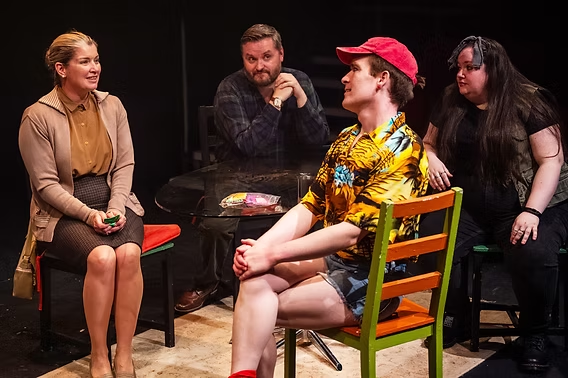
A powerful, largely overlooked story of Irish gay community and chosen family in the AIDS crisis, undercut by weak, unfocused direction.
There have been many plays and musicals exploring the harrowing years of the AIDS crisis in the 80s and 90s, but Derek Murphy and Amy Clarke’s Mammy’s House reveals an intimate and largely overlooked corner of the Irish gay community in London during this time. Drawn from first-hand accounts and extensive interviews, Murphy and Clarke shine a light on the difficulty of finding home and family as an outcast in a tumultuous era.
Set in the living room/kitchen of Mammy’s House — Mammy being Barry (Derek Murphy), a middle-aged gay man who has taken to welcoming young Irish people fleeing persecution back home — we follow the comings and goings of the residents over five years. A somewhat miscast Niall (Conor O’Dwyer), affectionately known as Nellie, comes across more as a caricature of a young gay man in the 80s than a fully realised character — all glitter and enthusiasm for his “Project Cowboy” drag act — and he never really sheds that caricature, even once illness enters the picture later in the play. To the production’s credit, Niall’s decline does mellow him out a touch and finally lets the audience feel something for him, but it’s a late and only partial correction.
Jemma Curran is solid as Mags, content to let others shine while offering Niall a steadying, maternal presence. Less essential is Stephen Chariton as Justin, who arrives in the second act performing his drag persona, Ginny — a device the play doesn’t seem to need.
Overall, the piece suffers from weak direction. It’s unclear that Brian Brady was ever quite sure what he was tackling here. Clunky stage directions, amateur sound design, confusing lighting cues and poorly judged scene transitions mean the production never gains the momentum it needs to keep the audience on board. A kitchen-sink drama like this should give a seasoned director plenty of room to sharpen the flow and bring out the relationships between characters — instead, it just clunks along. The writing doesn’t help matters: a run of cheesy, soap-opera beats undercuts scenes that should land with real weight, most jarringly when the Christmas scene is interrupted by a phone call, and Mammy comes back in to announce Shay has died.
The play badly needed a dramaturg willing to cut it down. This could easily have been one act with no interval — the second act’s drag show in particular feels like padding, and if it wasn’t going to be done well, it probably shouldn’t have been attempted at all. The ending suffers from the same excess: the penultimate scene plays like a natural close, and the audience clearly reads it that way, only for an entirely unnecessary final scene to follow — an epilogue nobody asked for.
The standout performances are Derek Murphy and Ciara Pouncett as Sally, the mother of a young man who briefly passed through Mammy’s house before dying of AIDS. Their scenes together are grounded and understated, giving the production a steady sense of relatability it badly needs elsewhere. Justin Ensor’s brief turn as Shay in the opening scene is also worth a mention.
Mammy’s House is telling a story worth telling — the material and the performances at its centre make that clear — but the production around it needed a firmer hand. Tighter direction and a willingness to cut would have let the genuinely moving moments breathe, instead of getting lost between the caricature, the soap-opera beats, and an ending that doesn’t know when to stop.
Mammy’s House is running at Upstairs at the Gate House until 13 September.