REVIEW: Siblings: Dreamweavers


Rating: 3 out of 5.

“An eccentric, audience-fuelled romp”


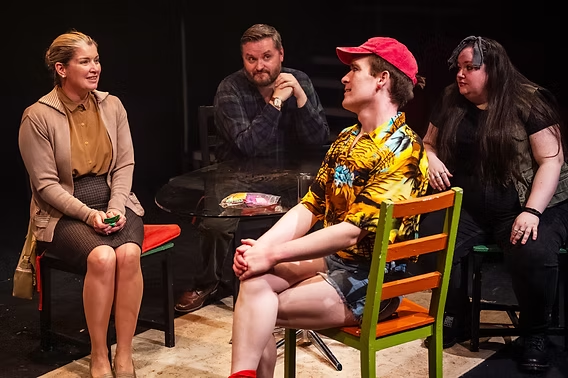
Tucked into the depths of Soho Theatre, audiences are having their dreams become a reality– in a sense. Entering the downstairs performance space, you’re immersed into a lab of sorts confronted with writer and performer Marina Bye, hooked up to some helmet concoction with flashing led lights, framed by many many lab coats. Another scientist is circulating around the space, interacting with audience members, asking if everyone has signed their NDAs, meanwhile Hillary Duff’s “This is What Dreams are Made of” blasts over the speakers.

From the getgo, Siblings’ latest piece, Dreamweavers, is quirky and intrinsically connected to the audience. As the piece progresses, various audience members are invited (or coerced) to participate in the presentation of a new scientific invention, allowing the helmet wearers to see their dreams projected onstage. Real-life siblings Marina and Maddy Bye share an easy, lively chemistry on stage, though tend to get frequently carried away with their various and sundry bits.

Opening with a spectacular display of flashing lights and WWE-esq voiceover, it immediately becomes clear that initially funny moments get dragged out to unnecessary lengths. Dan Wye’s direction gradually loses its rhythm, leaning so heavily into the joke that even the cast struggles to maintain their composure. The structuring of the piece remains engaging, however, with different audience members being chosen to witness familiar dreams such as being called to stage not knowing your lines and slightly less familiar ones of a game of ping pong turned pigeon attack. 

The piece is brought to life and filled out with the swift and sharp lighting design (Lily Woodford-Lewis) and sound design (Charlie Beveridge). The highlight of the piece was the musical numbers, which one might notice were the most polished moments of the whole show. Catching tunes and simple but organized choreography left the audience tapping their feet to the lyrics of “One Big Boob.”

The crux of the show hinges on the willingness of audiences to jump in uninhibited. When they do, Dreamweavers finds its stride. There is something undeniably charming about watching a packed basement in Soho rally behind a volunteer navigating an absurd subconscious landscape. In those moments, the Bye sisters’ knack for improvisation shines, and the show feels genuinely alive.

Yet that same reliance on audience abandon can expose the seams. When participation is tentative, the pacing dips and the gags linger a beat too long, as though waiting to be rescued. Dreamweavers is at its best when it trusts its premise enough to move swiftly, letting the absurdity speak for itself. Even with its overextended bits, the production remains an inventive, high-spirited experiment, buoyed by committed performances and a concept that, at its core, taps into something playfully universal: the strange theatre of our own dreams.

Siblings: Dreamweavers plays at Soho Theatre 28th February. Tickets are available here.

REVIEW: Our American Queen


Rating: 3 out of 5.

While Our American Queen is rich in historical detail, that meticulous attention often overwhelms the story, leaving the central characters underdeveloped and the drama struggling to emotionally connect.


America at war. Cracks showing within the Presidential cabinet. Families divided. A familiar scene is set before us, as we enter the world of 1864 Civil War America. Lincoln is at the helm and his Secretary of the Treasury, Salmon P. Chase is gunning for his seat with his daughter Kate acting the driving force behind the scenes. The ‘most celebrated yet overlooked women of 19th-century America,’ as Our American Queen champions her.

Portraying a historical figure convincingly is a daunting task, one that demands both historical context and compelling storytelling. Finding the balance between the two is key, but unfortunately Thomas Klingenstein, making his playwriting debut, struggles with the formula. We often find ourselves in various two-handers with each character spouting their opinions on the current state of the war, Lincoln’s policies, and the politics of the day. There is no doubt Klingenstein did his research, but the piece too often loses its momentum in its textbook-like approach. 

The first half of the piece is occupied with party preparations, which Kate has treated as a matter of utmost personal importance. It is revealed that this party is where her father will reveal his intentions to run against Lincoln. Wallis Currie-Wood as Kate Chase graces the stage with a restrained and steely demeanor, as she carefully sets the table and entertains several visitors. As the play progresses, however, this attitude settles into a wooden and two-dimensional performance. It’s difficult to believe the woman before us is the one others claim can get politicians to bend to her every whim. 

The charming and responsive Tom Victor portrays secretary to President Lincoln, Mr. Hay. Kate’s otherwise rigid demeanor softens in his presence, making theirs the most compelling pairing among the rotating cast of guests in the Chase dining room. Darrell Brockis as Secretary Chase holds the stage with ease and is one of the most compelling characters to follow throughout, portraying the complicated politician whose concern for his daughter feels sincere. Christy Meyer as the Secretary’s “close friend” Carlotta Eastman and Hadyn Hoskins as General McClellan provide moments of humor and sincerity, but the general’s scenes detract from the play’s forward momentum.

While the set is striking (designed by Neal Wilkinson) with the long mahogany dining table surrounded by 12 matching chairs, it seems to limit the playable action throughout, with actors often getting caught on either side of the table and resorting to delivering lines meant for their scene partner straight to the fourth wall. The distanced action grows tired once you realize it’s an architectural dilemma, a problem compounded by Christopher McElroen’s direction, which does little to help the actors forge compelling relationships. The addition of the giant framed screen at the head of the table transforms into a window to the war during scene transitions, displaying recruitment posters and images of dead soldiers. While impressive in scale, its use to project Salmon Chase’s face as he delivers his dinner party speech to the ghosts of the infamous dinner party upstage, and later to broadcast Kate’s face as she throws a fit over her father’s unfair treatment of her in her youth, ultimately detracts from both the actors’ performances and the play’s dramatic flow.

As an American audience member, I found myself confronted with new historical characters and events from the Civil War, so I can only imagine the catch-up a British audience may be feeling when trying to contextualize the piece. Coupled with following this young woman’s rise and fall, the play seems to be confused within itself as to its aims as it transforms into an internal battle for Kate as to whether she marries for love or prestige. An issue that only comes to light in the second half of the play. 

Our American Queen brings us into a world of ambition, loyalty, and quiet power, illuminating the lives of those often overlooked by history. While the play falters at times in its momentum and struggles to balance spectacle with intimacy, it still offers moments of striking humanity, wit, and emotional resonance. Though imperfect, Klingenstein’s debut leaves the audience with a vivid portrait of a young woman navigating power, family, and legacy in the shadow of the Civil War.

REVIEW: Wyld Woman


Rating: 3 out of 5.

While Isabel Renner’s 70 minute one-woman show about breaking out of her Shy Girl mode lacks consistent plot beats, it contains an entertaining array of quirky characters and excellent design elements


In this, the post-Fleabag era, one-woman comedies exploring the plights of twenty-something women finding their ways in a big city are not hard to come by. While each show makes earnest attempts to carve out their niche in the fringe landscape by trying to exhibit how they’re “not like other shows,” inevitably, the Waller-Bridge deja vu strikes sooner or later. Isabel Renner’s Wyld Woman: The Legend of Shy Girl does not escape the mold of the quirky comedy. In its attempts at individuality and uniqueness, the plot gets muddled in a scattering of overly-disparate memory vignettes and half-baked attempts at breaking the fourth wall. 

Now don’t get me wrong– the quality of this production was impressive. Stepping into the theatre, you can see no expense was spared when it came to the fully fleshed-out living room and kitchen of a New York City apartment, decorated floor to ceiling in pink party decor. Attention to detail was obviously not lacking in the design of this show. 

While the whole apartment is set up for a party, for the majority of the piece we are left in the dark as to precisely why. A show whose whole premise is about a ‘shy girl’ navigating living in the Big Apple, ‘amongst legends,’ despite her self-crippling ‘shy girl stuff,’ Renner recounts tales about how her shyness has impeded her desire to find love and connection. Through a series of vignetted memories, prompted by conversational topics on index cards, we witness her charcuterie board of character voices and physical comedy skills. After about five of these scenes, from her ‘hot girl roommate’ Memphis, to her 6-year-old therapist Shelly (the emotionally intelligent little girl she’s paid to babysit turned therapist), to her German gynaecologist, the plot grows cold and gets muddled in what hues dangerously close to feeling like a long form SNL audition. 

Supported by Catja Hamilton’s intuitive lighting design and Sasha Howe’s subtle and dynamic sound design, several moments of the piece are engaging and playful, particularly the climactic ‘Blowjob Ballet.’ Cameron King’s direction left no stone unturned and no corner untouched– truly proven by a whole segment taking place atop the fridge. 

When the eponymous Shy Girl attempts to ‘unleash her inner sex goddess’ through the Wyld Woman program, the play takes an unexpected tangent where her sex coach Twilight encourages the audience to proudly proclaim ‘My pussy is prophetic and prompt.’ Unfortunately, the attempts at audience interaction and “immersive seating” with the 4 audience members sitting at the dining table never reached their full potential. In the contemporary landscape of London theatre overflowing with interactive theatre, simply calling out audience members by name and getting them to shout out affirmations was not enough to warrant the 10 minute delayed start time where ushers scrambled about to get everyone to fill out pink name badges, and find willing people to sit onstage.  

Ultimately, an impressive set and expensive production budget does not a successful play make. Hailing from New York myself, I was eager to see how this play would adapt for the British stage. Although unfamiliar with earlier iterations, it seems to strongarm British references (and accents of course) with the clientele of the restaurant Shy Girl works at is mostly from the UK, culminating in the ‘unnamed British rockstar’ hitting on her while she’s taking his order. 

Despite the pitfalls of the plot, Renner does craft a compelling and comedic character with many delightful moments to enjoy. Through her trials of a failed lovelife and embarrassing Chipotle breakdown, the conclusion that we (her imaginary friends) are her real homies because we see her with love is a tad predictable, anti-climatic, and unintentionally sad, undercutting the endearing sentiment that the piece appears to be trying to cultivate. In the end, this show is an excellent vehicle for Renner to showcase her broad scope of characters, and maybe we can walk away seeing past the shy girl inside all of us to explore our true inner 6-year-old therapists. 

REVIEW: A Rose By Any Other Name


Rating: 2.5 out of 5.

Offers intriguing Shakespearean conspiracy theory insights, but its lecture-like structure, minimal design, and lengthy pacing make it more informative than theatrically compelling.


The question of the true authorship of the world’s most famous plays has been hotly debated for centuries. Some claim Shakespeare stole material from lesser-known playwrights; others argue that “Shakespeare” was merely a collective pseudonym, or even that the works were secretly penned by Queen Elizabeth herself. Of all these theories, it is the infamous Oxfordian claim that Edward de Vere, the 17th Earl of Oxford, was the true William Shakespeare that forms the heart of Rosemary Loughlin’s A Rose by Any Other Name, playing at Barons Court Theatre.

For any Shakespeare enthusiast, the piece may spark memories of their own first encounters with the Bard. Loughlin scatters recognisable speeches from The Merchant of Venice, Julius Caesar, and of course Romeo and Juliet throughout the show, offering both familiar pleasures and a few surprising facts about this enduring literary conspiracy.

A two-hour, one-woman performance is a formidable challenge for any actor, especially when the performer is also the playwright. Here, Loughlin may have taken on more than the format can comfortably bear. Frequent digressions into anecdotes about delayed buses and overly descriptive cups of tea weigh down the narrative, which begins to feel more like an extended academic lecture than a tightly crafted piece of theatre. Without sharper editing, the material struggles to maintain momentum across its long runtime.

Loughlin’s delivery of her poetic, idea-rich script also felt emotionally detached, her performance at times over-rehearsed. Ironically, the most engaging moments came when she briefly faltered, allowing the carefully constructed façade to slip and revealing the warm, inquisitive person behind the text.

Scenographic elements were minimal. Only two sound cues punctuated the evening: one a bustling street soundscape as Loughlin described her pilgrimage to de Vere’s London home, the other the sound of the sea as she arrived in Venice to trace de Vere’s travels. While evocative, these isolated cues felt arbitrary; a more consistent integration of sound might have provided the depth and texture the production lacked. Attempts at visual aids, such as glossy printed photos of the locations she visited, also fell short as the reflective surfaces distracted some audience members from the narration. More successful were the simple costume gestures, such as donning a scarf, a necklace, or a Renaissance headpiece to mark transitions into the Shakespearean monologues.

A Rose by Any Other Name offers a fresh perspective on plays audiences have known for centuries, blending personal reflection with historical intrigue. For devoted Shakespeare scholars, the piece may provide delightful insights and an intimate look at Loughlin’s evolving relationship with the authorship debate. For the casual theatregoer, however, its dense historical detail and leisurely pacing may feel more tedious than revelatory.

REVIEW: The Gathered Leaves


Rating: 5 out of 5.

At the edge of the 20th century, the Pennington family’s fractures are laid bare with striking clarity in Adrian Noble’s captivating revival of Andrew Keatley’s The Gathered Leaves.


Ten years after its critically acclaimed premiere at the Park Theatre, Andrew Keatley’s The Gathered Leaves makes a dazzling return to north London. Set design by Dick Bird is captivating as soon as you enter the house with a grand chandelier, crown molding, and the fully fitted-out sitting room of the Pennington family home. Not a detail was too small in this production, and the care and intimacy stretched its way through all aspects of the piece, not just the set design.

Weaving its way through Easter weekend, 1997, the Pennington family is fully reunited for the first time in 17 years for patriarch William’s (Jonathan Hyde) 75th birthday. As is the case with most family dramas, there is a family scandal at the periphery slyly making its way into casual conversation and haunting the awkward silences. An estranged  daughter, Alice, coolly played by Olivia Vinall, is set to make her return with her own daughter, Aurelia (Taneetrah Porter), after years abroad. The most compelling relationship, however, is between brothers Samuel (Richard Stirling) and Giles (Chris Larkin), glimpsed with charm in two flashback scenes where their younger selves are harmoniously portrayed by Joe Burrell and Ellis Elijah, perfectly in tune with their elder counterparts. Stirling’s portrayal of Samuel’s autism is done with care and aptitude that allows the authenticity of the character to be felt in all of his interactions, and Larkin’s sensitivity and fortitude as a protective brother is juxtaposed with  his fraught relationship with their father. 

You can sense the cracks in the foundation of the Pennington house, as the younger generations gain their voices, and the older become less steadfast with William’s recent dementia diagnosis. Grandchildren Emily (Ella Dale) and Simon (George Lorimer), the children of Giles and his icy wife Sophie (Zoe Waites), increasingly push the boundaries of their familial traditions as the weekend progresses, from Simon not shaving for church and arguing about feminism with his mother, to Emily sneaking into the living room with Aurelia in the middle of the night for a nightcap. Porter’s calm and calculated interactions as Aurelia pierce through the underlying tension in several moments throughout, and are especially endearing as she shares the stage with Hyde in a rare moment alone to bond. 

Adrian Noble’s expertise and craftsmanship is evident in every inch of this play. The slow, calculated movements of the action, and the ease with which characters exist in this world, allows audiences to fade into the depths of the Pennington family home. The almost 3 hour piece flies by while we see a family grapple with unresolved conflict and newfound bits to quarrel about. While some scenes ended with slightly cliched vignettes, supposedly exposing characters’ inner motivations, the world of the piece never faltered from its naturalistic presence.

The collaboration throughout the whole team is seamless, with unobtrusive sound design by Max Pappenheim and lighting by Paul Pyant. The sound design is subtle with a clock ticking and birds chirping in the main scenes, but then does a lot of heavy lifting through transitions as it grows into an emotional piano foreshadowing, setting the style and tone of the inner life of the piece.  Dick Bird, also eases us into the world of 1997 without beating us over the head about it. The simple and accurate costume design allows us to feel as if we’re panning through an old family photo album. 

With London theatre-goers often chasing the new and experimental, The Gathered Leaves reminds us of the quiet power of a well-crafted family drama: intimate, tender, and devastatingly familiar.

REVIEW:Elixir of Love (Reimagined) 


Rating: 3.5 out of 5.

A modernized rom-com-pera by Baseless Fabric Theatre, Elixir of Love (Reimagined), gives audiences a swift and energizing performance, though occasionally camp in its updated contemporary references. 


Boy likes girl, girl doesn’t feel the same way, boy buys fake love-inducing elixir to seduce girl, girl gets jealous of boy’s newfound attention after her situationship posts a viral Tiktok of him singing about buses, girl falls in love with boy, and they all live happily ever after. That old chestnut, right?

Well, that’s certainly the territory with Baseless Fabric Theatre’s reimagining of the 1832 opera, ‘L’elixir d’amore’ or ‘The Elixir of Love.’ With an updated Libretto by director Joanna Turner and reorchestrated by musical director Leo Geyer, this 2025 rom-com-pera compacts the story of Nemorino’s (Jonathan Cooke) unrequited love for Adina (Abigail Kelly) into a tight 55 minute tale of Tiktoks and viral ‘Love Effects’ sprays. The second of eight operas in the Arcola Theatre’s 17th season of the Grimeborn Opera Festival, The Elixir of Love (Reimagined) is by far the shortest piece in the festival, providing an accessible entry-point to new audiences who may find a traditional length piece daunting. 

            Rather than Nemorino’s original characterisation as ‘poor peasant guy,’ here he is a poor, bus-obsessed guy à la Francis Bourgeois. His tragic pining for ‘it-girl’ Adina is thwarted when handsome hipster Belcore, charmingly portrayed by Jack Holton, rolls in – teenie-beanie and biceps in tow. Adina, who has declared that she ‘doesn’t believe in love,’ decides this guy would be just right for a casual fling. When viral ‘Love Effects’ salesman, Dulcamara (Peter Edge) appears with the titular elixir, Nemorino jumps at the ‘deal’ with all the cash he has left in his bank account. Filled with twists of modernized interpretations of social folly, such as making moments ‘for the gram,’ and lamenting the pitfalls of Tinder, this reimagined and updated production aims to relate to 21st century audiences, in an occasionally slightly camp and cringe manner, yet it manages to retain the swift humor of the original opera that has captivated audiences for the past 200 years. 

            The performances from all four actors were lively and engaging, although slightly two-dimensional. Kelly brings a casual charm to the modern Adina and tackles her arias with grace, but she jumps a little sporadically and ungracefully from affectionate to cruel over the course of a single song. Cooke brings a naive and quirky humour to his Nemorino, although we see little growth in his character throughout the piece – likely more a fault of the stylistic conventions than Cooke’s own tackling of the role.

            The direction by Joanna Turner was unadventurous for such an updated ‘reimagining.’ Perhaps unsurprising for a casual opera audience, but younger theatre goers may yearn for a bit more creativity in the staging of the piece. The music was lovely and cheerful, expertly played by Leo Geyer, Yuliia Humeniuk, and Philippa Mo, keeping up the pace and tempo with the lively action. The text setting was occasionally inelegant in its scansion, but still managed to pull laughs from the audience with the actor’s clever delivery.

             In an age where modern audiences aren’t frequently drawn to see opera, it is refreshing to experience an updated classic in a digestible time frame. Lighthearted, relatable, yet slightly camp, this piece serves as an easy introduction to the vast world of operatic comedies. 

REVIEW: A Dark Line Upstairs


Rating: 4 out of 5.

A wittily woven tale of displacement and loneliness


‘A woman holding onto a tree’ – or in reality a dead potted plant. The silent image greets audiences as they file into the basement space at Baron’s Court Theatre for Matilde Vigna’s one-woman show, A Dark Line Upstairs.
The story of starting anew, whether by choice or circumstance, takes the stage in two interwoven storylines: one of a community in Italy totally displaced by the Polesine Flood in 1951, and the other of a woman constantly on the move in London in 2021. Serving variously as writer, director, and performer, Vigna captures a unique persona with her wit and magnetic energy from the get-go, rarely missing a beat.
The uncomplicated set design becomes a flat in Peckham and a flooded river bank, with simple atmospheric and effective lighting design by Alice Colla. The scenography of the piece reaches its peak as the blue glow of the fog expands slowly towards the audience while Vigna’s illustrative narration details the rapidly rising river engulfing everything in its path.
The scenes of the flood are underpinned by a rapid rhythm evolving in the growing panic and chaos of the disaster. Alessio Foglia’s sound design grows organically throughout the progression of the flood memories, however, you feel an absence of the beautiful sound design in the contemporary scenes, which remain for the most part, silent.
While writing and performing in a one-woman show is already an ambitious undertaking, Vigna has given herself a monstrous task of also directing and producing her piece. Understandably, the staging remained simple. Although mostly effective, it yearned for more of an expansive presence in the thrust stage space of Baron’s Court. Sitting on house left or right, audiences may feel forgotten as most action is focussed head on. However, there remains an eloquence to her controlled movement and layered embodiment of the text. Commanding and uncomplicated staging lends itself to highlighting the dexterity of the language. Moreover, while the imagery of the narration is vivid and visceral, the dramaturgy of the slippage between the two worlds gets muddied. It’s occasionally unclear exactly what mirroring effect, philosophical analogy or emotional segué is being proposed by their juxtaposition.
The potency of the piece also hits home for those affected by or familiar with the recent flooding catastrophe in Texas. Although decades and worlds apart, it’s difficult not to compare the tragedies of ordinary lives being obliterated in a matter of moments by a natural disaster. Vigna expertly captures the visceral panic citizens of Polesine must have felt as they climbed to their highest floors rather than following orders to evacuate.
This is juxtaposed against the modern character of a woman on the move who decides to take everything except the pillowcases in her flat, including a bouquet of dead roses from a supposed jilted lover. As she struggles to board a train with her cumbersome load, she witnesses a mother with a simple crossbody bag, strapping a baby to her back, prompting her to remark, “could it be that simple?”
Purely engaging and enjoyable, Vigna brings an exceptionally literary mind and wry energy to her piece. It’s dextrous and lyrical, and if the theater craft is further lifted to the same level as the narrative flair, this show is destined to excel in future iterations.

REVIEW: The Company of Trees


Rating: 3 out of 5.

High school drama meets heartfelt humour in The Company of Trees, as Hamilton District Youth Theatre lights up the Dorfman for NT’s 30th Connections Festival.


A single tree crafted ironically out of carved wooden pieces puzzled together greets us as we re-enter the Dorfamn Theatre for the second performance of the second night of the the National Theatre’s Connections Festival. Celebrating its 30th Anniversary, this annual youth theatre festival engages over 6,000 young people from around the UK. They then invite 10 companies to perform at the National for friends, family, and a curious public with pieces specifically curated for them by up and coming UK playwrights. 

The Company of Trees, written by Jane Bodie, digs into the harsh realities of high school drama. Art imitates life with the Hamilton District Youth Theatre presenting a story of unlikely friendship. The new girl Willow, who would rather spend her time in nature than on her phone, is ostracized by the ‘popular gang’ at her new school. When the popular girl, Tay, injures herself after attempting a dangerous gymnastic stunt, Willow extends a branch of friendship (literally bringing her a branch from her favorite tree). At first Tay maintains her ‘mean girl’ facade, but as her ‘real friends’ and ex-boyfriend, Ash, stop visiting her at her house while she recovers, she begins to embrace Willow’s outlook on connecting with nature rather than Insta followers. 

There are definite standout performances in this young ensemble- particularly ‘sexually confused’ Towan who hits every comedic beat he can grasp. The group, overall, have a smattering of chuckle-worthy moments throughout, to the delight of the young audience. Particular crowd pleasers were Tay asking Willow ‘How do you know anything without a phone,’ and Tay’s ex getting into a ‘your mum’ fight with the school bully. Say what you will about cliches, but they stuck the landing for this audience filled with fellow Connections Festival participants. 

Although energetic and charged with youthful enthusiasm, the young performers struggled in projecting and articulating so the audience could clearly follow the action. However, the added surtitle screens allowed everyone to pick up on muttered or forgotten bits. 

The clever sections of direction, such as moving Tay’s accident offstage and discovering multiple uses for a wheeled platform, were overshadowed by much of the action being swallowed on the large stage. The awkward spacing, such having the tree planted upstage left, and placing Tay’s recovery bed permanently onstage right once it was brought in, left the actors looking simultaneously lost and overcrowded. 

Sound design for the piece, while occasionally effective in providing ambient noise and atmospheric music, threw in some slightly jarring bits with Calvin Harris’ ‘Feel So Close to You’ blasting between a scene transition , and a rogue fly buzzing nature track on an uncomfortably leveled loop for the final scene. 

Although this was a one-night only performance it proved to be an incredible opportunity for these young people to perform on a historic stage, and interact with their theatrical peers in London. Seeing the benefit of these performances, not just for the kids on stage, but also those engaging with the pieces in the audience was heartwarming, providing a bit of optimism for the future of the next generation of theatremakers.

REVIEW: Mia and The Fish


Rating: 3 out of 5.

Abbey Grange Academy’s stirring performance of Mia and the Fish brought myth, movement, and modern meaning


For the 30th anniversary of the National Theatre’s Connections Festival, The National has invited ten youth theatre companies to perform specially curated shows on the stage of the renowned Dorfman Theatre — this year being especially precious as they are the first to grace the stage after its recent £26.4 million renovations across the whole building.

On the second evening of the festival, audiences enjoyed two performances, first of which was Mia and the Fish. This play was performed by Abbey Grange Academy from Leeds, written by Satinder Chohan. This mystic tale, adapted from an ancient Indian myth, Manu and the Fish, follows the story of Mia and her sister Halima who are recent refugees. While on their seaward venture to seek safety from their war-torn homeland, they were followed by a tiny rainbow fish. This treacherous journey is cleverly choreographed with the large ensemble embodying ocean waves and stormy weather. 

Once on land, Halima adapts quickly to their new life with an ease Mia can’t seem to mimic. The collection of peers is cleverly cast with an assortment of colorful teens, made up of Insta obsessed besties, self-proclaimed ‘Crypto-King’ Paz, an eco warrior, and a surfer girl. 

In her loneliness, Mia encounters the same fish who followed her in her journey to land, and to her surprise, it can talk. The fish is embodied by the eight ensemble members who have donned translucent, flowing sleeves, with the ‘head fish’ holding a tiny blue light. Although simplistic in its approach, the costuming for the piece is effective for every character, helping audiences to identify the various characters’ personalities, juxtaposed against the uniform ensemble dressed in black t-shirts and jeans. 

In this production, unity and movement shone out above all. Performing on such a large scale is no easy feat, especially when engaging with a piece that covers such large issues such as the climate crisis, xenophobia, and overall hardships of finding yourself in the chaos of the world today. While the dialogue was, at times, difficult to understand, subtitles supplemented the action allowing the audience to pick up on any crucial plot beats they might’ve missed. 

When Mia’s rainbow fish, which she affectionately names Samaki (Arabic for fish), delivers an ominous prophecy of a massive storm that may destroy all of mankind, the young teens rally together to fix up a boat (simply established by a length of rope lifted and swayed in sync by the ensemble). 

The onset of the storm came in with a loud bang and flash of light synchronized with more ensemble ocean movements. A ‘Lord of the Flies’ conflict ensues onboard when the teens don’t believe Mia can communicate with a giant fish (which has now apparently transformed into a narwhal). That is, until Samaki guides them to dry land, where they discover they are the lone survivors on earth and vow to make the new world a better one. 

Overall, this piece was impressive in its scale and precise direction. The young talent is projected through their passionate approach to ensemble work and enthusiastic engagement with the script. While, of course, it was not at the level of a typical National show, it was an incredible opportunity to see these young people getting involved in the arts and working with fellow artists. 

REVIEW: Ruthless


Rating: 1 out of 5.

The misogynistic take on a real-life modern figure was disappointing and toeing the line on  inappropriate, framing her as a schizophrenic, man obsessed, alcoholic and drug addict


The Madoff Ponzi scheme is one of the most infamous cases of financial fraud in modern history, bringing the Madoff family into the spotlight with the 2008 arrest of patriarch Bernie Madoff, for defrauding investors of $65 Billion through a phoney wealth management fund. The compelling complexities of this modern family drama would pique any author’s interest, and for Roger Steinmann, the matriarch Ruth is the  inspiration for his fictional deep-dive into the secret life of a convicted felon’s wife. Filled with a mashup of disparate musings about the speculative life of this “lonely woman”, left in the lurch after the arrest of her husband and the untimely death of both sons, Ruthless ultimately becomes little more than  a borderline offensive and sexist take on the modern single woman. 

From the moment you walk in the theatre something seems askew, with almost-nonexistent house lights and an eerily quiet atmosphere, i.e. dead silence. The giant portraits of Bernard and his two sons stare down the audience, accompanied on stage by a lackluster set of mismatched furniture – a dining room table off to the side, a mirror precariously hung to the right, a period cabinet and garish white-wooden door – leaving audiences confused as to when and exactly where this play is taking place. Bernardo Hita’s lighting and sound design, while aiming to emulate a naturalistic environment, eventually ascending to an out of body psychosis, miss the mark with oddly mixed voiceovers and often distracting levels of generic disgruntled mob. 

Now, performing an almost one-woman show is no easy feat, and Emily Swain’s take on Ruth is energetic and driven. But she’s also grotesque and borderline schizophrenic, veering between nonsensical musings on her attempts at being the perfect housewife yet not knowing her husband at all. The whole piece fractures even further with the arrival of caricature Italian pizza delivery boy Marco, played by Assistant Director Evan Emmanuel. The scene that plays out is unnervingly close to the precarious premise of an adult film, where an unsuspecting pizza delivery boy stumbles into the apartment of a distraught older woman. And it’s directed exactly that way. Ruth repeatedly and predatorily insists Marco join her for dinner, attempting to physically pull him into her prison of kitsch lace tablecloths and plastic wine glasses.

Overall, the direction by writer Steinmann is a mix of unbalanced absurdism with a dash of university sketch comedy, but in a completely un-ironic fashion. The entire play captures the vision of a weak and lonely woman whose only purpose in life was to be a mother and a wife, and now that she has lost “her men,” the only rational course of action is ending her life. As she holds a gun to her head in the second act, she begs the question, “where’s the dignity?,” yet the audience has been asking that question from the moment she stepped on the stage in a gaudy plastic blonde wig, dressed in a white shroud. The misogynistic take on a real-life modern figure was disappointing and toeing the line on inappropriate, framing her as a schizophrenic, man obsessed, alcoholic and drug addict. 

With the jump from somewhat absurdist naturalism to drug-induced afterlife confrontation, the play exceeds the audience’s patience as they witness Ruth arguing with the voices of her two sons in heaven and her disgruntled “hubby” in hell. By the end of the play, the audience is left questioning if the moral of the story was truly as simple as “women are the root of all evil…” and poor Bernie Madoff was a victim of love, embezzling billions to try and please his high school sweetheart.