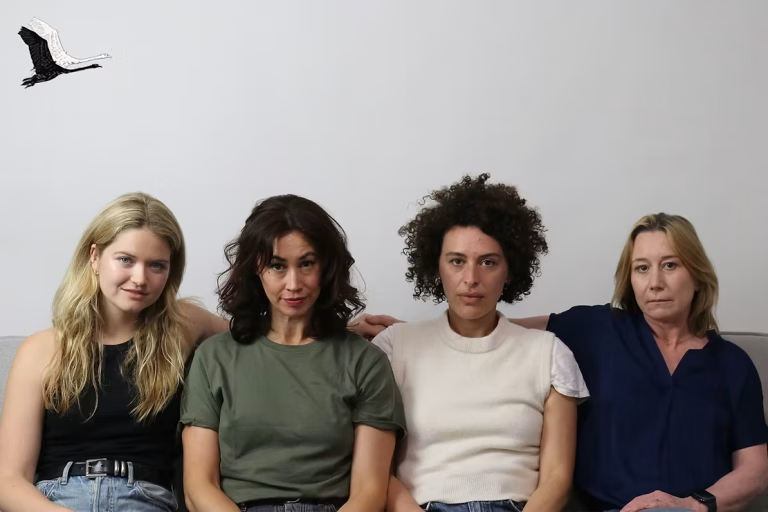
IN CONVERSATION WITH: Alexis Gregory and Marc Svensson

As SMOKE prepares to tour the UK, writer and performer Alexis Gregory joins forces with Marc Svensson to create a bold, two-part theatrical experience that extends beyond the stage. Blending a gripping, darkly comic queer thriller with live post-show discussions led by You Are Loved, SMOKE confronts urgent issues around mental health, addiction and community in the digital age. Tickets are available here.

In this conversation, Lex and Marc reflect on the real-life experiences that shaped the work, the natural evolution of their collaboration, and their shared mission to open up vital, and often avoided, conversations within the LGBTQ+ community.


Alexis, SMOKE begins with such a haunting and contemporary premise. What first sparked the idea for this story?

Alexis: I was hacked, which of course is a very everyday experience now, but it was a very targeted one, with all my accounts being broken into over a few weeks, with log-ins from around the world, and my money being spent. At the same time I was observing, on social media, numerous deaths of gay men being announced, often in relation to drug misuse or suicide. In SMOKE, I explore this automatic assumption about the cause of death, which is obviously not always the case, but statistically more likely to be so than our straight counterparts. I combined these two themes as an urban queer thriller. And oh, I decided to add comedy into the mix too. 

How did your collaboration around the themes of the show begin to take shape?

Alexis: Marc and I were exploring and highlighting the same themes at the same time, Marc via his organisation You Are Loved, and me via my work as a playwright, creating work about, and for, the queer community. We decided to pair up, and offer audiences a unique two part experience; I have never seen a play and community organisation partner in this way, and try to reach as many people as possible across the UK. 

Marc: I completely agree with Alexis point about the shared themes. To me, it felt incredibly powerful from the outset that this wasn’t a collaboration where we had to force alignment; the themes were already shared. The work Alexis had created and the work we’re doing through You Are Loved were speaking to the same underlying reality: that too many people in our community are struggling in silence, and too many lives are being lost as a result. The collaboration really began to take shape through that recognition. The themes didn’t need to be imposed; they emerged naturally. Both the show and our campaign, The Silence Ends With Us, are rooted in the same truth: that there are conversations we’ve collectively avoided or shut down, particularly around mental health, drug misuse, and the more complex, uncomfortable parts of queer experience. What brought it together was a shared urgency. A sense that we’re at a point where continuing not to talk about these things is no longer an option. The partnership creates a space to confront those realities, and our work aims to extend that beyond the theatre into communities, into conversations, and into action.

Marc, from your perspective as founder of You Are Loved, what stood out to you about the piece when you first encountered it? 

Marc: I feel like I encountered SMOKE twice, in two different but equally impactful ways. The first was when Alexis told me about it. What immediately stood out was how closely it mirrored experiences I’d had myself. Particularly that feeling of repeatedly coming across posts on social media about people in our community who have died suddenly and prematurely from suicide or drugs, and seeing any meaningful conversation about it either shut down or quickly moved past. There’s this pattern where we see something tragic, we feel it briefly, and then we collectively look away. The second encounter was seeing the show at the King’s Head Theatre. What struck me then was how powerfully it captured the difficulty of trying to make sense of people in a world that often doesn’t make sense itself. We’re living in a digital era where the boundaries between what is real and what is constructed are constantly shifting, and that has a profound impact on how we understand each other, and ourselves.  

SMOKE looks unflinchingly at aspects of queer experience in a digital era. What conversations were you hoping to open up through the work?

Alexis: We hope the conversations starts in part two of the audience’s experience. You Are Loved have created a post-performance, forty-five minute community panel, with different guests each night in London, and different themes highlighted. On the road, for our regional dates, there are guests specific to that town or city, for example experts in various fields connected to SMOKE and YAL, community figures, and people with real life experiences the same as explored in SMOKE and that YAL’s vital work touches on. 

Marc: In terms of the conversations the work opens up, whilst this is probably a question primarily for Alexis, it’s also deeply connected to what we’re trying to do at You Are Loved. The reality is that the way we socialise, connect, and seek intimacy has fundamentally changed. For many gay men in particular, connection, sex, and even the search for love now primarily happens through apps. That brings opportunities, but it also brings challenges—around validation, comparison, accessibility of drugs, and the speed at which things escalate. What SMOKE does so effectively is hold a mirror up to that world and ask us to sit with it, rather than scroll past it. And that’s exactly the kind of conversation we need to be having. 

What have you both learned from audiences during the show’s journey so far?

Alexis: SMOKE had a mini run at the new Kings Head Theatre at the end of 2024. We went on to sell out the run. The audiences were amazing. SMOKE is challenging for the audience and asks them to take a risk with me, as the solo performer, too. Most audience members totally understood the story and themes I was trying to communicate. Audiences do want new, interesting, exciting work, that is outside the box. Well, my audience do anyway!  

Marc: What I have learnt from audiences during the YAL events we have done thus far is that there is a real and urgent need for these spaces to be created, and for these sometimes difficult conversations to be had. The fundraising concert we put on in October last year at St Giles Church in Barbican, London was incredibly powerful and frankly, one of the most significant days of my life (so far). I had so many people coming up to me during and after the concert, as well as contacting me afterwards, to tell me about loved ones they personally had lost and how much it meant to them that this space had been created to recognise the loss, and to show them that they are not alone. That concert was such a beautiful and powerful reminder to me that the work we are doing matters, and the power of our community is limitless.    

Looking ahead, what kinds of creative or community-led projects excite you most? 

Marc: What excites me most right now is the sense I have that something is shifting within our community, and within the organisations that support it. There is a growing recognition that the issues we are facing—whether that’s loneliness, poor mental health, or drug misuse—aren’t things that any one organisation can solve in isolation. They require a collective response, and to me it feels like people are genuinely leaning into that idea of collaboration rather than competition, or working in silos. We’re also seeing more willingness to address root causes, not just symptoms. To look at things like loneliness, disconnection, and identity, and ask harder questions about why people are struggling, and not just how we respond once they are. Alongside that, I see a rise in grassroots initiatives. New community groups, peer-led spaces, and social projects are emerging directly in response to the loneliness crisis we’re seeing across the LGBTQ+ community. That’s where real change often starts – at a local, human level. Personally, the most exciting projects are the ones that bring those elements together: creative work, lived experience, community connection, and collaboration across organisations. Because ultimately, that’s how we shift culture. Not just by raising awareness, but by creating spaces where people feel seen, connected, and supported, before they reach a point of crisis.

REVIEW: HOUSE23 Presents Short Shorts: Comedy


Rating: 5 out of 5.

A fun collection of comedy shorts


New art community HOUSE23 put on a limited selection of comedy shorts from up-and-coming talent, with a Q&A with a BAFTA award winning director and a BAFTA award winning writer at Riverside Studios to discuss their work. 

The evening started off with a friendly and warm welcome from Molly, the founder of House23. A small group had already formed and were talking to each other, several of whom either knew or had worked with each other before. After brief introductions and a short chat with an actor-writer, we were given a goodie bag and ushered into one of the cinema screens. The screen itself was small, maybe a 40 seat capacity, but it was perfect for the screening and the seats were really comfy. Other short film screenings have not been in such venues and that alone made this event stand out. 

There were five films being screened, each of around 20 minutes. Each short was of high quality and what was produced on presumably a small budget was impressive. It is easy to produce very amateur productions on small budgets but none of them felt like that. Each was polished, engaging plots, well acted and good soundtracks or sound design and the filmmakers involved clearly were experienced. A standout short being “Egg Timer” which deals with the pressures of society expecting women to have children, which is very topical at the moment. All five shorts were equally funny and got a good reception from the audience. It was clear to see why several had been winning awards and festivals. There was one actor who appeared in a couple and it had been curated so that we saw the actor play a character avoiding noise and socialising to another character who was “hired” by a couple, making the audience feel like we were going on a personal development journey. Only in comedy short screenings would that level of attention to detail work and actually made the second screening even funnier, given how we had previously seen him. 

The Q&A was brief but a good insight into what it takes to develop a short film, highlighting many challenges that filmmakers face. What was being said clearly resonated with the audience as many were nodding in agreement. It was interesting to hear how the director went from shooting shorts to working with Saturday Night Live UK and how she approached the step up. Equally it was an interesting insight to hear how the writer was organising a rehearsal for the bbc on a silent film and the process of the filming. The night ended with more networking, discussing what was thought of the films and friends catching up. In an industry that relies on connections and your network, it was lovely and refreshing to see a group of people come together to support each other. 

After having a brief discussion with Molly about where she wants this art community to go, as someone who works in the industry and a fellow creative, it is reassuring to hear that there are people who are wanting to create a sense of community and support, especially when the arts is largely accessible for people who have the funds to do so. It’s exciting to know that there is a startup that is looking to address issues that filmmakers face and the realities of being a creative, even more so in uncertain times.

You can keep up to date on upcoming events via Instagram @HOUSE23_LTD or email hello@house23.co.uk for any enquires. 

REVIEW: The Gondoliers


Rating: 4 out of 5.

A ritzy riot of an opera


The English Touring Opera’s production of The Gondoliers, staged at Hackney Empire on the 11th of April, was colourful, flamboyant and immensely entertaining. Composed by Gilbert and Sullivan in 1889, the Victorian-era comic opera oscillates between lively political satire and unbridled farce. For those unfamiliar with its topsy-turvy plot, the opera follows the journey of two ‘republican’ gondoliers who are suddenly informed by the Grand Inquisitor of Spain, Don Alhambra del Bolero, that one of them (but he does not yet know which) is the long-lost heir of Barataria; and not only is he the heir, but he was also secretly married, as an infant, to the Duke of Plaza Toro’s daughter, Casilda. Upon hearing the Grand Inquisitor’s surprising news, the gondolier brothers swiftly accept their royal status and travel to Barataria to rule the kingdom jointly until the true heir is revealed, leaving their new wives behind. However, since they are still ‘republicans’ at heart, they insist on ‘a monarchy tempered with Republican equality’, a system so impractical that it quickly exhausts both itself and its creators.

The Gondoliers is an opera with an unwieldy, somewhat ridiculous narrative, and the ETO did well to stage a production that was lucid as well as joyous. Every scene was distinctive and full of character, which helped to ground and energise the whole. In the opening chorus, the young maidens (Contadine) were fantastically saccharine while proclaiming their love for the handsome gondoliers, surrounded by a sea of artificial roses and picturesque bridges. Likewise, in the Cachucha, every performer threw themselves into an amazingly energetic dance routine, each singer as passionate and rhythmic with their ribbon-adorned tambourines as any seasoned Spanish dancer. Such moments, brimful of enthusiasm, are precisely what made this opera so lively and enjoyable to watch. They also compensated for some weaker patches in the production, where musical technique was less than perfect. For instance, in more challenging passages, singers occasionally fell out of time with the orchestra, and over the course of the evening it became apparent that one or two soloists were not as confident at projecting their voices in a big space. Thankfully, many of these minor defects were easily overlooked because of the production’s overall entertainment value.

There were also a number of incredibly talented performers in The Gondoliers. Especially captivating were: the Duke, the Duchess, Casilda and Don Alhambra del Bolero. Lauren Young’s brazen performance of ‘On the Day When I Was Wedded’ was greeted with loud, spontaneous applause – and for good reason. She is not only an excellent mezzo, but also a great comic actress. Any supercilious Duke would unquestionably be tamed by such a Duchess. Insignificant progenitors of England, beware! The same was also true of Kelli-Ann Masterson, the capable soprano who played Casilda (the Duke’s daughter). Her vocal tone and range were consistently impressive, and her knack for comedy no less so. In her duet with George Robarts (Luiz), Masterson leaned into the modern, raunchy humour that punctuated the ETO’s spring production. ‘Recollecting’ embraces assumed a whole new meaning! There was just enough innuendo for it to be funny, but not so much that it became vulgar and overdone: perfect for a British audience with a taste for the wittily, judiciously inappropriate. If they were still around today, Gilbert and Sullivan would have had a ball at Hackney Empire this weekend. Even if some improvements could still be made to further refine the production, The Gondoliers did exactly what you would expect of a comic opera: it showed the audience a good time.

This show runs at Hackney Empire until Y. Tickets here.

REVIEW: David Arnold in Conversation


Rating: 4 out of 5.

“A rare opportunity to hear directly from a composer whose work has shaped modern film music.”


David Arnold in Conversation at the Royal College of Music offered an engaging and insightful look into one of Britain’s most celebrated screen composers. Presented as part of the London Soundtrack Festival, it balanced anecdotal storytelling with thoughtful reflections on the craft, making it appeal to dedicated film music enthusiasts and general audiences alike.

Arnold, whose career spans over three decades, spoke candidly about his journey from early projects like The Young Americans to scoring blockbuster movies such as Independence Day and multiple James Bond entries, including Tomorrow Never Dies and Casino Royale. The conversation, hosted by film and soundtrack journalist Sean Wilson, felt informal yet focused which allowed Arnold’s personality to shine through. He is dry, self-deprecating and quietly passionate, which is an appealing blend of traits. He frequently returned to the importance of collaboration, highlighting how relationships with directors and producers shape a score as much as musical inspiration itself. He also illustrated how creating a good score is similar to the telling of a good joke – content is one thing but structure, timing and delivery are everything. 

The setting of the Royal College of Music’s Performance Hall contributed to the intimate tone. Unlike a formal lecture, the event felt conversational which added to Arnold’s relatability and likability. His ability to articulate complex musical ideas in accessible language was a standout strength, reinforcing his reputation not just as a composer but as a witty, engaging raconteur.

If the event had any limitation, it was its brevity; with such a wide-ranging career including work on TV shows like Sherlock and Good Omens, there was an inevitable sense that certain areas were only briefly touched upon. This nonetheless did not diminish the overall experience. All in all, it was an entertaining highlight of the festival which left the audience with a deeper appreciation of the artistry behind the screen.David Arnold in Conversation was part of the London Soundtrack Festival which concluded on Sunday 12th April 2026.

REVIEW: Fantasia Orchestra with Jasdeep Singh Degun: Between the Raags


Rating: 5 out of 5.

Fantasia Orchestra led a vibrant and instinctive meeting of East and West, where traditions blended naturally into a shared, living musical experience.


There are events that promise to curate a programme where West meets East, but there are others others that move past that idea entirely. Under Tom Fetherstonhaugh, this felt fluid and open. Not East meets West or the other way round, but rather a shared space where both could exist at once. In a world he described as fractured, everything felt quietly grounding, cultures coming together naturally. 

There was a looseness to the evening, closer to a live session than a formal concert, but never unfocused. Everything relied on listening and trust. The Fantasia Orchestra did not just accompany. They were the engine of the night, pulling the audience through shifting moods with so much energy, precision and a sense of fun. 

At the centre, Jasdeep Singh Degun felt less like a soloist and more like a connector. His sitar moved through the sound rather than sitting on top of it. Sometimes it blended so closely you almost lost it, then it would return, bright and clear. It carried both the story and the atmosphere, holding everything together without forcing it.

The programme could have felt mixed, but it worked. Degun’s own pieces sat alongside Jean-Philippe Rameau and minimalist works by Terry Riley and Philip Glass. The connections became clear in the repetition and slow shifts, which felt shared across styles.

Rameau brought some of the strongest moments. In Tristes Apprêts, the sitar took the vocal line with real sensitivity. It did not imitate the voice, it reshaped it. The result felt both familiar and new at the same time. Earlier, the Thunderstorm from Platée added contrast with its sharp energy, a reminder that the programme needed that shift in tone.

Rhythm was at the centre of everything. Gurdain Rayatt on tabla was incredible, acting as the heartbeat of the evening. His playing grounded the music and kept it moving, often pulling your focus as much as the melody.

This really came through in Riley’s In C, which was one of the most striking parts of the night. Degun and Rayatt, with their backs to the orchestra all the time and unable to take cues, followed it almost instinctively. It felt less like coordination and more like shared instinct. The lead violinist was turning from time to time towards Degun, listening closely to his rhythm, and everything seemed to settle into a pulse created in the moment.

That sense of negotiation defined the evening. The differences in rhythm and structure were not smoothed out. Instead, they were explored. Eastern and Western approaches met through listening and adjusting, creating something that felt alive rather than fixed.

The final piece, Arya, brought everything together. It felt calm and resolved, as if the music had found its balance.

The sound itself was also handled with care. In a space like this, balance can easily slip, but here the sitar, tabla and strings sat clearly together.

This was not just a collaboration but a real meeting of traditions, handled with care and confidence. It showed how music can bring different voices together without losing what makes them distinct.

IN CONVERSATION WITH: Steve Roe


For two decades, Steve Roe has been at the heart of London’s improv scene, building Hoopla Impro from its early days above a pub into one of the UK’s most vibrant and welcoming creative communities. What began as a space for playful experimentation has grown into a hub for thousands of performers and audiences alike – yet at its core, Hoopla has always been driven by the same simple idea: bringing people together to laugh, create, and feel fully present in the moment.

Now, as Hoopla marks its 20th anniversary with a special festival reuniting artists from across its history, Roe reflects on the journey so far and the enduring magic of improv. From intimate performances in its 80-seat theatre to the wider impact on the UK comedy landscape, the festival is both a celebration of where Hoopla began and a glimpse into where it’s heading next. Find out more about the festival here: https://www.hooplaimpro.com/20


Hoopla is celebrating its 20th anniversary this year. When you look back to those early days above a pub, what stands out to you most?

    Good question! Most of all what stands out from then is the feeling of joyful play and fun. People coming together, taking a break from work and other worries, making things up together, laughing together and really enjoying being alive and around other people. I remember very early on thinking I wanted to keep that going for as long as possible. I wrote it all down and still have it all stuck on the wall behind my desk so I look at it every day. I’m really happy to write that answer as it’s that feeling that Hoopla is still doing today, but now for more people than ever.

    The anniversary festival brings together artists from across Hoopla’s history. What does it mean to reunite those different generations of performers?

    One of the amazing things about the UK improv community is it has always been very open and supportive and very flat hierarchy. For instance Dylan Emery, one of the founders and Directors of Showstoppers The Improvised Musical, has taken that show to the West End, on national tours, and on to their own Radio 4 series, but he will also be performing at our smaller 80 capacity theatre with his other groups and be so kind and welcoming to new improvisers and very generous with his time and advice. The people who perform in Austentatious on the West End will also performing in other spin off shows around town and help grow the wider improv community by supporting new improvisers. I think festivals like this accelerate these kind of relationships and communications. Performers who have started recently will watch shows that inspire them, and chat to the cast on the same night. It’s impossible to say what happens in the future, but these nuggets of inspiration and relationships can have a positive effect that influences performers and the wider improv community for years. 

    What do you think makes Improv such a powerful form of performance?

    It’s right there, totally alive. I feel like a lot of people are getting a bit fed up of AI, screens, doom scrolling, social media, work work work blah blah! Improv cuts through all that and says hello. It’s a fully human thing happening right on stage right now that is totally connected to all the people in the room. 

    The festival takes place in an 80-seat venue, where many of these artists first performed. What does that intimacy bring to the experience for both performers and audiences?

    I work in Hoopla so much and for so long that I’m rarely in other theatres! When I do I get really confused by all their different sizes and shapes. What I love about our space is that it’s large enough to have an amazing laugh sound, when it takes off it really takes off and can feel so amazingly alive. Also as a performer it’s great as it’s small enough that I can just about sense what’s going on in the room and what the general mood is, that’s a great feeling when you feel like you’ve really got the room. For audiences too I think it’s great as it can feel really lively and a big night out, but you’re never more than 5 rows away from the stage so you can feel really connected to what’s happening. Also I love how unforgiving the room is too. If I say something that I think was going to be funny on stage, and it’s not, it’s really obvious! Different comedy and theatre spaces have different personalities I think. Our theatre was originally a punk venue back in the 70s and I think there is a spirit there still. It was also randomly a pizza hut in the 1980s for a bit, I don’t know what that brings to the table though.

    Hoopla has trained thousands of performers and built a strong creative community. What do you think has made that sense of community so enduring?

    Being absolutely values led. Values that we established 20 years ago we will try to communicate constantly to our teachers, our performers, our support team, everyone. And never get complacent about that. And those values should be active, not passive and hidden away on some pdf document that nobody has read. So if we want to make improv fun we regularly run events and shows and training with that in mind. If we want to make improv open and accessible for everyone we constantly look at that and do more to help that. Also I think being brave and deciding what not to do sometimes. Sometimes we have ideas but they just don’t “feel like Hoopla” so we don’t do them and wave goodbye to them. 

    After 20 years of Hoopla, what continues to inspire you about the work?

    The people. The people I work with, the people I perform with, the people I teach, the people at our shows, the people at our venues. I feel very lucky about that. Hoopla has so many amazing people and just being around them makes me feel young and happy and alive. So thank you people!

    REVIEW: My Uncle is not Pablo Escobar 


    Rating: 4 out of 5.

    A bold, bilingual heist that fuses playful chaos with sharp political bite, demanding visibility for Latinx voices long erased.


    I’ve been aware of the strange omission of Latinx people from the UK census for some time, brought to my attention by both activists and friends. Having grown up in a community with latinx people, and finding myself in a community with them today, this has always felt an inconsiderate and unrepresentative choice. This omission is precisely what My Uncle is not Pablo Escobar seeks to recover, starring four latinx women from different backgrounds as they engage in a heist, a storyline interwoven with wacky intermissions that speak more directly to the issue at hand. 

    The main thread follows Alejandra (Yanexi Enriquez), a young woman studying for her A-levels whilst holding down a cleaning job at the bank. When her sister Catalina (Lorena Andrea), a prominent journalist, arrives, asking for a favour, Catalina soon finds herself dragged into an investigative operation tasked with taking down a major bank for money laundering. The writers Valentina Andrade, Elizabeth Alvarado, Lucy Wray, and Tommy Ross-Williams, and Joana Nastari (quite the team), do an excellent job making clear the mechanisms of exploitation being committed by this bank, whilst injecting the story with an apt amount of fun and silliness. I found the explanations relatively easy to follow, quite a feat given the amount of information covered. This created further investment in the story, and it was particularly rewarding when the bank itself is actually named, tying this heist to HSBC’s 2012 money laundering scandal. I love that the show is another contribution to not letting them live this one down and not letting us forget, so much so I think that moment could be made even a little bit more clear. 

    The main tension with the show comes from its need to tackle its grievances head on, and a want for a humane, nuanced story. I think the fact that the show is best understood by a bilingual spanish/english speaking person is a very interesting linguistic choice that is complimentary to the entirety of the play. The intermission parts did a great job taking us out of the natural world of the play, reminding us that we were watching a very visceral demand for representation. At their best, these parts were funny, revelatory, and brought the room together. Some felt a little heavy handed, underlying points shoehorned in more bluntly, such as a line chanted “British not Borders”. Whilst it would have been nice to have had these points woven more neatly into the play, they felt necessary nonetheless, and made me consider exactly the tension this cast and creative team were working with. Because, if a group of people are made so systemically invisible, how subtle can you really ask them to be? I’d ask for nuance from any good story, but here, the overall frankness was by no means offputting

    The cast performed brilliantly with excellent chemistry. The sister’s tension felt fully realised with standout performances by both Enriquez and Andrea. Cecilia Alfonso-Eaton was a fun inclusion in the cast, bringing a lightheartedness that felt true and grounded. Nathaly Sabino had a surprisingly moving portrayal of Honey, a victim of the play and its antics. The consequences were felt, inflicted by a system unappreciative of its necessary migrant workers. There is an underlying story of tragedy for each character, making their unabashed joy even more appreciated. 

    It’s worth mentioning the excellently dynamic set and lighting, designed by Tomás Palmer and Roberto Esquenazi Albakes respectively. There are some hilarious choices here, giving the cast great ground to play on. I would suggest the captions be moved lower to ensure better visibility for all, and when mixing voiceover recordings with live microphone speech, the volumes needed to be more aligned for better clarity. But the design of the play overall compliments its fun, often silly, nature. 

    There is a lot of love poured into My Uncle is not, owing to its extensive list of collaborators. This alone shows just how present the community is in ours, and recognition of this is not up for question. With My Uncle is not, the show is now getting a full run at Brixton House, one that is definitely worth a watch. 

    My Uncle is Not Pablo Escobar is at Brixton House until May 3rd. 

    REVIEW: The Spectacular


    Rating: 3 out of 5.

     An energetic and often funny play with a vital subject at its core, yet one which struggles to balance satire and seriousness.


    For most schoolchildren in the United Kingdom, the history of armed conflict on the island of Ireland was not on their curriculum. This absence of education on Irish matters – dating back to the Anglo-Norman invasion of 1169, all the way through to the Good Friday Agreement of 1998 – is exactly what Séan Butler’s The Spectacular seeks to correct. Whilst this intention is certainly a noble one, the play unfortunately fails to give this important subject matter the attention and sincerity it deserves. 

    The play consists of two young, dissident Republicans from Dublin named Jake and Naomi who insist they are “not the IRA”. The play follows them as they workshop different methods, or ‘spectaculars’, of Irish Nationalist activism in order to end the ongoing British occupation of the six counties that make up Northern Ireland. These vary wildly from the relatively benign and humorous to the harrowing and terroristic. As the drama progresses, a rift begins to form between the pair and they are forced to interrogate each other’s, as well as their own, motivations for their activism. They soon realise the profound differences in their attitudes towards the cause and end up reckoning with the fact that not all republicanism is made the same. 

    The play is written and directed by Butler, whose kinetic lighting, sound and stage design give the drama a frantic, sometimes abrasive feel which fits well with the theme and provides funny and slapstick moments. The actors do a great job balancing the comedic with the serious and the screen behind the performers provides entertaining slideshows depicting both important Irish history and pop culture. 

    However, the writing and development of these characters sometimes feels muddled. For example, Naomi is presented to the audience in the first three quarters of the play to be the more measured and intelligent half of the duo. It is even said that she left Dublin to study for a PhD at an English university and evidently serves as the brains to Jake’s brawn. However, her character arc seems to take a jarring 180-degree turn in the final act of the play, as her ‘spectaculars’ are revealed to be more brutish and ill-conceived than anything that the gullible and simpler Jake had thought of. The ensuing final moments of the play felt rushed and out of place with the rest of the piece. 

    This unevenness extends to the play’s broader ambition. Butler clearly wants to use humour to expose British ignorance of Irish history, and there are moments where this lands, such as the slideshow sequences and quips about the British Royal Family which create a sharp comic rhythm that the rest of the play struggles to sustain. But too often the satire drifts into caricature. The wilful ignorance of the British population being lampooned is so broad and cartoonish that it never quite implicates the audience in the way it needs to. For audiences who already know the history, the treatment will feel shallow. However, for those who don’t, it may leave them with the impression that they have a better understanding now. 

    The Spectacular is by no means without merit. It is energetic, often funny, and its performers are committed throughout. The decision to involve audience members was a welcome one, which provided moments of spontaneity and unpredictability that loosened the tension between the play’s heavier themes.

    The play’s run at the Camden People’s Theatre has unfortunately coincided, entirely by chance, with a reminder of just how much weight this subject still carries. In recent weeks, a dissident republican group calling itself the New IRA attempted a proxy bomb attack in Lurgan, forcing a kidnapped delivery driver at gunpoint to a nearby police station with an explosive device in the boot of his car. The timing is unfortunate and certainly nothing that the play’s team could have anticipated. But it serves as a sobering illustration of why the topic of violent republicanism deserves more than a comedic framework can comfortably hold.

    REVIEW: Flyby


    Rating: 4 out of 5.

    Ambitious musical grounded in human fragility


    Flyby is a new musical written by Theo Jamieson, and directed and created with Adam Lenson, now playing at Southwark Playhouse Borough. At first glance, it presents itself as a musical about space, but beneath its interstellar aesthetic lies something far more intimate and human: a story about childhood trauma, the fragility of emotion, and the quiet, often invisible ways these forces shape adult relationships.

    What immediately stands out is the production design. The use of screens is exceptional as an active storytelling device throughout the show. In the moments set in space, they create a genuine sense of vastness and isolation, making Daniel’s journey feel eerily real. More impressively, these same screens are repurposed to externalise his inner world, replaying countless shameful and deeply uncomfortable memories from his past with a clinical clarity. 

    The performances anchor the piece. With a cast of just five, Flyby feels both intimate and emotionally expansive. Each actor carries significant weight, and the chemistry and passion between Daniel and Emily is electric whilst also being believable. Their relationship unfolds less like a romance and more like a collision of unresolved pasts, shaped by formative experiences that neither of them fully understands. What unfolds is a deeply human story about damage; how it’s formed, how it manifests, and how it perpetuates itself across relationships. 

    Musically, the songs do a lot of heavy lifting as they actively drive the narrative forward, unpacking character psychology and moving the story along with purpose. The most powerful moment comes towards the end, when Daniel asks a devastatingly simple question: what does it take for people to be nice to him? It’s a line that cuts through the show’s conceptual layers and lands with disarming directness. In that moment, the spectacle falls away, and what remains is something raw, vulnerable, and deeply human.

    Flyby is a striking, deeply moving and profoundly human piece of theatre. It lingers not for its premise, but for the uncomfortable truths it surfaces, particularly its unflinching portrayal of how even the most well-intentioned people, in trying their best to love, can still fall short and hurt one another.

    This show runs at Southwark Playhouse Borough until 16th May. Tickets here.

    FEATURE: Emma at Barbican Cinemas

    Seen through the lens of the London Soundtrack Festival, Emma reveals itself as a film elevated by its music. Introduced by composer Rachel Portman in an onstage conversation, it plays like a case study in how score can become structure, not just accompaniment, but the very thing that gives a film its tone and emotional coherence.

    Douglas McGrath’s version of Jane Austen’s novel has long been characterised as light, witty, even “Miramaxed”, a work that prioritises accessibility over textual fidelity. But what becomes newly apparent in this context is how deliberate that lightness is. The film moves quickly, compressing social intricacies into bright and legible gestures. 

    From the opening bars, her music establishes a world of buoyancy and control: lilting strings, playful woodwinds, melodies that seem to drift rather than resolve. These are now recognisable Portman signatures, but in Emma they align us with Emma Woodhouse’s perspective, a consciousness that experiences social life as something manageable and orchestrable. The score subtly endorses her world.

    Gwyneth Paltrow’s performance sits comfortably within this tonal design. Her Emma is bright, composed, faintly insulated: a young woman whose confidence is cushioned by the film’s aesthetic softness. Around her, Jeremy Northam’s grounded Mr. Knightley, Toni Collette’s pliant Harriet, and Ewan McGregor’s performative Frank Churchill all move with a kind of musical logic, their interactions shaped as much by rhythm as by dialogue. Even the comedy, often cited as the film’s greatest strength, lands with a precision that feels scored as much as written.

    Portman’s reflections on her process complicate this apparent effortlessness. Working primarily at the piano, she describes melody as a way of externalising something internal, translating instinct into structure. Watching a film, she identifies key stretches, not isolated scenes but clusters of time, and begins there, allowing themes to carry across narrative space. In Emma, that approach results in a gently insistent score that guides the viewer through Emma’s emotional arc even when the film itself resists introspection.

    Her comments on changing industry practices are equally revealing. Where directors once encountered a completed score in something like a first performance, an unveiling, contemporary filmmaking often dissolves that moment through constant iteration. Emma belongs to that earlier paradigm, and the confidence of the music reflects it. There is little sense of compromise or over-explanation; the score trusts its own tone and, in doing so, asks the film to meet it.

    Critically, the music has often been described in soft-focus terms, “sweet,” “soothing,” “string-rich”, sometimes even criticised for its familiarity. Yet that familiarity is part of its function. The repetitions, the circling melodies, mirror Emma’s own limited perspective, her tendency to see patterns where there are none, to impose narrative where there is only contingency. The score comforts but it also contains.

    Placed against later interpretations, particularly the more overtly textured work by Isobel Waller-Bridge and David Schweitzer for Emma, Portman’s approach can seem almost restrained. Where the 2020 adaptation expands outward, layering themes and vocal textures, Emma (1996) narrows inward, committing to a singular tonal identity. It is less interested in variety than in consistency, less in reinterpreting Austen than in smoothing her into something continuous and playable.

    Three decades on, Emma endures not because it resolves the tensions between fidelity and accessibility, but because it sidesteps them. It becomes, instead, a film about tone, about the management of feeling, about the quiet authority of music to make even the most familiar story feel newly composed.

    The London Soundtrack Festival concludes on Sunday April 12th 2026, with a variety of concerts, talks, Q&A’s and podcast recordings on offer.