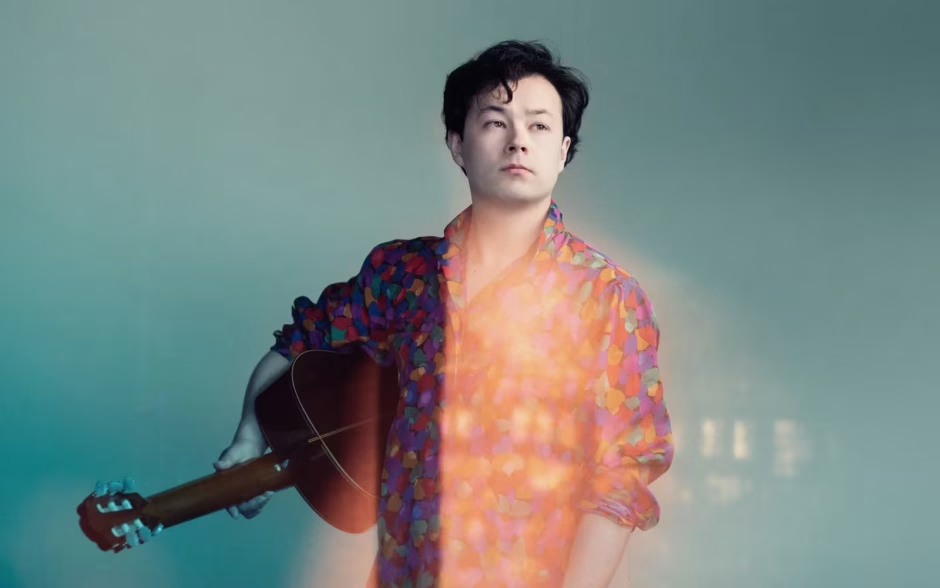
IN CONVERSATION WITH: Michael Buffong

Talawa – the UK’s leading Black British Theatre Company – is marking a significant milestone of 40 years in 2026. We sat down with Michael Buffong, Artistic Director at Talawa Theatre Company.


How does TALAWA 86:26 celebrate 40 years of legacy while supporting the next generation of Black British theatre talent? 

We take a moment to reflect on the incredible journey taken over the past forty years. We create opportunities to honour our fore founders, and we work to establish a resource base that allows us to continue to nurture the next generation of great Black British talent.  

What role does the Mona Hammond Lecture Series play in connecting Talawa’s history with contemporary diversity and inclusion debates? 

The entire history of Talawa is built on creating space for our artists to exist and thrive, tell their stories in the manner they choose. To support their work, we have built a community of creatives that share this ethos. Part of doing this successfully requires having challenging conversations on the true state of our industry.  

Mona was a trailblazer who possessed an incredible clarity of vision — she told the truth and she told it boldly. We want to keep that spirit alive by sparking dialogue around some big themes that often are not spoken about out loud. Artist wellbeing is a huge area of concern and will be one of the first themes we explore in detail. 

How do movement and spoken word in Fragments of Us shape the storytelling of Black British experiences today? 

There are explicit and implicit expectations for Black men to move, speak or behave in a certain way. Vulnerability is still not a readily championed quality. This work explores and challenges some of the stereotypes around a young Black man and his ability to connect with outré art forms. 

How does Talawa nurture emerging writers and performers while maintaining its signature adventurous spirit? 

We empower artists to shoot for the moon, punch above their weight. That is the essence of “Talawa.” It’s about providing a safe space where artists feel free to fully explore their ideas, without fear of judgement or failure. We have historic programmes such as our young people’s theatre workshop (TYPT) and Talawa Firsts that to this day provide unique opportunities for emerging artists. 

With productions like The Black Jacobins, how do you ensure historical stories of resistance stay relevant for modern audiences? 

These themes are endlessly recyclable because human nature hasn’t changed and we often fail to learn the lessons of history. The art is a mirror of society as we see it. 

I think it’s important to be aware of our history and historical figures such as Toussaint L’Overture. In doing so, we reveal the huge challenges we have overcome but also learn how to avoid repeating some of the mistakes of the past. 

Looking ahead, what are the next steps for Talawa in championing Black talent and shaping British theatre’s future? 

Creating bigger stages, attracting better funding, platforming more fearless storytelling. 

REVIEW: Guildhall Studio Ensemble with Snowpoet


Rating: 5 out of 5.

A breathtaking collision of jazz, electronica, and orchestral brilliance


The Guildhall Studio Ensemble’s collaboration with Snowpoet is nothing short of extraordinary; The immersive evening expands an already rich material into something even more emotionally charged and sonically expansive. Guildhall Studio Ensemble with Snowpoet is what happens when exceptional composition meets fearless reinterpretation. 

From the moment you step into the Milton Court hall, a full orchestra stretches across the stage, framed by a softly glowing silver disco ball, while round light bulbs flicker gently in and out, adding a subtle sense of movement throughout the performances. The audience is diverse in age, and with hardly an empty seat, there’s an unmistakable buzz of anticipation.

The first half is led by the students, divided into two alternating ensembles, each bringing a distinct character to the stage. What’s especially charming is their individuality, not just musically, but visually too. Each performer wears their own outfit, reflecting their personality and adding a sense of informality and authenticity to the performance.

The first group, fronted by vocalist Rosa Witts, delivers a fuller, instrument-heavy sound. Opening with Alive With Closed Eyes, they immediately set a high standard. Rosa’s voice is both powerful and nuanced, drawing you in with ease and carrying the piece.

In contrast, the second group leans into a more stripped-back feel. With four vocalists at the forefront, their take on Little Moon Man feels intimate and layered, the voices interweaving. Each singer brings something different, and together they create a sound that feels cohesive yet textured.

As the two groups alternate, the programme gains a natural momentum. A Chance to Hear the Rain and If I Miss a Star give Rosa another chance to take centre stage, the latter building into a standout moment where each instrument briefly steps forward before the music opens into an energetic and absorbing jazz section. The second ensemble responds with equally compelling interpretations of Skin and Facetime, marked by inventive arrangements and strong vocal character. Urtė Ginėlevičiūtė in particular leaves an impression, her distinctive tone cutting through with an unconventional edge.

The half concludes with Host Reprise, bringing both ensembles together into a playful collaboration, closing on a high before the interval.

After the interval, the ensemble returns dressed in coordinated black, giving the stage a sense of cohesion, before Lauren Kinsella and Chris Hyson step in – Kinsella in a vivid pink dress, Hyson in an oversized shirt – bringing the focus back to Snowpoet’s character.

From here, the music feels less like a set of songs and more like something being reshaped in real time. The jazz roots come forward naturally, with a looseness in rhythm and a confidence in the improvisation that gives each piece space to unfold. With such a large ensemble, the sound expands with a cinematic sweep. 

Tracks like Waves and Tenderness stretch into wide, almost film-like landscapes, while The Therapist / Under the Tree moves delicately between vulnerability and strength. There’s a clear sense of growth in these performances, especially in the newer material, where themes of family and parenthood bring a sense warmth and reflection.

What’s most striking is how well this music holds up at this scale. Instead of losing its intimacy, it feels deepened with each detail refracted through the ensemble without losing its core. The mix of jazz, ambient textures and orchestral colour creates something that feels both close and expansive at the same time.

By the time Roots closes the set, there’s a real sense of connection across the room with the musicians and audience in sync. It lands less like a finale and more like a shared moment that’s been building all along. 

This was a one off show by the Guildhall Studio Ensemble and Snowpoet at the Milton Court Concert Hall on Friday 27th March 2026. 

REVIEW: An Evening With Gregor Fisher


Rating: 5 out of 5.

Fisher’s flair for storytelling and absurd humour had the audience in fits of hysteria


Fans filled out the theatre as legend of stage and screen Gregor Fisher sat with Nigel West to discuss his life, career and everything in-between. Having always been known for his sly wit and particular brand of Scottish humour, Fisher hasn’t missed a beat and is just as funny as ever.

Before discussing his famous roles or really anything about his career, he reminisced over his childhood growing up in Scotland. From tales of almost drowning in sewage after taking unnecessary shortcuts to his multiple attempts to skive school, Fisher painted a vivid picture of his early days of mischievousness. However, he also delved into conversation regarding his relationship with his mother and recanted the interesting tale of asking where he was baptised. A conversation about family baptisms, young Fisher did not expect to be met with silence when posing the question, especially after asking as second time. Choosing to “give it up as a bad habit”, Fisher left the topic alone until his Mum knocked on his door one day (a very uncharacteristic action in a house where people came and went as they pleased without much concern). Fisher re-enacts the bashful way in which his Mum sat down with him and told him that the reason they didn’t know where or if he was baptised was that he was adopted. This came as quite the shock to the 14-year-old and it was never spoken of again. When West asked him how he took the news and if it caused him to act out in any way, Fisher admitted that there were times after where it could have caused him to be less than kind to his Mum which he states, “I’ll bitterly regret till the day I die”. It is clear though how much love and affection he had for, stating as the evening went on how she would always come to see him in any stage work he did. He also gave the audience an anecdote about what was said the first time she met his wife, Vicki Burton. Ever the impressionist, Fisher did his best version of her voice as he quoted, “Aren’t you aiming a bit high?” 

It all worked out though as the two were eventually married, even if West did playfully hint that “she gave him the runaround” for a while beforehand. The two met on a production of A Midsommer’s Night Dream, with Fisher going on to do various other stage roles in productions such as The Importance of Being Earnest, Chitty Chitty Bang Bang and The Wizard of Oz, the show that led to Fisher and West’s first encounter as the director hired him to play The Cowardly Lion. We were even treated to renditions of songs from both these musicals, showing that despite his claims he took these jobs as “tax breaks”, he still remembers the work fondly. That was not the only rogue joke made about his past work as Fisher candidly referred to the popular rom-com Love Actually as a “skidmark”. Despite not believing much in the script, he seemed to at least enjoy his time spent with his fellow actors on the project.

Fisher’s most famous role, of course, is playing the titular character in iconic Scottish sitcom Rab C. Nesbitt. When asked why he thought the show worked, he mentioned he’d never quite understood the how or why. He spoke about how if people could work that out, “they’d have the Holy Grail for good television”. This prompted and audience member to loudly exclaim, “YOU ARE THE HOLY GRAIL!” This was a sentimental moment in the evening and while Fisher seemed to slightly play up his emotion for laughs, it was clear to see he was genuinely touched by this comment. That character absolutely still lives in people’s hearts as when West turned to the audience for questions, many revolved around the hit show. When asked if he would ever return and if the character would still work in this day and age, his response was “Never say never”. A more specific question revolved around whether there were plans for a skit involving Rab following the Tartan Army to this year’s World Cup. Though he hadn’t thought of it, Fisher was quick to mention that this was a very good idea, even stating he may pitch this. Another idea he appreciated, in which the entire audience were in sound agreement, came from one of the final audience questions in which a woman asked if he “could save us and finally give us a good Hogmanay this year”. Having only recently returned to living in Scotland after living in France for several years, Fisher was unaware of the dire state of Hogmanay television, a sentiment held by all. Hearing this plea, he simply said,” I’ll write to them”. Perhaps Hogmanay celebrations may be saved after all.

Overall, Fisher’s roguish charm and at times self-deprecating humour made for a night of laughs and stimulating conversation. The way he did small character bits here and there as well as impressions of friends and family really added to the night. It was truly delightful to hear about the life of a true Scottish legend, not only as a reminder of how much he has contributed to the craft over the years but to see how much he still has to offer. 

It’s arguable that even for those who aren’t longtime fans, they could have sat in that room and been turned into one just listening to Gregor Fisher talk. For those who are, this tour won’t disappoint.

REVIEW: Sea Shanties


Rating: 3.5 out of 5.

A surprisingly restrained journey through the history of the sea shanty


Sea shanties erupted into the public consciousness with Nathan Evans’ TikTok rendition of Wellerman deep in the COVID-19 pandemic. It’s not hard to see how a genre focused on bringing people together felt particularly resonant at a time of such separation. But long before TikTok, the sea shanty was a musical mechanism for co-ordinating the manual labour of sailors; ensuring everyone was pulling in the same direction (literally).

Fans drawn in by the compulsive percussion of Wellerman and propulsive vocals in Assassin’s Creed: Black Flag will be surprised by The Manchester Collective and Sean Shibe’s interpretation. Here, the sea shanty becomes a more melancholy, restrained beast. Charting a course across 500 years – from Dowland and Purcell to the contemporary – much of the repertoire is instrumental, with restrained percussion. It’s a beautiful sound, but an unexpectedly reserved one. Interleaving a few more crowd-pleasing numbers would make for a more engaging experience.

The first half of the show evokes the soundtrack played as you enter the tavern in a pirate video game, for both good and bad. It’s a pleasant, often beautiful sound that periodically erupts into something more evocative. But it also feels like accompaniment rather than the centrepiece. The musicians’ performances are accomplished and adept, but it feels like something else should be happening alongside them.

In its second half, the show becomes more playful and takes more risks. Its earlier stuffiness evaporates. Beibei Wang’s percussion is transformative, and Jonathan Morton pulls out wonderfully haunting sounds with every bow stroke. The audience contribute their own chant (“Ho, Row”) to Donald Grant’s arrangement of the traditional Scots Gaelic Ailein Duinn, a nì ’s a nàire (Brown-haired Allan, alas and alack) – this desperately sad piece about a whole family lost at sea is irresistibly rhythmic, and a clear highlight. It echoes around the room and into the very soul.

The performance culminates in the world premiere of Ben Nobuto’s Arksong. It was said that, with the rise of steam-powered ships drowning out the singing, “steam and music are irreconcilable”. Nobuto captures this as a tug-of-war between dissonant (yet strangely compelling) sound and his musician’s skillful fluidity. Wang’s voice beats out a series of orders, jerking the musicians into mechanical motion; later, humanity wrestles back agency and control. This is music as performance art, contrasting with the reserved performances of the show’s first half and ensuring the audience leaves energised and happy.

Shibe and Grant provide background on the upcoming songs between sections, including discussion of original lyrics – a piece based on a Kipling poem about supply ships, written just before the outbreak of the First World War, stands out. Grant acknowledges the unexpectedly dreary tone of the first half. But recognising this dissonance isn’t enough – interleaving some more popular shanties would have elevated the whole performance through its contrast. As it is, the audience would be forgiven for feeling a little tricked by the show – it’s a strong and interesting set of performances, but not what was expected going in. The show never quite reconciles this expectation and reality. It isn’t toe-tapping, but it is undeniably beautiful.

This was a one-off performance at The Southbank Centre. More shows from The Manchester Collective, who perform around the world, can be found on their website.

REVIEW: Chaos


Rating: 3 out of 5.

A slick, frenetic scratch night blending a bizarre array of stories


Chaos at the Pleasance Theatre is an innovative and slick version of a scratch night. From Long Nights Productions (Jack Medlin, Theo Collins, and Sarah Chamberlain), Chaos consists of nine performances, blended together, in a cabaret-esque setting. It’s certainly ambitious, and it’s unusual, even for a scratch night.

Naturally, given its context as a scratch night, the pieces themselves vary drastically in quality. It’s a little challenging to comment on the overall theatrical experience because each piece is so disparate from the others; the challenge is to shield yourself from the tonal whiplash. And there’s no unifying theme – despite chaos, I suppose – but chaos is not a conceit in and of itself.

The show opens with one woman pouring vodka into a carton of orange juice, before she is harassed by the door, and watches as two women drag in a body bag. Quickly, the stage setup is pushed about, and so begins a piece about a child and an obsessive neighbour (also a child). At some point, a monologue was delivered from the perspective of a vengeful Scottish toilet. Then we were whisked to the peak of a mountain where a bunch of queer youths stood in line for a Berghain-esque club, just with the added peril of being atop a mountain. There was also some attempt at Clown concerning a series of backpacks.

Some of the writing was accomplished: I enjoyed Barney Doran and Anna Fenton-Garvey’s performance and writing as the ruthless non-binary clubbers. And the four women sharing pastries in their hostage situation was a highlight. However, as an overall theatrical event, it struggles to captivate. Without any perceptible binding conceit, it’s a struggle to invest yourself in any of the pieces or gain any sense of pattern recognition. And in the absence of thematic unity, the context of ‘chaos’ loses any architectural meaning.

I would probably argue that not everything is a theatrical opportunity (see: the Scottish toilet – he kills his male philandering owner in a self-righteous fury). There was also an ethically dubious piece about an Italian restaurateur’s Japanese wife who turned out to be a lifeless doll.

The set design (Geneve Chu) is commendable; the transitions are smooth, and the space is imaginatively understood. For a scratch night, it is extremely organised; it’s reassuringly structured. The band (LA Family Trio) is a fun accompaniment, and the lighting (Aaron Molloy) is well deployed. But the pieces themselves – and the organising concept – fail to engage and lack the satisfaction of a more conventional piece of theatre. As a scratch night, of course, the intention is not to create one unified story, but it is a struggle to care about any of the stories or characters within this setup.

REVIEW: Jaja’s African Hair Braiding


Rating: 5 out of 5.

a lesson in excellence and a phenomenal story rooted in culture and relationships


Jaja’s African Hair Braiding is an incredibly powerful production that exemplifies excellence in every way. From stagecraft to design to music, the show is a masterclass in production quality, a direct example of how passion and storytelling can be seamlessly integrated.

At its heart, the play offers audiences an intimate glimpse into the lives and relationships of women working in a Harlem hair salon. What playwright Jocelyn Bioh does so beautifully is craft small, vivid moments that allow the audience to fall in love with each character. These aren’t huge moments more than it’s in the banter, the humor, the tension, and the honest confessions. Each woman is navigating her own sense of self, her exhaustion, her dreams, yet need and crave another through shared womanhood and connection. As many of the characters are African immigrants, the play also highlights the deep longing for familiarity and sense of home, something they find in each other despite different cultures and opinions. 

The world of the play is brought to life with striking authenticity. Set designer Paul Willis creates a Harlem salon that feels lived-in and culturally rich. Adorned with vibrant African flags, posters of intricate hairstyles, and bursts of color, the set pulses with identity and pride.

Director Monique Touko stunningly weaves together every performance element. The movement direction by Kloé Dean and sound by Tony Gale keeps transitions fluid and engaging, drawing the audience in without distraction. Even the act of hair braiding, a pivotal aspect of  the story, is executed with such precision that changes happen almost invisibly. Every element of Bioh’s script is handled with such care and detail.

What makes culturally rooted plays so interesting is how differently audiences may connect to them especially those who are unfamiliar with the culture. As the play is grounded in the experiences of African women in America, it still holds a familiarity with the global Black female experience, touching on identity, survival, ambition in ways that feel universal. On press night, the audience was surging with laughter, comedy, joy and excitement despite their personal connections. That’s the beauty of Bioh’s work, it’s just human.  

As an ensemble-driven piece, the performances are exceptionally strong. Every actor serves the story with intention and excellence. Jadesola Odunjo brings depth and nuance to Miriam, balancing fear, motherhood, sacrifice, and resilience with remarkable ease. Her arc is handled with sensitivity and strength. Bola Akeju is a commanding presence as Ndidi, embodying both authority and care with a grounded confidence that fills the stage. Renée Bailey delivers sharp comedic timing, bringing levity and energy at just the right moments.

One of the most dynamic relationships in the play is between Bea (Dolapo Oni) and Aminata (Babirye Bukilwa). Their connection feels deeply authentic, two women bound by dependence, and love, yet unafraid to clash. Their exchanges are honest, messy, and refreshingly real, capturing the complexity of true relationships. Across the board, the ensemble operates in harmony, fully inhabiting the same world.

Though the show is relatively short, it leaves a lasting impact. The ending is bittersweet, echoing the realities of immigrant life and the sacrifices that often go unseen. More than anything, this production stands as a testament to womanhood, to African and African American culture, and to the resilience it takes to keep pushing.

If you’re looking for a production that not only tells a story that’s enriched with culture and history but teaches you something about storytelling itself, this is not one to miss.

REVIEW: Flora


Rating: 5 out of 5.

A powerful, ceilidh-charged celebration of Scottish history


There’s something really special about a show that feels completely rooted in where it comes from, and Flora absolutely does. Performing at the Pavilion Theatre in Glasgow, this new musical doesn’t just tell a story, it celebrates Scottish heritage in a way that feels fresh, alive, and genuinely exciting. From the moment it  begins, there’s a real sense of energy and purpose that carries right through to the final moments. 

Written by Belle Jones and directed by Stasi Schaeffer, the production feels clear in its vision and confident in its  storytelling. Most people know Flora MacDonald for helping Bonnie Prince Charlie escape, but this show goes  much further than that. The first act gives us the story we recognise, while the second act digs deeper into what  came next, showing the reality of her life beyond the legend. It adds real depth and makes the story feel far more complete. 

The decision to split Flora into two (Junior and Senior) is such a strong creative choice. Karen Fishwick brings  energy and determination to Flora Junior, while Annie Grace gives a more grounded, reflective performance as  Flora Senior. There’s a real sense of contrast between them, but it works beautifully and helps show the full  journey of the character. 

The wider cast are just as impressive, particularly in how they move between acting and playing instruments  throughout the show. It’s a demanding setup, which adds to the energy and creates a strong ensemble feel. A  special mention has to go to Lana Pheutan as Annabelle/Lady Sleat, who brings a real presence to the stage and  stands out in every scene she’s in. 

Musically, the show is a real highlight. With music by AJ Robertson and John Kielty, the score blends traditional  Scottish influences with a modern edge, creating something that feels both authentic and accessible. The live music element adds so much, especially with the cast being so involved in creating the sound on stage. There are also moments of rhythmic, almost spoken storytelling that give it a contemporary feel without losing its identity. The use of Gaelic alongside English adds another layer and strengthens that connection to Scottish culture. 

Visually, the production is simple but very effective. The costumes, overseen by Head of Wardrobe Jenny Lööf, feel authentic to the period while still allowing the performers to move freely between scenes and musical  numbers. Everything has been curated to serves the story. 

Benny Goodman’s lighting design also plays an important role in shaping the atmosphere. It shifts smoothly  between the more intimate moments and the larger ensemble scenes, helping guide the audience through the story. At times it creates a real warmth, especially during the more communal, ceilidh-style sequences, and at others it sharpens the focus for the more serious moments. 

What really stands out is how well everything comes together. The performances, music, and staging all feel  connected, creating a show that’s easy to get lost in. There are moments where it genuinely feels like you’re part of the experience rather than just watching it. 

The tone is well balanced throughout. There’s humour and lighter moments, but they sit comfortably alongside  the more serious themes of war, survival, and identity. It never feels too heavy, but it also doesn’t shy away from the reality of Flora’s story. 

By the end, it’s hard not to feel completely swept up in it. Flora manages to be both entertaining and meaningful,  which isn’t always easy to get right. It feels like a show that knows exactly what it wants to say and delivers it with confidence. 

This is more than just a musical, it’s a celebration of culture, storytelling, and identity. If you get the chance to see it, don’t hesitate. It really is something really special.

IN CONVERSATION WITH: Lizzie Klotz


Lizzie Klotz is a dance artist, choreographer and facilitator based in Gateshead.
Rooted in care, play and embodied connection, Lizzie’s practice spans work for theatres, outdoors, galleries and film, unfolding across local, national and international contexts.
Often made in collaboration with artists and communities, her work is underpinned by inclusive processes that create accessible and meaningful experiences for participants and audiences alike, where people feel seen, valued and connected to their own power.
Abundance is her upcoming work, created in collaboration with the creative team.

Abundance will premiere at Dance City in Newcastle on Thursday 2nd April at 7.30pm, before touring to Queen’s Hall in Hexham on Wednesday 22 April at 7.30pm and Alnwick Playhouse on Friday 25 April at 12.30pm.


Abundance brings together dance, installation, music and communal gathering.
Where did the first spark for this body of work come from?

The work began through conversations – asking people what abundance was to them. Early on, I worked with Dance City’s over-55 company, Boundless, creating a 10-minute work built from images and moments that felt abundant, such as an empty supermarket aisle, fields of rapeseed, and a black hole.

Those ideas stayed with me, and later, during a MotherOther residency at The NewBridge Project for parent and carer artists shortly after the birth of my second son, I found myself returning to them. It was a moment of reconnecting to my practice after several years of early motherhood, and I realised there was more to say – particularly about how abundance sits alongside care, labour, joy and exhaustion.

From there, the work expanded into a multifaceted project, creating different ways for audiences to encounter and connect with it.

The performance includes both professional dancers and local volunteers. What has it been like to create a shared movement language across different experiences of dance?

A significant part of my practice is bringing together professional and non-professional dancers, and I’m particularly interested in the processes and performances that emerge from working in this way.

The process for Abundance has always begun with conversation – reflecting on what abundance means to us – followed by improvisation rooted in those reflections. Regardless of experience, I’m interested in what comes instinctively to each individual dancer, and how we can build from that. I tend to lean into what works, rather than pushing towards something that feels out of reach for anyone in the work.

Because of this, the material holds traces of each performer – their instincts, histories and ways of moving. Over time, we’ve developed a shared language, using prompts like messy, joyful, meditative, expansive and restful.

There are moments where the movement aligns and becomes quite similar, and others where performers move more freely – and those differences are really visible. That contrast feels important, holding individuality and not asking performers to be anything other than who they are.

It’s important to me that this feels like a genuine collaboration, and that there is a real sense of cooperation within the process and the performance. Everyone remains on stage throughout, and each role reflects the performer’s interests, capacities and personality. The aim is that everyone feels ownership of the work and a sense of power within it.

Colourful duvets play a central role in the visual world of the piece. What drew you to these objects as both practical and symbolic elements?

Duvets are such familiar, intimate objects – they hold rest, comfort, illness and care. I was drawn to how they can transform space so quickly, and how they carry both existing meanings and the potential for new ones.

In the work, they become playful, and sometimes places to hide or rest. They create a shifting landscape for the dancers, supporting both stillness and movement, and begin to take on a presence of their own, like additional performers in the space.

Seeing different bodies – particularly older bodies – playing, resting and moving with the duvets feels significant. It gently reimagines who gets to occupy space in this way, and how play can exist across a lifetime.

A young audience member at a previous work-in-progress said they wanted to go home and dance with their duvet too. That was a real win!

How does live music by Jayne Dent shape the atmosphere of the performance?

Jayne’s music creates a shifting, immersive atmosphere that frames the journey through the work.

She works with electronic sound that moves between extended drones, rumbling textures and harmonious tones, layered with open, lulling vocalisations. It brings a live, responsive quality that allows the work to breathe.

There’s an ongoing negotiation between sound and movement – moments where we move with the atmosphere she creates, and others where we gently resist or disrupt it.

Jayne draws on her wider practice as a musician, Me Lost Me, as well as her research, which she is currently developing through a PhD at Open Lab in Newcastle University’s School of Computing.

She has also adapted a duvet using e-textiles, connecting it to her equipment so it can be played like an instrument, bringing her physically into the world of the work.

What kinds of feelings or reflections are you hoping people might carry with them after encountering Abundance?

I hope people leave with a sense of permission – to pause and to rest, and to experience a sense of softness and possibility. It’s about creating space for reflection rather than offering a fixed answer.

It’s a work that holds a lot of feeling, which reflects how I navigate the world. It’s a kind of knowledge that sits in the body. I hope audiences feel washed over by a sense of abundance – something that feels like an act of self-care.

There’s also something in it about how we think about age – who gets to perform, who gets to take up space, and how that might shift. That feels quietly political.

If audiences leave feeling a little lighter, more open, or more connected to themselves, that feels meaningful.

REVIEW: Mysteries: Beethoven and Mozart


Rating: 5 out of 5.

Sinfonia Smith Square discovered unity in mystery


Performed by the talented fellows of Sinfonia Smith Square, ‘Mysteries: Beethoven and Mozart’ was a dazzling contribution to the London Festival of Chamber Music. The programme opened with Beethoven’s Cello Sonata No.5 in D major, Op. 102 No. 2, an introspective and experimental work typical of his late style, followed by Mozart’s Sinfonia Concertante, a lively piece composed during the young Mozart’s tour of Europe (1778-1779). Juxtaposing Beethoven’s late style with Mozart’s youthful voice proved particularly compelling in performance. After the interval, the programme then returned to Beethoven, concluding with his Triple Concerto for Violin, Cello, and Piano in C major, Op. 56, written in the early 1800s as the composer began to go deaf. 

In the capable hands of cellist Paul Watkins and pianist Alessio Bax, Beethoven’s Cello Sonata No. 5 was a captivating experience. The Allegro hinted at a delicate rapport  between the two performers, while the ensuing Adagio was soft, sensitive and positively dripping with dynamic contrast. In a venue like Smith Square Hall, with its  grand Corinthian columns, lofty ceilings and sweeping golden chandelier, the effect was enchanting. Every sustained legato filled the hall, commanding the space with a sombre grace. The Allegro, too, had real character, with the faster pace allowing for a  little extra flourish from the pianist.  

Moving into Mozart’s exuberant Sinfonia Concertante, the interplay between violinist Alena Baeva and violist Lawrence Power was just as impressive. The pair were remarkably responsive to one another throughout, creating an intimate dialogue that was fascinating both aurally and visually. Far too often, the poor viola is on the receiving end of a great many mean-spirited jokes while the violin steals the spotlight, but in Sinfonia Concertante, the viola and the violin share the spotlight as co-soloists in  conversation with the orchestra. Alena Baeva and Lawrence Power embraced this rare opportunity, offering up a feast of coy exchanges that felt deliciously flirtatious.  

It always makes such a difference when you can feel the performers enjoying  themselves on stage, completely engrossed in the music. Baeva and Power should be applauded for their presence. The orchestra, in turn, matched the soloists’ energy,  driven by the exacting baton of conductor Paul Watkins, who was practically jumping up and down in the final bars of the Presto. This momentum then carried seamlessly into Beethoven’s Triple Concerto, producing a unified sound that was fittingly majestic. Right up until the final Rondo all Polacca, every performer was beautifully in sync with one another, listening and responding as one; it was this unity between musicians that ultimately made for a very special concert. Brava, really.

IN CONVERSATION WITH: Maz McGinlay

We sat down for an exclusive interview with Maz McGinlay who plays Dr Jess Irvine in this captivating and soul-stirring new musical infused with nostalgic Scottish folk sounds and foot-stomping rhythms.

Lifeline runs from 28 April to 2 May at Southwark Playhouse Elephant. Info here.


LIFELINE spans love and a looming global crisis — how do you keep it feeling intimate rather than overwhelming?

I think focussing on the human aspects of the show is what keeps it from feeling overwhelming or something we can’t get our heads around, which is easy to get lost in when dealing with a heavy subject. The show hits relatable topics such as grief, loss, discovery, love, family and best of all hope. 

With real-life medics on stage, in what way will the show land differently for you each night?

Naturally with a wonderful group of real life medical professionals each week, the show will stay fresh and exciting for all of us involved. These people are incredible humans who have given up their time to join us on stage, and what each of them do professionally is entirely different. As actors it’s our job to respond to that authentically.

How do you navigate jumping between 1950s Scotland and present-day Edinburgh as a performer?

My role in the show only deals with the modern day story, but it’s actually quite lovely to leave the stage in a pair of scrubs then pass someone entering into a new scene in period style costume. It’s so unique in that way and hopefully by the end, the worlds will meet in a clever and artistic way.

This is science-led but emotion-driven — where do you find your way into it?

Yes the Science is incredibly important and relevant to this story, but can also be polarising if you don’t quite understand all the technicality of phrases etc….. I definitely don’t! However, at the heart of the story is the real- life human emotions of what each of the characters is going through. Science like-minded or not, that is something we all relate to. Whether it be heartbreak, falling in love, grief, loss, laughter.  We all understand that. 

What feels different about working on a piece that’s still evolving and so tied to real-world stakes?

I definitely feel the weight of telling the story in the most authentic and clear way. It’s a topic that needs to be heard and understood by everyone around the world, and what better way to do it than in art form. And how lucky we are to have real life medical professionals who face Antimicrobial Resistance (AMR) every day, to help us in doing that. We’ve also been lucky enough to have an incredible creative team who are open minded and malleable at every corner.

What’s this show revealed to you about the power of “ordinary” people?

No one is actually ordinary. And when working together especially, we can achieve extraordinary things.