IN CONVERSATION WITH: Brendan Murray

A tender but unflinching look at the messy complexity of love, lies, loss & sexuality, Learning How to Drive tells the story of three people facing the reality of what it means to truly know someone. We sat down with award winning writer, Brendan Murray, to discuss their upcoming production. Learning How to Drive plays at the White Bear Theatre 10th – 21st February. Tickets are available here.


Learning How to Dive explores the shock of discovering you never fully knew the person closest to you — what first drew you to that emotional fault line as the heart of the play?

The play grew out of my own personal experience of being “the other woman”. For over thirty years I’ve been having (and still am) what I suppose you’d call an affair with a married man. I know just about everything about his life and family but (as far as we’re both aware) they know nothing about me or our relationship. In the play, Barry (the fictionalised version of my partner) dies and Matt – one of his sons – discovers that his adored father has had a second, secret life, and Jill – his widow – comes to realise the woman she thought her husband had been seeing for years was/is in fact a man. 

How did you approach writing about grief and hidden sexuality without allowing either to become a “reveal,” but instead something quieter and more human?

As I’ve said, the play grew out of my own experience / story – and, as a gay man of nearly seventy, I was also part of the generation touched by AIDS. I lost several friends – three of them former partners – to the disease, so death / grief / loss / sexuality have long been recurring (albeit sometimes tacit) themes in my work – even my work for children. For me, these things are part of the fabric of my life and experience, not mere dramatic devices. 

The play spans love, lies, and memory across generations — did your perspective on these themes change as you revisited playwriting after so many years?

For the past thirty-five years or so (after I stopped acting) I’ve been a writer first, director second and teacher third. Of course, you fall out of fashion / the people who commissioned you retire or die but I’ve never stopped and, happily, my back catalogue continues to be produced both in the UK and (even more so) in Europe and the USA. Of course, over the years (living / loving / losing) your perspective shifts. Maybe you become more forgiving, more interested in character / less in plot. It’s no coincidence that my favourite playwright (bar none) is Chekhov. 

What felt most different, or most confronting, about returning to the stage as an actor in a story you also wrote?

It’s true that I stopped acting in the late 80s, but I never moved away from theatre / the stage. I wrote for the stage / for actors. I directed plays / actors and – maybe most importantly of all – I taught acting at several London drama schools. I thought long and hard about acting and what it means to be an actor. In many ways my teaching was based on / a reaction to all the things I felt I’d done wrong when I was starting out. Coming back to it after nearly forty years (in a semi-autobiographical play) I worried about things like remembering lines (could I do it anymore?) but feel strangely liberated. I’m not building a career / don’t need people to like me. My ego is no longer an obstacle. I can just listen / respond / be. 

The piece is described as tender yet unflinching — where did you feel it was most important not to soften the truth for the audience?

The piece is based on / explores / invites the audience to reflect on / respond to the messy complexities of life / love / loss / lies. Warts and all to coin a cliché. It felt important to write from the heart – the positives / the negatives, the beauty / the mess of it / the truth. I wanted the audience to identify with / feel the resonance of the story I was telling. Big things in the lives of small people / what it means to be human.

At its core, the play asks what it really means to know someone — after writing it, has your own answer to that question shifted?

I’m not sure I was looking for an answer (either for myself or the audience) but rather a better understanding. There’s a line towards the end of the first act where Terry (the lover) is talking to Matt (the son) about his now deceased dad; I think this might sum it up: I know it’s hard, some of the things you’re finding out – same here – but they were part of him. You can’t choose the bits you want. That isn’t love. 

REVIEW: The Woman In Black


Rating: 5 out of 5.

Minimalist, masterful, and terrifying. The Woman in Black reminds you why live theatre can still scare the life out of you.


The Woman in Black at the Glasgow Theatre Royal, lived up to its reputation as one of the  most effective pieces of theatre I’ve experienced in a long time. Sparse, clever, and deeply  unsettling, it proves that you don’t need elaborate tricks to truly frighten an audience, just  imagination, precision, and trust in the power of storytelling. 

The play follows Arthur Kipps, played by the wonderful John Mackay, a man haunted by a  traumatic experience from his past. Seeking relief, he hires a young actor, Daniel Burke, to  help him recount his story in the hope that sharing it will finally bring him peace. What  begins as a seemingly simple rehearsal slowly and horrifyingly transforms into something far  more real, for both the characters and the audience. 

John Mackay gives a compelling and grounded performance as Mr Kipps. His portrayal  captures the emotional weight of a man desperate to rid himself of painful memories, and his  gradual unravelling feels authentic and earned. Mackay handles the psychological intensity of  the role with impressive restraint, allowing the fear to creep in quietly rather than forcing it  upon us. 

Daniel Burke, as The Actor, provides a perfect counterbalance. Initially confident, almost  dismissive, he brings a lightness and theatrical bravado that helps ease the audience in (which  only makes his eventual descent into terror more effective). The chemistry between Mackay  and Burke is crucial to the success of the production, and here it works beautifully, driving  both the narrative and the tension forward. 

Director Robin Herford’s vision remains masterfully simple. The minimalist approach places  complete trust in the performers and the audience’s imagination, something that modern  theatre doesn’t always dare to do. Scenes shift seamlessly, often in front of our eyes, and the  lack of excess means we are constantly alert- scanning shadows, listening for sounds, and  filling in the gaps ourselves. In a horror story, this is exactly where you want the audience to  be. 

Michael Holt’s set design is deceptively clever. At first glance, it feels almost bare, but it  proves endlessly adaptable, transforming from rehearsal space to eerie landscapes with subtle  changes. This flexibility enhances the feeling that reality is slipping, that the boundaries  between performance and memory are dissolving. 

Kevin Sleep’s lighting deserves special mention. It plays a vital role in building the  atmosphere, often revealing just enough, and no more. Darkness becomes a character in its  own right, and the careful use of light ensures that when something does appear, it hits with  maximum impact. The audience reactions around me included shrieks, sharp intakes of  breath, and moments of stunned silence, are all a testament to how effective this is. 

What makes The Woman in Black so powerful is its confidence. It doesn’t rely on spectacle  or gore. Instead, it understands that fear comes from anticipation, from what we think we see, 

and from the spaces left unfilled. As a result, the play lingers long after the curtain falls — not just in memory, but in feeling. 

Seeing this production at the Glasgow Theatre Royal felt like the perfect setting for such an  intimate and unsettling experience. It’s a reminder of what theatre can do when it strips back  to its essentials and fully commits to its craft. 

In short, The Woman in Black is tense, intelligent, and deeply effective. I loved it and I didn’t  feel entirely comfortable walking home afterwards, which I think is the highest compliment I  can give a ghost story.

REVIEW: Inspector Morse: House of Ghosts


Rating: 4 out of 5.

“A whodunnit done well!”


Alma Cullen’s adaptation of the characters of the Morse universe are given new life and breadth in this expansion to the story and new mystery. For any lovers of a good murder mystery sprinkled with some gallows humour then this is worth the watch.

Obviously, I don’t want to spoil too much of the plot here, where would be the fun in that? The play starts with a production of Hamlet, Justin (played by Spin Glancy) gives a soft and touching rendition to the well-known ‘to be or not to be’ speech. As Ophelia/Rebecca enters I found myself settling into the rhythm of Shakespeare with ease. During this section we are ‘ticked’ with the use of sound, hearing someone talking during the production. As the actors reacted to this, we are quickly reassured this is part of the show.

Then it happens, Rebecca doubles over, laughs, then collapses, dead. We’re thrust back into what we’re all here to see. Next, charging down the isle of the stalls comes the eponymous Morse (Played by Tom Chambers) and at last the mystery begins!

The creative use of the space was a refreshing touch, with actors appearing from the upper circle amongst other unconventional movements. A charming use of a projector to spin the audience’s perspective to view the scene from the back of the stage looking out to the seats was an interesting moment. The staging and scene changes for the piece were a little dizzying, with set changes being done by the actors with at such a pace that you feel the sense of urgency building. Along with this, a mildly Brechtian style of leaving the wings of the stage exposed did not detract from the piece at all for me, though whether the fit or distracted from the more naturalistic performance may not be to everyone’s tastes.

The cast gives a plethora of colour to the show, with some characters leaning heavily into the ‘larger than life’ personalities actors can be linked with ‘actor types’, though at times bordering on caricature. Verity (played by Charlotte Randle) particularly hit home for me as an eerie reminder to my theatre days. The relationship between Lewis (played by Tachia Newall) and Morse had a lovely back and forth, though there were a few times where Lewis felt a little too quick to anger than felt necessary.

There was a lovely touch in expanding more on Morse’s personal life that gave some heartfelt moments through the piece, with a mix of his romantic life and aspirations. This built the pity we feel for such a melancholic detective very well for me. Mixing this with his rather bitter outlook and dry wit felt like a good continuation to the character.

Overall, the piece gave a compelling plot that kept us guessing throughout, during the interval I found myself listening in to other people’s theories and who the murderer was. As with all good crime thrillers, the pieces all fall into place and we leave the theatre with a satisfactory twist to the tale. Whether or not you’re a Morse fan, I’d recommend this show for it’s touching drama and let’s face it, who can say no to a good mystery?

REVIEW: Safe Haven


Rating: 2.5 out of 5.

‘A focus on western diplomacy dulls a genuinely terrifying period of Kurdish history’


On the night I saw Safe Haven, there was a performance by Kurdish musicians prior to the start of the play, and the walls of the Arcola Theatre were hung with historic photographs showing the events the play seeks to retell, accompanied by some useful placard information. There was a clear amount of care given to this night that gave a real impression of centring the culture and lives of the Kurdish people who the play seemed to centre around. Written by Chris Bowers, a former British diplomat, the play has some great insight on the governmental process of diplomacy. He clearly seeks to shine a light on a minoritised history most forget, but this centering on western diplomats ultimately limits the play’s narrative capability.

The show follows Catherine (Beth Burrows), a diplomat working for the British government, trying to manage the aftermath of the first gulf war. Paired with Clive (Richard Lynson), the two work to try and figure out a way to protect the Kurdish people fleeing Saddam Hussein’s regime, two of which are Najat (Eugenie Bouda) and Zeyra (Lisa Zahra).

Lisa Zahra is an undoubtable standout in the show. Her performance has an adaptability and distinction that allows her to play both the wife of a diplomat (Anne) and a Kurdish refugee (Zeyra). Props must also be given to Beth Burrows, who handles the show’s narration with care, and Mazum Gül, who gives the story some of the urgency it needs, playing the real-life Iraqi diplomat, Barzan Ibrahim al-Tikriti, and real-life Kurdish activist Dlawer Ala’Aldeen. Gül does not get much stage time as these characters, which was surprising given the subject matter. It is unclear whether or not Catherine and Clive are real people also. 

Some design choices felt a little confused, with props left onstage and a split stage that didn’t always feel necessary. Scenes taking place between office furniture and garden furniture could have taken place on the same blocks, given the play’s already non-naturalistic design. This would have given more space to the storyline following the Kurdish women fleeing. During their scenes, it often felt like they were working around these sets, which was somewhat how the show felt as a whole. The stories of the Kurdish characters felt somewhat secondary to the story of the British diplomats. Seeing the process of diplomacy laid out was insightful, but this didn’t quite carry the same urgency as the plight of the Kurdish people fleeing Saddam Hussein’s regime, so having them side by side, felt like a jarring contrast. The focus on this diplomacy dulls what could be a far more gripping play. It would have helped to see how the movement around this mountain range was physically exhausting and restrictive for our Kurdish characters, but working around these constant sets of Western offices and garden tables made for a somewhat subdued environment.

At the end, Clive congratulates Catherine saying “It’s not everyday someone tries to stop a genocide”, presenting her kind of diplomacy as something sort of noble. But it is her paid job, and the sudden discussion between the two about working against or within the system would be an interesting angle if it had been explored throughout the play. Catherine drops a line about how many Kurdish people and children died during the pass through the mountains, which came as a total surprise, given this is not mentioned or portrayed at all prior to this conversation, which only comes after the safe haven has been formed and agreed to. 

It’s clear that Bowers has experience in diplomacy. The script is thorough to the point of overdensity. For someone well studied in politics and its functions, the show might be insightful. But for others, there is less focus on the human aspects of the play, even if they’ve been considered. Bowers’ efforts to include Kurdish characters in this narrative are appreciated, but incomplete. There is no stage time given to the Kurdish protestors who staged protests in London in 1991, occupying the Iraqi embassy, storming the Turkish one too. It is a bit of a travesty that the actions of those who were equally instrumental in getting the government to act are failed to be represented at all on stage.

REVIEW: GBSR Duo, For Phillip Guston at King’s Place


Rating: 4 out of 5.

There is no “right” way of listening to For Phillip Guston […] [it] is not just a listening exercise but a living one.


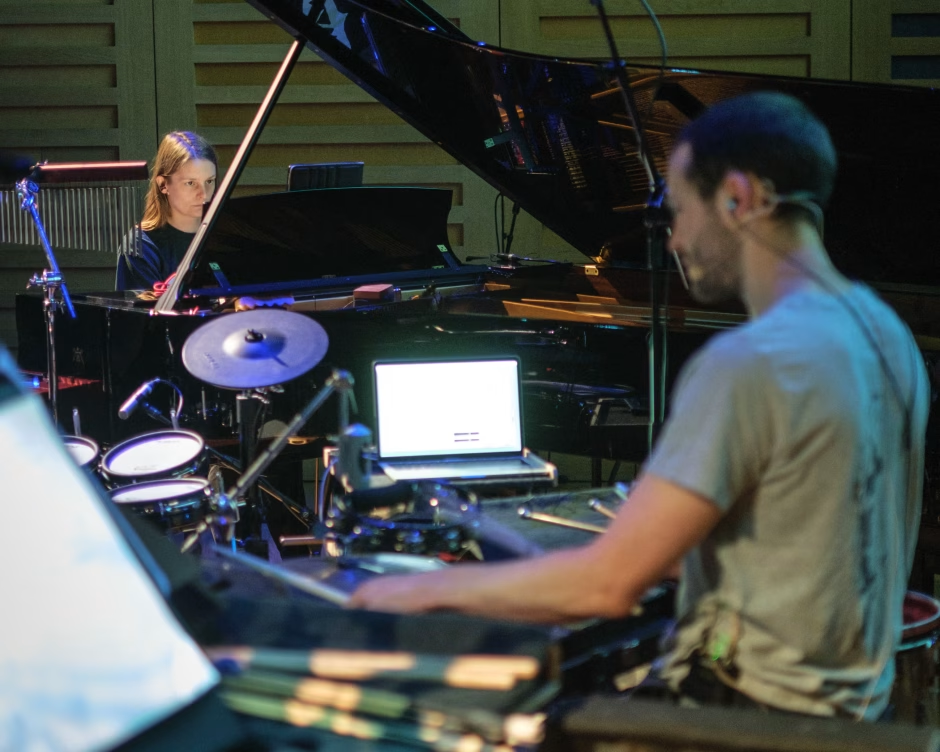
GBSR Duo, George Barton (percussion) and Siwan Rhys (piano), are one of the three artists in residence for Kings Place in 2026. Previously Kings Place has offered an annual series of award-winning performances surrounding a theme and this year’s programme is titled Memory Unwrapped; the series intends to get artists and their audiences ‘remembering the past to reimagine the future’.

The GBSR Duo have definitely a lot to offer the programme this year, their broad interest in 20th Century Modernism ranging from Stockhausen to Aphex Twin (a pairing which they are performing later this month at the Southbank Centre) affords an insightful and experimental take on the meaning of memory.

Their performance of renowned composer Morton Feldman’s single-movement work, For Phillip Guston, is a perfect example of their approach. Playing alongside Taylor MacLennan (flute, alto flute, piccolo) the ensemble took on the mammoth task of performing Feldman’s 4 and a half hour long composition with no interval. This performance is not for the faint of heart, not only is it a test of endurance (people complete marathons in less time) but it is also, aptly, a test in memory.

For Phillip Guston is a textured landscape of soft lasting sounds and motifs, whether it be from the tubular bells, celeste or piccolo the haunting range and duration of these phrases cause the ‘listener [to become] unable to retain everything they have heard […] unsure if they are hearing repetition, variation or new material’. Feldman’s composition is hypnotic, it is the deliberate desynchronising of the ensemble which gives an uneasy scale tipping quality to the beginning of the piece. Sounds between the trio are tipped back and forth in slow but constant motion, it takes some getting used to. Once you’re in, the experience becomes something totally unique and meditative in its journey.

There is no “right” way of listening to For Phillip Guston, I overheard an audience member say he had seen this piece once 15 years ago and “very sore bums” are to be expected. Throughout the performance I looked around and some people had shut their eyes, others nodded off. Fewer people than I expected walked out, there was continual readjustment of seating positions and someone, ridiculously, brought a baby which was quickly removed from the space. I definitely learnt something about myself during this rare performance. Focus, fatigue and curiosity came in constant waves. For Phillip Guston is not just a listening exercise but a living one, assisted by the fact that my watch had broken and my phone was off, I had no concept of time nor any idea of what four and half hours felt like.

Another clever angle this piece approaches memory from is the fact the work also serves as a memorialisation; a tribute to the close friendship between Feldman and the eponymous Abstract painter Phillip Guston. The pair became estranged in 1970, a decade prior to Guston’s death in 1980. Feldman felt betrayed that Guston had turned to figurative painting which in his mind was Guston effectively turning his back on the foundation of their friendship; their mutual love for Abstract Art and Music. They never reconciled. Yet the final half an hour of the piece feels hopeful. Its arrangement is more harmonious and pretty than previous parts and perhaps this is a slight sign of acceptance or reconciliation in grief.

Once I left the auditorium I honestly forgot what the piece sounded like, and I think that’s the point. The performance plays with your musical ear, constantly sounding both familiar and unfamiliar, blurring the lines between present and memory. For Phillip Guston is a listening experience unlike anything I’ve ever had before. As an audience member you are implored to immerse yourself in a long and intimate encounter with sound. The trio deserved the masses of applause for their discipline and focus. They performed this piece with such high fidelity and grace, it’s something I will never forget but I might wait 15 years to hear it again.

REVIEW: The RSNO’s Viennese Gala


Rating: 5 out of 5.

The RSNO delights, bringing Vienna to life through a fresh technological theme.


The RSNO believe that music can enrich lives and once again brought their Viennese Gala tour to The Beacon, delighting audiences with a fresh new theme. This year’s programme, centred on technological advancement and discovery, proved both imaginative and entertaining.

Each piece was carefully selected to reflect changing technological landscapes, from the advent of steam trains to the invention of the television by John Logie Baird. While conductor Derrick Morgan acknowledged that some featured composers were not alive at the time of these innovations, the musical choices remained thoughtful, cohesive and beautifully performed.

The gala paid homage to composers including Johann Strauss II, Rudolf Sieczyński and Carl Michael Ziehrer. The transition from Strauss II’s Electromagnetic Polka, written for an 1852 engineering students’ ball at the Vienna University of Technology, to Ziehrer’s Onwards! Into the 20th Century March, composed for the Concordia Ball in 1900, captured the spirit of the evening perfectly. The theme was further reinforced by Ruggero Leoncavallo’s Mattinata (Morning), the first piece written specifically for the Gramophone Company, later known as EMI. This also marked our introduction to presenter Jamie MacDougall’s rich tenor voice, which immediately brought a sense of calm and warmth to the hall.

The programme extended beyond Vienna, Italy and Denmark, with Scottish influences woven throughout. Malcolm Arnold’s Four Scottish Dances opened the second half and was executed with precision and flair by the RSNO. A selection of Scottish songs followed, all performed by MacDougall. Sleeps the Noon in the Deep Blue Sky stood out for its elegance and emotional depth, but it was his final number, Song of the Clyde, that resonated most strongly with the Greenock audience. As a local, I appreciated MacDougall’s clear affection for this piece and it made it a fitting and heartfelt conclusion.

A certain level of excellence is expected from a live orchestra, but such standards are never achieved without dedication and skill. In tackling works such as Strauss II’s By the Beautiful Blue Danube, the RSNO rose confidently to the challenge. Their closing performance of Johann Strauss I’s Radetzky March was equally assured, bringing the evening to a triumphant close.

Overall, the concert was a resounding success and a masterclass in orchestral performance. With a full calendar of engagements throughout the year and consistently high standards, the RSNO remain an ensemble not to be missed, whether at the Viennese Gala or beyond.

REVIEW: The Burns Project, National Trust for Scotland


Rating: 4 out of 5.

“We’ll tak a cup o’ kindness yet, For auld lang syne.”


With Burns Night right around the corner, the National Trust for Scotland brings this theatrical treat to the Georgian House in Edinburgh. Created by James Clements, who stars as Robert Burns himself, the show is accompanied by Lisa Rigby’s beautiful music inspired by Burns and directed by award-winning director Cora Bissett. Following its sold-out run at the Fringe in 2025, this production is the perfect way to get into the spirit of Burns Night.

Upon arrival at the Georgian House, we are welcomed by front-of-house staff member Robbie and given the opportunity to examine a 200-year-old book by Burns before entering the performance space. We then meet producer Tuesday McPhail, who explains the seating arrangements, which gradually become clear over the course of the one-hour show. The audience is gathered around a long, curving dining-room table, used creatively to drive the narrative forward. There are moments of audience interaction throughout, while Rigby sits in the corner of the room, accompanying the action with lively tunes that help set the tone for the evening.

The partnership between Clements and Rigby is a real strength of the production. They complement each other beautifully, bringing a sense of energy and cohesion to the performance. The show feels at times like a Robert Burns version of Six the Musical, exploring his past lovers and children from Burns’ own point of view. The dining-room table becomes a character in itself, its lights illuminating the folds and creases of the tablecloth, with clever use of table settings to support the storytelling and visual imagery. At moments, it feels almost cinematic, as though stepping into a Disney film.

Rigby’s soundtrack feels authentic and sensitively composed, setting the mood throughout, while Clements’ portrayal of Burns captures a wide emotional range as the poet moves through different stages of his life. From beginning to end, it is clear how much thought, care and passion have gone into this project, along with a deep love for Burns’ story and Scottish history more broadly. The performance also incorporates recorded voices, drawn either from Burns’ past or from discoveries made during the research process. These recordings add texture and commentary, offering insight into how Burns was perceived and introducing additional voices that enrich the narrative.

There is some gentle audience participation throughout, mostly involving Clements playfully selecting female audience members to represent Burns’ various love interests. This occasionally prompts amused looks of caution from their partners. For me, the show felt akin to an immersive experience you might find at the dungeons, but stripped back of darkness and fear. Instead, it offers theatre and history combined, retelling the story of a historical figure in a way that excites, entertains and captivates. With only a limited number of performances remaining and a waitlist filling up ahead of Burns Night on Sunday 25 January, this is one to catch if you are in Edinburgh and fancy an engaging piece of historical entertainment centred on Scotland’s most famous poet.

REVIEW: Aurora Orchestra with Brett Dean & Lotte Betts-Dean 


Rating: 4 out of 5.

A night of music that was philosophical, lyrical, and highly palatable.


Memory, the experience of the past being retrieved, reconstructed, and relished by the mind, is always about echoes and reverberations across time. It is the mind’s continual rewriting of the past: two points separated in time, yet intersecting and overlapping, reunited by the device of memory.

The programming of Aurora Orchestra: Memory with Brett Dean and Lotte Betts-Dean made this idea unmistakably clear. It was not only about selecting songs that explicitly speak of memory, but also about tracing echoes through time itself, from Ravel’s echoing of Couperin, from György Kurtág’s tribute to Robert Klein and Joannis Pilinszky, and through the thematic connection between Kurtág and Charles Ives’ compositions. These echoes also appeared in musical motifs and tonalities, as well as in the iteration of repertoire, with the same composer’s work performed twice and sometimes placed both at the beginning and the end of the concert. An echo of time.

The night opened with Charles Ives’ Memories, arranged by Sebastian Gottschick. The contrast between the two songs, Very Pleasant, light-hearted and playful, and Rather Sad, as its title suggests, created a wonderful juxtaposition in colour that immediately set the tone for the evening. From there, the curation expanded into Baroque music such as Couperin, while also embracing contemporary rearrangements of recent popular music, including Radiohead’s Harry Patch (In Memory Of). The programme then led us into more expansive and philosophical territory: the grand questions of life in Mieczysław Weinberg’s Marta’s Aria from The Passenger; an exploration of the modern psyche through György Kurtág’s Kafka Fragments; and the melancholic lyricism of Nadia Boulanger’s Versailles. Beyond musical versatility and the echoing of motifs, the curation offered a rich literary exploration of memory itself: memory as nostalgia, memory as longing for the loved one, memory as both personal and collective, and memory as a hopeful gaze towards the future.

The repertoire was curated in a way that felt highly accessible to the audience; even those unfamiliar with classical or contemporary music could enjoy it. The programme resembled a rich tapas spread, composed of distinctive yet carefully crafted small dishes. Each song or instrumental piece lasted only a few minutes, creating a constant renewal of curiosity and attention. This approach allowed for strong contrasts between pieces, as well as a vivid range of colours and emotions, from light-hearted playfulness to weighty, grand arias; from Kafkaesque intensity to hopefulness and joy.

Through the courage of presenting such a wide-ranging programme, spanning cultures, languages, and stretching across time, Lotte Betts-Dean and Brett Dean proved themselves to be audacious and masterful musicians, as well as thoughtful curators of a contemporary musical experience marked by forward vision and sensitivity to the audience of their time.

REVIEW: Woolf Works


Rating: 5 out of 5.

A gorgeous, immersive triptych that embodies Virginia Woolf’s life and writing through movement, light and composition. 


Olivier Award-winning Woolf Works returns as something genuinely rare: a revival that still feels alive, still feels discovered rather than dutifully revisited. Emotionally resonant and confident in its focus, Virginia Woolf’s sensibility is woven through every layer of the production, as though her prose has been absorbed into the atmosphere of the stage and re-expressed through bodies in motion.

Distilled from Mrs Dalloway, Orlando and The Waves, the ballet unfolds as a triptych: three distinct worlds that nevertheless feel rooted in the same interior terrain. Rather than illustrating narrative or text, the work translates Woolf’s writing – its rhythms, its poetry, its shifting perspective and lucidity – into composition, light, collective choreography. Stream of consciousness becomes physical: time layered and fragmented, meaning passing between writer and her work; memory carried through echoed and repeated movement.

The opening Mrs Dalloway section is particularly affecting. Identity feels doubled and echoed, with multiplied selves learning from one another, mirroring, supporting, carrying each other through joy as well as in harder times. There is a strong sense of companionship – across time, across inner lives – that seems to reach outward towards Woolf herself. The result is deeply moving, tender without sentimentality, and grounded in a sense of care between bodies. 

Throughout the piece, the dancers are asked for extraordinary physical precision and emotional restraint. McGregor’s movement language – elastic, angular, demanding – pushes classical technique into something sharper and more contemporary, while still allowing moments of softness and suspension. The performers meet this with clarity and control, creating a sense of collective intelligence rather than individual display.

The central Orlando panel breaks that intimacy open. Identity loosens and blurs; time folds in on itself; gender is slipped on and off, handed like a baton across centuries. This section is more playful, faster, more volatile – choreography and design moving in sync to suggest centuries collapsing into the present. Neon bright lighting design in greens and blues picks up haze – clouds framed by light, creating thresholds that the dancers move across in evolution. Costumes and silhouettes flicker between eras; bodies seem to mutate mid-phrase. At times, the density of ideas threatens to overwhelm, but the exhilaration of speed and transformation carries it through, injecting the evening with energy and wit.

Music and design play a crucial role across all three sections. The score underpins the work’s emotional architecture, blending playful electronics with orchestral swell, while lighting, film and spatial design create immersive environments that feel inhabited. These elements are meticulously layered: never illustrative, never decorative, but working together to shape atmosphere, rhythm and change through flow. The staging does not clamour for attention; it draws the audience in gradually, allowing emotion to accrue rather than resolve neatly.

The final section, The Waves, is devastating. It opens with a reading of Woolf’s suicide note, before her death by drowning – not as spectacle, but as an act of stillness that recalibrates everything that follows. From there, the movement feels fragile and inevitable. The dancers move as if carried by something larger than themselves, individual identity dissolving into the collective motion of the sea. It is a heartbreakingly beautiful ending that resists closure around loss while offering something like recognition. 

Overall, Woolf Works remains an immersive, atmospheric experience – an associative translation, emotive and sometimes quietly overwhelming. It is not a literal adaptation of Woolf’s writing, but something more elusive and more faithful: an evocation of her inner worlds, of identity blending and fracturing across time, of echoed meaning, rendered through the layered, indistinct and profoundly expressive medium of dance.

REVIEW: The Wizard Wae The Big Baws


Rating: 3.5 out of 5.

Big baws and bigger laughs, this panto thrives in its dirty humour


Patter Productions is a brand-new company with the aim of bringing first-class theatre made here in Scotland to audiences around the world. Their freshman production, “The Wizard Wae The Big Baws” has embarked on its first tour starting at The Beacon Arts Centre and this twist on The Wizard of Oz is sure to have you crying with laughter.

As adaptations of this particular story go, it’s certainly one of the more entertaining ones. Be warned, this adult pantomime is not for the feint of heart or the easily offended (especially if you live in Port Glasgow). The humour is absolutely filthy and revels in wonderfully crude jokes from start to finish. As soon as Glinda enters with Dilly-do, her crystal friend that does more than just help her keep an eye on Dorothy, it’s abundantly clear that this is going to be a different kind of show. Instead of the yellow brick road, we have the yella cooncil lines. Dorothy isn’t trying to go home. She wants to escape the scheme and find a man. Specifically, one with baws big enough to satisfy her, the biggest in all the land. So, Glinda sends her on her way to the Emerald Shitty to find The Wizard Wae The Big Baws, believing he will have the answer she seeks. 

Along the way, Dorothy meets some new friends who accompany her on her journey, though they may not be exactly as you remember from past versions of this tale. Instead of being brainless, Scarecrow’s mind is only on one thing; getting into Dorothy’s pants. He becomes instantly enamoured with her when she happens across the bin he’s living in. There are various altered versions of well-known pop and clubland hits throughout but Craig MacDougall’s rendition of “Belter” upon meeting Dorothy is by far the most hilarious. It left the audience in stitches. However, Scarecrow is without a home as well as a girlfriend so upon hearing of The Wizard, he decides to join Dorothy in the hopes that he can help him find a nice house, “in Gourock or Inverkip”. 

They soon come across the Tin Wummin who instead of a heart, just needs her hip replacement so she can dance again. Megan McGuire’s attitude really adds to the humour, especially when her character is ready to scrap with Scarecrow. As for The Lion (or “Pussy Boots” as Scarecrow affectionately labels him), his cowardice cleverly centres around being his true self and coming out the closet. However, his wish for The Wizard is to help him find followers online and a brand deal. This change is probably the furthest reach but it works within the context and is ultimately good fun.  Together, they set off to meet Big Baws in the hopes he’ll grant their heart’s desire.

The visualisation the audience is met with when first seeing The Wizard is ludicrous, comically so. He undoubtedly has big baws, on display across his green suit for all to see. Props to the costume department, I don’t think they could have made them look more amusing if they tried, and of course to Sanjeev Kohli who had to keep them in place the whole night. The reasoning for them being so big is as vulgar as you’d expect. They haven’t been “emptied” in 14 years. The exact amount of time since he was last with his former paramour and the so-called villain of the story, The Wicked Bitch Who Smells Ae Pish. Gloriously played by Gayle Telfer Stevens, The Wicked Bitch is after back payments of CMS money for the son she conceived with him 14 years ago, who just happens to be a flying monkey. The back-and-forth between the former River City stars makes for some of this panto’s best moments, often breaking the fourth wall in enjoyable ways that acknowledge their longstanding history on TV.

The only areas this performance lacked somewhat is in set design, which was very minimalistic and in some aspects of singing. There were however enjoyable performances from Stevens, demonstrating hidden talents beyond her acting abilities and Andrew Grayson in his altered version of “I’m Coming Up” (changed to “I’m Coming Out”) which definitely added to the quality of the performance. Dorothy’s final song was also very sweet. Molly Quinn’s accent coming through proves that songs not traditionally made for Scottish voices can sound lovely. The crowd favourite seemed to be “Fly On The Wings Of Love”, repeated throughout the night and encouraging everyone to join in.

Overall, the strengths of this production lie in its humour, as it does with most pantomimes. Cherry West’s Glinda is a raunchy dame who made any scene better and arguments between Dorothy and Scarecrow were often some of the funniest moments. There was so much personality from everyone on stage and it shined through in a very entertaining way. As a first production from this company, this was an enjoyable, laugh out loud success! Patter Productions is worth keeping an eye out for in the future.

The crude humour and regional nods to Greenock and the surrounding areas were right up my street. Imperfect but a very fun night with lots of laughs which is all you can ask for.