REVIEW: Operation Mincemeat


Rating: 5 out of 5.

“A brilliant reminder of why you fell in love with theatre in the first place.”


With 88 (and counting) five star reviews, it is hard to know what other compliments can be given to the incredible musical, Operation Mincement

Beginning its world tour at The Lowry is a wonderful full circle moment for the show. 15 minutes of the show were shared with a small audience in the Aldridge Studios after the writers took part in The Lowry’s artist development programme. To grow from that intimate showcase to the West End, Broadway and beyond is a testament to the strength of British theatre development. It is only right that the yellow carpet was rolled out to mark this exciting new chapter in the shows story.

Operation Mincemeat is based on the true story of MI5 deceiving the Nazis. At a critical point in WWII, the Germans knew the Allied forces would attack Southern Europe. The Allies favoured an invasion through Sicily – but the obstacle was the 100,000 enemy troops waiting there. MI5 needed a plan bold enough to convince Hitler that Sardinia, not Sicily, was the true target, clearing a path for victory.

The ingenious plan was to plant a corpse on a Spanish beach carrying falsified documents in a briefcase outlining an invasion of Sardinia. The musical captures both the absurdity and the gravity of this mission, balancing belly laughs with a grounded respect for the very real lives behind the story.

It is almost impossible to believe the show is performed by just five cast members. The UK tour cast – Christian Andrews, Seán Carey, Charlotte Hanna-Williams, Holly Sumpton and Jamie-Rose Monk – deliver a masterclass in versatility. Seamlessly transitioning between genders, accents and entirely different characters, often in a matter of seconds, they command the stage with razor-sharp precision and sustained momentum. Watching them shift from broad comedy to poignant sincerity is a marvel and a testament to the calibre of every performer who has stepped into these roles.

“Dear Bill” is, of course, a highlight. Experiencing the incredibly moving performance live from the exceptionally talented Christian Andrews was a joy to witness. The simplicity of a solitary spotlight allows the emotion to breathe, reminding the audience of the human heart at the centre of wartime romance. It is a beautifully judged pause amidst the pace and wit of the show.

One of the elements that makes Operation Mincemeat so remarkable is the sheer complexity of its writing. What is particularly striking is the clarity of storytelling despite the density of information. With around 80 characters brought to life, the clarity and structure of the script are impressively controlled. It is this meticulous craftsmanship that explains both the critical acclaim and the fiercely loyal following the show has amassed.

Ben Stones’ costume and set play a vital part in the success of the staging. The stage is alive with various inventive props and clever set pieces that help move fluidly between characters, timelines and storylines. The hilarious costume pieces that are added to the iconic suits enrich the constant movement.

If you are not convinced by the Oliviers and Tony the production has received, then trust the experience. If you enjoy theatre that makes you laugh out loud, sends you out humming your favourite songs and tugs unexpectedly at real emotion, this musical delivers that and more. If you can score a ticket to the sold-out dates, Operation Mincemeat plays at the Lowry until 28th February and continues on its UK tour. Tickets are available here.

REVIEW: The Opposite of Distance


Rating: 3 out of 5.

Made for those who enjoy the post-dramatic, abstraction, and devised work


As soon as the performers in The Opposite Of Distance at Playhouse Easthad taken their final bows, they addressed the audience directly. The show, they explained, is in development and they would be grateful for any audience feedback. Audience members received pens along with slips of paper sourcing our thoughts and opinions on the previous hour. 

With the understanding that The Opposite of Distance is a work-in-progress, it is full of magnificent potential. It begins as an exercise in patience. When the show opens, the audience is immediately asked to sit for many long minutes listening only to the sound of dripping water, after which a single hand emerges painstakingly from a pile of chairs, inch by inch, for what feels like an interminable amount of time. Forcing the audience into total, excruciating awareness of time is, of course, intentional. The importance of waiting becomes clear with the first line of dialogue; the speaker explains we are in a play about science. Specifically, a play about stalactites (rock formations that hang down from the ceiling of a cave) and stalagmites (rock formations that rise up from the floor of a cave). These two formations eventually meet to form a column but only after hundreds of thousands of years – the passage of time results in connection. Connection which is, of course, the opposite of distance. 

Though science remains one of the more salient parts of the show, The Opposite of Distance is not straightforward. Most of the play is symbolic, the literal is few and far between. It is perhaps more accurately described as a series of moments, vignettes and movements held together by threaded themes and props. Minimalist sets, costumes and props allow the performers to create their own physical world, but props are repurposed repeatedly, to great effect. There is a moment of particular brilliance using pure light and gauze to create the experience of moving deeper into a pitch-black cave. The piece could also be experienced as poetry or collage. Music is its own character. As, confusingly, is the movie Ghost. 

It is rare to see a play that is truly surprising, but when The Opposite of Distance transforms midway through into a piece about theatre and the artists living inside of it, it was genuinely unexpected. That the beating heart of the piece is theatre-making, however, comes full circle in hindsight. There are choices involving staging and technology in the play’s initial moments that have new meaning when repeated at the end. 

The Opposite of Distance is created and performed by Hannah Mook, Jake Walton and Lowri Jones, members of the Paper People Theatre company. It has the distinctly intimate feel of devised work, as though the performers spent hours physically embodying a stalagmite, playing with chairs, and sharing personal audition stories. They are deeply connected to the work, each movement, look, word, and lyric feels critically intentional. The performers are equally connected with each other, as though they are living the performance in unison. 

Audience members who prefer traditional narrative and dialogue may not be suited for the experience. It is made for those who enjoy the post-dramatic, abstraction and devised work. The Opposite of Distance is likely also not for audiences who want theatre “magic” that feels effortless and hides anything technical or laborious from view. In The Opposite of Distance, the labor is visible. We see the effort of the performers as they carry chairs and each other; we hear the thud as their bodies repeatedly hit the floor. The realities of theatre making are laid bare visibly and thematically.

The Opposite of Distance was, as the company explained, a “one and done” at Playhouse East. Paper People Theatre will incorporate feedback before their next production. I, for one, look forward to seeing what they do next. 

Check the Paper People Theatre company website for more information. 

REVIEW: Swans Are F****** Arseholes 


Rating: 3 out of 5.

Contends with issues that are critical to our time


Swans Are F****** Arseholes at the Canal Cafe Theatre, directed by Freja Gift, begins with a strong opening monologue. The monologue, delivered by playwright Emma Zadow, establishes the fact that swans are, well, arseholes. It also establishes swans as a symbol of the dangers of associating beauty with safety. Protagonist Sarah – written and performed by Zadow – describes the dissonance between the swan’s attractive aesthetic and its violent nature, offering a perfect metaphor for appealing exteriors masking violent interiors. 

Unfortunately, the play is not interested in continuing this particular exploration from here. It instead takes an immediate and puzzling turn to focus on the nuances of consent in the digital age. Though there is a swan critically embedded into the story, any symbolism falls apart over the course of the play’s sixty-minute run time. Zadow seems less interested in the allure of beauty than the dangers of deepfake technology. Luckily, the dangers of deepfake technology is a distinctly timely subject. This introductory thematic bait-and-switch, from one interesting topic jarringly into another, is a succinct window into the experience of Swans Are F******* Arseholes – modestly confusing, somewhat unpolished, but ultimately well-performed and conceptually compelling. 

The plot of Swans Are F****** Arseholes begins when Sarah, a school receptionist, anonymously receives a pornographic video of herself. Despite her insistence to her partner and the police that the video is fake, its existence threatens to expose real secrets from her past and risks destabilising the life of security she has painstakingly built. In the script, Zadow offers many provocative questions. These questions range from ‘how does a society protect itself from technology that advances faster than the system can guardrail?’ to ‘how is identity constructed? By and for whom?’ 

The play’s greatest strength, in addition to its topicality, is its talent. All four cast members, most of whom juggle multiple roles, give excellent performances. Zadow is strong as the play’s emotional and narrative center. She is rarely offstage and seamlessly navigates the intense highs and lows of Sarah’s story. Benjamin Sumrie imbues Sarah’s partner with a three-dimensional humanity. Mary Tillett and Michael Bendib provide important support and consistent comic relief. The company does a fantastic job using physicality to embody various characters but has an unfortunately heavy lift. Their job includes holding together the entire narrative thread. Individual performers are solely responsible for establishing time and place. Costumes and props do little to no work cluing the audience into jumps in timeline and character. 

The actors make up for the weakness in the script and direction where they can, but despite their best efforts, the show remains somewhat convoluted. The plot and staging can be confusing and clunky at times. Though the play takes risks with tech and video, it occasionally feels that there are more moving parts than necessary, especially given the short run time. Zadow’s script is willing to leave questions unanswered. It does not spoonfeed its audience, which effectively creates intrigue and maintains audience engagement, but occasionally dips into obfuscation at the expense of clarity. 

Swans are F****** Arseholes is not a perfect play but is a play that contends with issues that are critical to our time. It provides, in addition to its sly title, something relevant. Zadow’s provocation is at the forefront of a collective cultural reckoning. Artists, like all of us, are grappling with the role of the internet and sex work, AI and OnlyFans. The relationship between technology, sex, safety, and consent are as integral to the story as they are to the present moment. Zadow’s script interrogates bodily autonomy online as well as within relationships. She raises questions about reality, identity, the role of the body in a partnership, what obligations we have to the people around us, and the ways we enable them and ourselves. 

Audiences who catch Zadow’s play at The Canal Cafe Theatre are guaranteed to leave with something to think about, even if it’s just, why are swans such arseholes?

Swans are F****** Arseholes is on at The Canal Cafe Theatre through Sunday 22 February, 2026.

REVIEW: The Events


Rating: 5 out of 5.

An electrifying performance you will not forget


‘The Events’ is a play written by David Greig, directed by Jack Nurse, and assistant directed by Morgan Ferguson. It follows the journey of Claire (Claire Lamont) – a priest, a choir leader, and the sole survivor of a church mass shooting – as she grapples with trauma, grief, and confusion. A summary doesn’t fully do justice to the plot and story unfolding in Greig’s play, which offers a visceral hope for the future even in the face of the darkest aspects of humanity.

Wonder Fools, along with the live community choir, put on a performance that is jarringly unsettling, tearfully hopeful, and deeply beautiful. Walking into the theatre, the choir is smiling and cheerful, the overhead lighting warm and inviting: you are offered tea, coffee, and to join in with the choir’s warm-up songs. It is impossible to feel uneasy or anticipatory for the dark events about to unravel. Indeed, in the face of the choir’s easy welcome, the audience is lulled into a sense of security and comfort. When The Boy (Sam Stopford) — the shooter, never given a name — appears onstage, this security shatters. For that split second, the audience feels the same fear, horror, and shock as the choir do, as it is revealed The Boy murdered them all. The people in the choir feel real: as they disappear into the darkness, and as the audience understands them to be dead, it is hard to shake the connection that we had with the choir, and the feeling we have lost something, along with Claire.

From this electric beginning, I knew I was watching a five-star performance, and I was never proven wrong. Lamont’s grief and desperation to understand what has happened to her is devastatingly compelling. Lurching between the past and the present and the possible, Lamont’s portrayal of Claire’s spiral is beyond impressive. Confronted with the impossibility of the question – “What if bad things just happen?” – in her search for reason after unthinkable violence, Lamont demonstrates victimhood and the healing process as complicated, ugly, agonising, angry. 

Stopford oscillates between equal parts menacing, despicable, lost, and tragic. Stopford also has the challenging task of playing other characters that Claire seeks out on her journey – a racist politician who condemns The Boy’s actions but believes his message worth listening to; a neglectful father who rejects The Boy in one breath and talks about mocking him the next; Claire’s girlfriend, Catrina, who suffers from Claire’s obsessive compulsion to uncover the truth about The Boy. Despite the monumental difficulty of making each of these characters compelling and fleshed-out, Stopford goes above and beyond. 

The choir is what ties this whole performance together. At times jovial, other times haunting or frightening, their songs and presence add another tier of uneasiness. They exit the stage very rarely, almost always watching, and it is impossible to forget their fates. Each member of the choir was a vital addition to the play: their presence is a necessity, and each one of the choir members is equal parts chilling and painfully human.

From the haunting music (by composer John Browne, sound designer Gary Cameron, and community choir directors, Calre Haworth and Gerard Johnson) to the powerful use of lighting and shadows (from lighting designer Lizzie Powell), not a single area of the performance detracts from the story. While I personally wished the ending was different, I believe it remained true to the overall message of the play – that forgiveness may not be possible, or complete understanding, but empathy is always an option for us, even in the face of the worst moments of our life. 

A magnetic, incredible show in every aspect, Wonder Fools’ performances of ‘The Events’ is not to be missed. The show has concluded its tour at the Tron Theatre in Glasgow, but continues at Dundee Rep on the 25th February before going to the Traverse Theatre in Edinburgh on the 27th and 28th February.

REVIEW: Little Sister


Rating: 4 out of 5.

Tense, tender and deeply unnerving


It’s been 21 years since she disappeared. Then, one night, a young woman turns up at the door – bloodied, shaken, and recounting details only a long-lost sister could possibly know. Do you let her in? Or do you keep the door firmly shut?

Little Sister follows three siblings thrust back together by this impossible return: the eldest, presumed lost; the dutiful middle child who has held everything in place; and the youngest, still fragile, still living in the shadow of absence. From the outset, we are invited to study them closely. Who are they now? Who were they then? And crucially – what does each of them want?

The production leans confidently into its folk horror frame, weaving an eerie Irish folkloric thread throughout. There is something ancient humming beneath the domestic setting, something unsettling that never quite shows its full hand. The atmosphere is sustained with control and restraint, allowing tension to simmer rather than explode. It’s subtle and powerful, never blatant, never obvious.

The writing feels embedded and found in the moment – conversations overlap, emotions flare and retreat with realism. Flynn delicately sprinkles breadcrumbs through the script, guiding us towards a twist that lands with quiet brilliance. When it comes, it doesn’t scream for attention; it simply shifts the ground beneath your feet. The audience is asked to reassess everything. Is this really the sister? And if not – who is she?

Importantly, moments of comedy are threaded throughout, offering brief relief before another sharp turn plunges us back into uncertainty. That balance is carefully judged. Just as we settle, the unease creeps in again.

The performances are strong and grounded, each actor fully inhabiting the shared history that binds these women. We feel the weight of the missing years, the blame that lingers, and the questions that were never answered. The impact of a missing person ripples far beyond the individual – into family, community, and those who try to help. Fingers point home. They always seem to.

Lighting and sound are supportive and effective, enhancing mood and subtly marking shifts in time and place without ever distracting from the story.

Liam Rees’ direction is confident and slick. The pacing is sharp, the storytelling clear and generous. Above all, the piece explores how grief changes you – how it can eat you alive, or quietly turn you into something unrecognisable.

A wonderful, eerie and unsettling production that lingers long after the door closes.

Watch Little Sister at The Glitch, Waterloo, London until 1st March.

REVIEW: Viy


Rating: 3.5 out of 5.

Impressive in its use of physical theatre, haunting staging and absurdist dark comedy


Viy is an adaptation of the 1835 novella by Nikolai Gogol: a sinewy, monstrous story full of shadow and horror. Writer and Director Angelina Voznesenskaia has undertaken a challenge in turning this strange and puzzling tale into a bold piece of theatre.

The story revolves around Homa, a student who is about to graduate from a Kyiv seminary. Homa, played by Ross Barbour, is a wily and carefree Philosophy student who leads a trio of friends, Halava (Morgan Avery) and Tiberius Gorobets (Olivia Merritt). They create a convincing sense of camaraderie, with well-judged comic timing. When Homa travels home with his friends for the holidays, he encounters a strange witch (Rianne Snape), who he murders, whereupon she transforms into a beautiful young woman. Especial praise must be given to Rianne Snape, whose physical embodiment of the witch was a masterclass in shape-shifting prowess. When Homa is forced to pray over the young woman’s body for three nights, her demonic reanimation from her coffin, from the moment her hands clutch the sides, is truly terrifying.

Homa’s character arc is well developed by Barbour, from impish student rifling around for tobacco to tortured soul praying with utter desperation. His gradual descent into fevered torment, as the nights progress, is performed with a hysteria that never descends into pantomime. A particularly effective moment within this sequence is the interlude of the frenzied Cossack dancing with two servants (also played by Merritt and Avery). The trio captures a sense of wild abandon which is particularly effective as the other side of the coin to deep terror and despair.

The story is woven together by the charismatic narrator (Callum McGregor), who sets the wry, observant opening tone of the piece, to be later demolished by the terror of the supernatural unknown. McGregor is also convincing in his dual role of Pannochka, the father of the witch. The set designer Daria Gorbonosova makes a praiseworthy effort with a simple set design, creating a sense of earthiness and aliveness through natural materials such as straw, wheat and pine. These elements provided an effective contrast to the horror that unfolds within the entrapping confines of the church scene, a reminder of Homa’s attempts to cling to reality as his world spins out of control. However, the danger of exploiting religion as a tool of manipulation, a stated aim of the piece, is not conveyed with conviction in the script, and the tale’s take on moral hypocrisy feels more of a sidenote than a well-developed theme. The play is well-paced with astute direction, creating an entertaining performance of intermingled comedy and horror. However, with a lack of a clear deeper message, it is down to the audience to draw their own interpretation from the essence of the folklore inspired tale, rather than to leave with a real sense of the impact of this particular adaptation.

REVIEW: Becoming Mrs Danvers


Rating: 5 out of 5.

She does what she must, and lives with what it makes of her. 


In Becoming Mrs Danvers, Heather Alexander delivers a masterclass in solo performance of a haunting and psychologically rich piece of theatre that lingers long after the end of the play. Inspired by Mrs Danvers from Rebecca by Daphne du Maurier, this is not a retelling but a original imagining of a story that asks what happens when the past refuses to stay buried.

The play follows a young girl cast into an orphanage in the early 1900s. From that beginning unfolds a life shaped by survival, injustice and the necessity of doing “what must be done.” 

From the moment the audience walks into the theatre, Heather Alexander is already in character, moving through the space as if the story has been unfolding long before we arrived. The staging is striking: chalk words scrawl across the walls covering the room in fragments of thought, accusation and memory. Everyday objects: a clothes rack, scattered garments, domestic relics and pictures wait silently in the space. Each item carries weight, though its purpose is not immediately clear. As the story unfolds, these objects are activated meticulously, transforming from innocuous props into symbols. 

As a performer, Alexander is extraordinary. In this demanding one-woman show, she commands the stage entirely alone, accompanied only by voiceovers, music and evocative lighting. Sometimes the space resounds with those voiceovers but most of the time, it is her raw and immediate narration that drives the action. She shifts seamlessly between a frightened, vulnerable child and a calculating, composed woman hardened by experience. The physical precision of her performance is remarkable: whether sewing quietly or spiralling into emotional intensity, every movement is purposeful and exact.

Alexander’s control of tone is equally masterful. She knows when to dominate the room with steely resolve and when to let herself be swallowed by it in moments of softness and fragility. The audience hangs on her every word, utterly convinced. 

As writer and director, Alexander and Tina Melini master storytelling. The structure unfolds like a psychological puzzle, each revelation carefully timed and building towards a climax that is both shocking and disturbingly inevitable. At its core, Becoming Mrs Danvers confronts the lifelong impact of trauma and the systemic violence faced by women and girls,  a reality that has always resonated and feels especially relevant today. The piece does not sensationalise this pain; it examines it with unflinching honesty and clarity.

Becoming Mrs Danvers is theatre at its most powerful: intimate, unsettling and human. It is a showcase for an exceptional talent who understands how to use space, silence, language and body to devastating effect. Heather Alexander has created something provocative and unforgettable, a gripping story of survival that demands to be seen.Becoming Mrs Danvers runs until Sunday 22nd February at Upstairs At The Gatehouse, London. 

REVIEW: What I’d Be


Rating: 3 out of 5.

 A showcase for two finely tuned performances and a thoughtful exploration of sisterhood under strain


In the intimate upstairs room of the Jack Studio Theatre in Brockley, What I’d Be sets itself a deceptively simple task. Written by Tanieth Kerr and directed by Katy Livsey, the two-hander follows estranged sisters Makayla and Ally as they meet on a park bench after their mother’s funeral. Over the course of a tightly contained hour, the play asks whether shared history is enough to repair a fractured bond.

The Jack Studio, perched above the Brockley Jack pub, is not a space that tolerates half measures. The stage is compact, the audience close enough to catch the smallest flicker of doubt. It is here that the production finds its greatest strength. Both actors are utterly present, inhabiting the space with a concentration that never slips. In such proximity, any false note would clang. Instead, their performances feel precise and lived-in.

The constriction of the stage sharpens the drama. The actors use that to their advantage. Their exchanges crackle not because the dialogue is showy, but because the listening is active. Each line appears to land and register before the next is fired back. The sense of shared history is palpable, not just in what is said but in how quickly the temperature changes.

The play tackles raw material: grief, estrangement, and the long shadow cast by a formative rupture in the sisters’ past. There is a temptation in such narratives to overstate, to heighten every confrontation into a crescendo. Instead, the production opts for restraint. The tone is tender without becoming sentimental. Even at its most painful, the writing maintains a degree of composure, allowing the actors to carry the emotional weight rather than forcing it.

The sisters’ dynamic is sharply observed. Their humour is edged, their affection reluctant. They slip easily into old patterns of provocation and defensiveness. What makes it compelling is that neither woman is positioned as entirely right or wrong. The play understands that estrangement rarely rests on a single grievance; it accumulates, layer by layer, until the distance feels irreversible. Watching them attempt to unpick that accumulation is the evening’s quiet triumph.

Where the production falters slightly is in its structure. The most significant twist, the revelation that reframes much of their history, takes place offstage and is relayed through dialogue. As a result, the play leans heavily on exposition. Characters recount events, clarify misunderstandings and piece together timelines. While this deepens our understanding, it also slows the momentum. The audience is told about the rupture rather than experiencing its shock alongside the characters.

That decision limits the dramatic impact of what should be the play’s most seismic moment. Because we encounter it second-hand, its emotional reverberations feel somewhat contained. The script gestures towards the enormity of the event but stops short of fully interrogating it in the present tense. There is a sense that the material could withstand greater risk, that a more sustained confrontation might have unearthed further complexity.

And yet, even in its more explanatory passages, the production retains its grip thanks to the actors’ discipline. They find subtext in lines that might otherwise feel functional. A simple correction of a memory carries accusation; a moment of hesitation suggests doubt about one’s own narrative. In this way, the play becomes less about the factual details of the twist and more about the competing stories we tell ourselves to survive.

Importantly, What I’d Be resists tidy resolution. The sisters do not arrive at catharsis in the conventional sense. Their reconciliation, if it can be called that, is tentative and partial. The damage remains visible. This refusal to overpromise feels honest. The play acknowledges that some wounds alter the shape of a relationship permanently, even if contact is restored.

In a larger venue, the piece might struggle to command attention. At the Jack Studio, its intimacy works in its favour. The audience is drawn into the sisters’ orbit, made privy to a conversation that feels almost private. When the lights fall, the prevailing mood is not one of spectacle but of recognition.

What I’d Be may rely too heavily on exposition to deliver its central revelation, but as a showcase for two finely tuned performances and a thoughtful exploration of sisterhood under strain, it makes a persuasive case for the power of small-scale theatre. In a room where every breath counts, it holds its nerve.

What I’d Be ran at the Jack Studio Theatre, Brockley, from 17–21 February 2026.

More information: https://brockleyjack.co.uk/jackstudio-entry/what-id-be/

REVIEW: Talking People – Feb 16th


Rating: 4 out of 5.

Enjoyable evening of co-creation in a refreshing and entertaining format, brilliantly executed by the Talking People team.


Walking into Underbelly Boulevard, expectations were unclear, but the director swiftly set the tone with a punchy and relatable introduction. A reminder that everyone in the room is human, that humour is subjective and that no offence is intended established an atmosphere of generosity and collaboration. What followed was a genuinely shared theatrical experience, shaped live by cast, director and audience. Talking People tells stories through directed improvisation, with lightly prepared characters and narratives built in the moment using audience prompts, a Bag of Pain, relationship cards and the director’s guiding hand.

This performance featured Aliyah Odoffin (All My Sons), Will Merrick (F1), Alexander Theo (Dreaming Whilst Black), Amelia Clarkson (Red Rose) and Elisha Applebaum (Fate: The Winx Saga). Initial nerves gradually gave way to confidence as the story took shape.

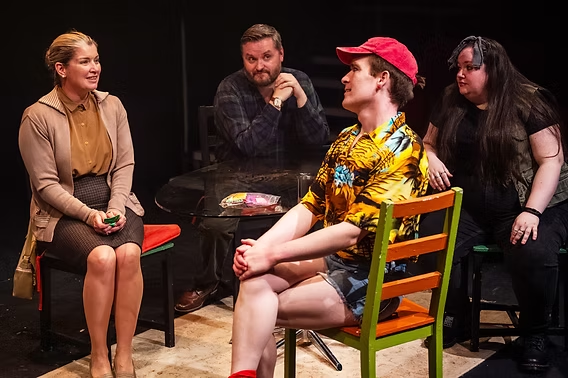
The narrative centred primarily on Tony, played by Merrick, and John, played by Theo, and their relationship. Through sustained audience questioning, the first half became an intense examination of the two men, inadvertently sidelining the three female characters. Structured as a panel discussion with the cast seated and interrogated by the audience, this format offered strong foundations for character development but left the women comparatively underexplored.

Odoffin engaged most readily with the dynamic, using audience interaction to deepen Rhia and integrate her more fully into the central relationship. Applebaum’s choice to present a character already settled and secure limited opportunities for dramatic tension, while Clarkson’s more guarded portrayal of Zoe, though believable, constrained the character’s capacity for growth. Whether this imbalance stemmed from audience focus, directorial steering or differing levels of improvisational ease remains open to question, and it would be intriguing to see how the balance shifts on another evening.

Merrick handled sustained scrutiny with assurance, though a late decision to define Tony as fully gay created narrative complications that required some backtracking to permit interconnected storylines with the female characters. Theo was the standout of the night, embodying John with emotional clarity and physical conviction. His performance extended beyond sharp answers to audience questions; the character felt lived in and empathetically drawn.

The second half, shorter and more traditionally staged, unfolded in a flat setting with minimal audience interaction until the end. Here, the material generated in the first hour was dramatised into a cohesive scenario. The shift in format clarified the story and allowed the emotional consequences of earlier revelations to land with greater weight.

While the production is billed as an exploration of seeking answers in the cold and chaotic world of the internet, this strand felt underdeveloped. A reference to AI-generated pornography appeared somewhat shoehorned and lacked depth. In truth, the evening’s strength lies less in commentary on digital culture and more in its examination of relationships, perception and the often unheard voices on the sidelines.

As an experience, the show succeeds. It is lively, engaging and consistently fresh, with each performance existing only in the moment it is created. The comedy tends towards sharp, fleeting observations rather than enduring set pieces, but that ephemerality is part of the appeal. The lasting impression is not of a standout story but of shared humanity, spontaneity and connection.

Catch Talking People on 9th March at Shoreditch House with a later show in late April to be announced. Follow them on Instagram here.

REVIEW: Iolanthe


Rating: 3.5 out of 5.

A light-hearted production of a less frequently performed Gilbert and Sullivan


A Gilbert and Sullivan classic, Iolanthe was produced during the peak of the composers’ collaboration, opening on the same night in 1882 in both London and New York. This production joined the list of ‘Savoy Operas’, shows performed in the Savoy Theatre which was purposely built to showcase the work of the famed duo. 

With a run cut short in March 2020, today Iolanthe is performed in Wilton’s Music Hall by the company of Charles Court Opera. The story follows a classic tale of mistaken identity, with an extra dash of magic. Fairies are forbidden to marry mortals but Iolanthe has gone ahead and done so anyway, producing a half-fairy half-mortal son while she’s at it. General chaos ensues, with the story set in central London’s House of Lords. 

The ensemble is vocally strong, producing some glorious harmonies and articulating the often fast-paced lyrics with skill. Unfortunately, there is some considerable background over-acting which often serves to upstage the soloist, a shame when the singing is the highlight. 

Matthew Kellett is a magnificent Lord Chancellor, delivering on both comic timing and vocal prowess. His performance of ‘the nightmare song’ is well-paced and hilarious, eliciting well-deserved whoops of appreciation from the audience. Meriel Cunningham is a dominant yet cheeky Fairy Queen, with a beautifully unique voice commanding cast and audience attention alike. 

Gender-swapping a lord character to Lady Mountararat (Catrine Kirkman), we are treated to a fabulous Theresa May impression and some lovely vocals. Strangely, although this casting choice results in a lesbian relationship, director John Savournin completely shies away from the reality of this. While the male Earl and his female partner sit on each other’s laps and hold hands, the all-female pair stand stiffly side by side. If a gender swap is introduced, this disappointing same-sex relationship prudishness rather defeats the purpose. 

A very enthusiastic Charles Court Opera Chamber Orchestra is conducted rather noisily by David Eaton, producing a beautiful score at a fiery pace, with performers struggling to keep up at times. 

Set design by Rachel Szmukler is flexible and realistic, while costumes and makeup leave much to be desired. Fairies are dressed in anything from boxing boots to Dr Martens, with unexplained, newspaper-inspired costumes. The female cast members are made-up very heavy-handedly using an intense, fiery palette potentially with stage lights in mind, but this is not required for such an intimate venue. 

A comic opera well-suited to the current political times, Charles Court Opera presents an admiral revival. Iolanthe plays at Wilton’s Music Hall until February 28, 2026.